Two Business Days to File: UBO Register in Singapore for Directors


Most Singapore companies, foreign companies registered here and limited liability partnerships must maintain a private Register of Registrable Controllers and unless exempt, lodge those particulars with ACRA’s Central RORC. The main exemption covers companies listed on the Singapore Exchange and certain financial institutions. If you haven’t identified your controllers yet, that’s your first move, whether you do it in-house or through a corporate service provider.
TL;DR:
Companies must identify controllers, set up a private register, and verify annually within strict statutory windows to avoid enforcement actions.
Beneficial ownership registration applies to all private and foreign companies and LLPs, except those listed on SGX or regulated financial institutions, which are temporarily exempt.
Detailed particulars, including residential address and ID numbers for individuals, must be recorded accurately and kept securely at the nominated registered office or with a service provider.
Filing deadlines are tight: two days for central registration updates after private register changes, with non-responses and late updates exposing companies to penalties.
Outsourcing RORC compliance to experienced providers helps ensure ongoing adherence, especially for complex ownership structures and nominee arrangements.
Table of Contents
What are the immediate actions for UBO register compliance in Singapore?
What is a registrable controller under Singapore’s UBO rules?
Which Singapore entities must register beneficial ownership?
What are the ongoing UBO compliance obligations in Singapore?
Editorial perspective: why outsourcing RORC beats DIY spreadsheets
What are the immediate actions for UBO register compliance in Singapore?
Three things need to happen before you can call your entity compliant, and they need to happen in this order.
Identify your controllers. Apply the ownership test where a person holds a substantial portion of shares or voting rights and the control tests before assuming there is nobody to register.
Build the private register. Set it up at your registered office or with your appointed corporate service provider, recording the prescribed particulars for each controller and filing the required entries with ACRA’s Central RORC inside the statutory windows.
Run annual verification. Send notices to controllers, keep evidence of responses, and update records promptly when something changes.
Skip any one of these and you’re exposed. ACRA doesn’t treat “we didn’t know who our controllers were” as a defence, and inspectors routinely ask for the paper trail, not just the final answer.
What is a registrable controller under Singapore’s UBO rules?
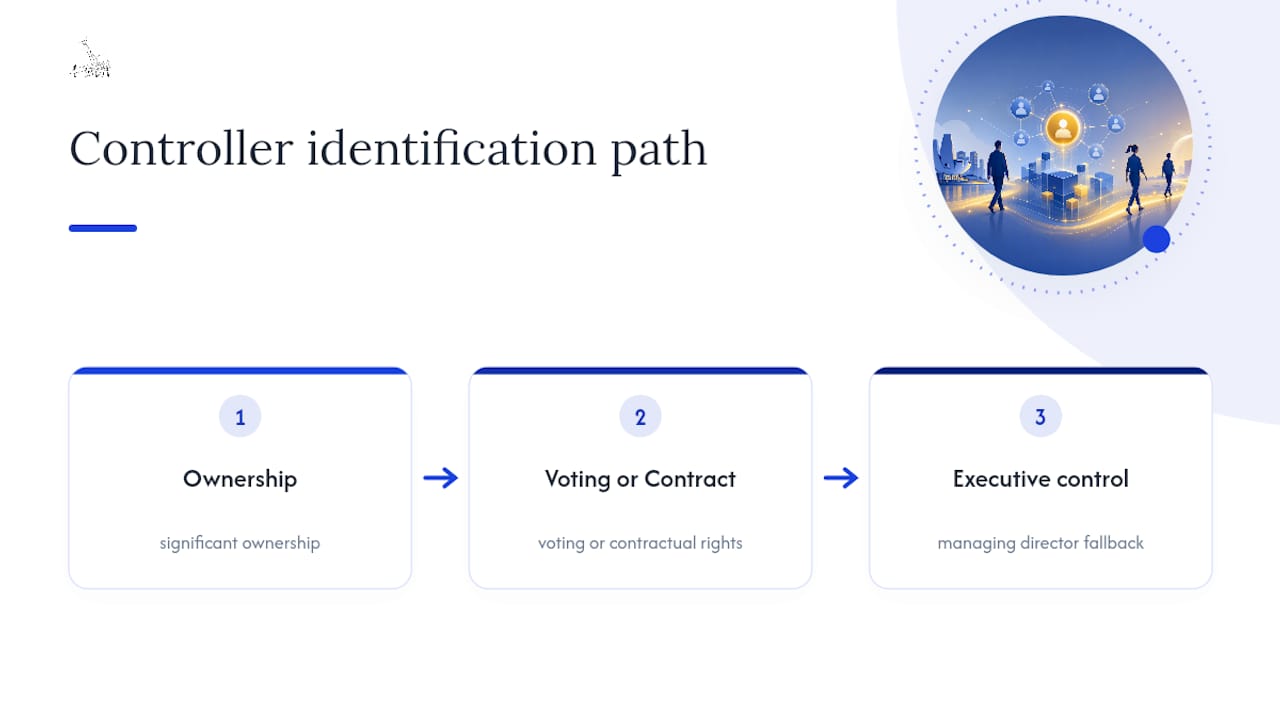
A registrable controller is any individual or legal entity with significant ownership or control over a Singapore company, foreign company or LLP. Where no single party clears that threshold, a separate control test applies, covering voting rights over board decisions, contractual rights to direct the entity’s affairs, and, as a last resort, executive control such as a managing director who runs day-to-day decisions when no other controller can be identified.
Two related but distinct registers exist. The private RORC is the register your own company or LLP keeps at its registered office or with a corporate service provider. The Central RORC is the version ACRA holds centrally, populated by lodging specified particulars from your private register. They’re not interchangeable: you must maintain the private version regardless, and the central filing is the additional statutory step for most entities.
In practice, three scenarios dominate. Layered ownership through holding companies in two or three jurisdictions is the case that trips people up, because you have to trace through to the natural person at the top. Nominee arrangements are the third, where the named shareholder isn’t the real economic owner, which is why ROND and RONS exist as parallel registers.
Which Singapore entities must register beneficial ownership?
Private companies, public companies, foreign companies registered in Singapore and LLPs all fall within scope unless a specific exemption applies. There is no size threshold that lets a small private company opt out; a single-shareholder company with one director still needs a private RORC.
The primary exemption covers companies listed on the Singapore Exchange, because listing rules already impose disclosure obligations that serve a similar transparency purpose. Certain regulated financial institutions carry comparable exemptions. That exemption isn’t permanent by default: if a company delists from SGX, it re-enters scope and must set up its private RORC and begin central filing within the applicable statutory window, not at some point down the line.
Timing catches out new entities more than established ones. On incorporation, a private company must maintain its RORC from day one. A foreign company registering a Singapore branch faces the same obligation on registration, and many directors only discover this when a corporate service provider asks for controller details during onboarding, well after they assumed compliance was “sorted”.
What particulars must a UBO register in Singapore include?
The particulars required depend on whether the controller is an individual or a corporate entity, and the Companies Regulations prescribe both lists precisely. Guesswork here is the fastest route to a rejected filing.
For an individual controller, you need:
Full name and any aliases
Residential address
Nationality and identity or passport number
Date of birth
Email address and contact number
The date the person became a controller, and the date they ceased to be one, where applicable
For a corporate controller, the register must record:
Registered name and Unique Entity Number (or equivalent foreign registration number)
Registered office address
Legal form and the jurisdiction it was formed in
The corporate registrar it is registered with
Contact details
Dates of becoming and ceasing to be a controller
Keep the private register at your registered office or at your corporate service provider’s office, whichever you’ve nominated, and treat the data as sensitive. Controller particulars include home addresses and identity numbers, so access should be limited to those who genuinely need it for filing and verification purposes.
How do you file the UBO register with ACRA?
Filing follows a fixed sequence, and the statutory clock starts at different points depending on which step you’re on.
Identify controllers first. Work through the ownership and control tests before touching any form. Rushing this step is the single biggest source of incorrect filings.
Send notices where required. If you’re establishing controllers for the first time or verifying existing ones, issue the relevant notice and log the date sent.
Populate the private RORC. Enter the prescribed particulars for each controller in your private register, whether that sits with you or your corporate service provider.
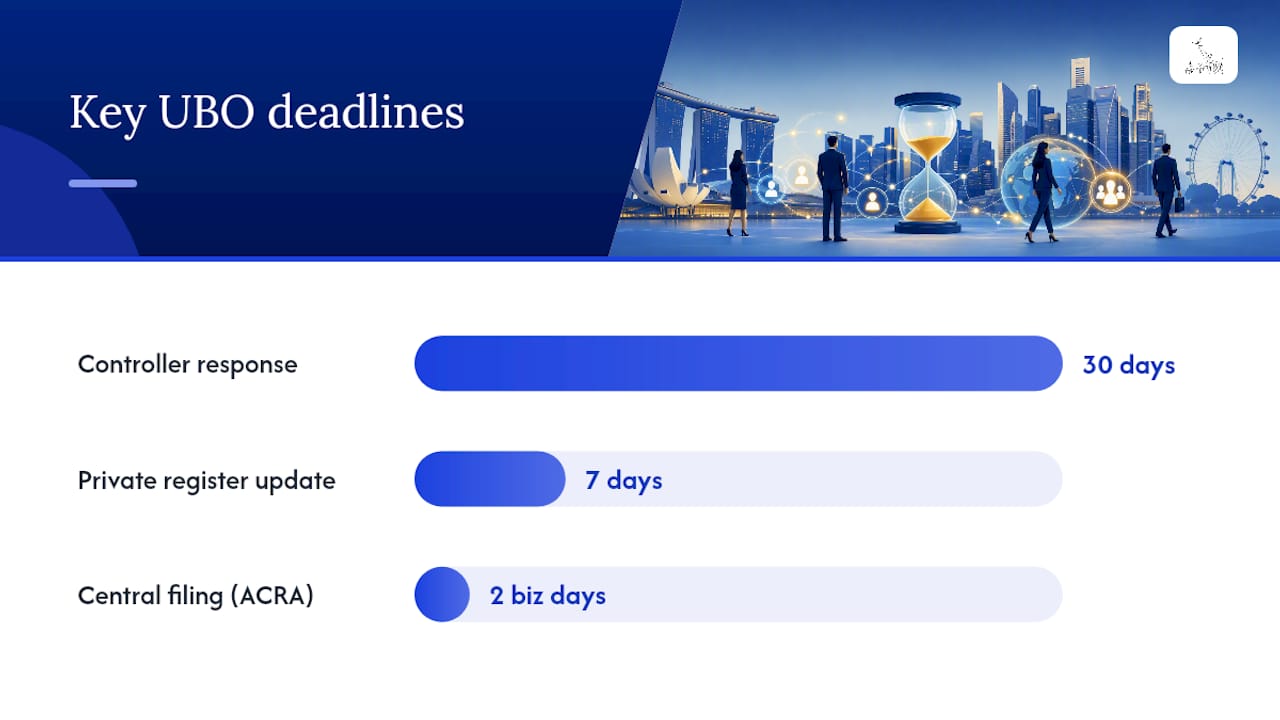
File with ACRA’s Central RORC via eService. Once particulars are confirmed, lodge them through ACRA’s central register. Where a central filing is triggered by an update, you have two business days to lodge it after updating your private register.
Repeat for changes. Any change in controller particulars restarts the private-register update clock, which runs to seven days, and the two-business-day central filing rule if the change also needs to reach ACRA.
Deadlines differ slightly depending on when your entity was incorporated or registered, since transitional rules applied when the regime took effect and again as later amendments came in. If you’re unsure which window applies to your entity, check the date-specific guidance on ACRA’s RORC pages before you file, rather than assuming the general rule fits your case.
What happens when no controller can be identified? This isn’t as rare as it sounds, particularly with widely held private companies or complex offshore structures. The correct approach is to fall back on the executive control test, identify the individual who directs or significantly influences the entity’s activities, and record them as the controller by default. Crucially, you must document the steps you took to search for a controller before reaching that conclusion. That decision log is exactly what an ACRA inspection will ask to see.
What are the ongoing UBO compliance obligations in Singapore?
Setting up the register is the easy part. The recurring duties are where most enforcement risk sits, because they depend on you doing something every year without being reminded.
Annual verification notices. Send notices to each registrable controller to confirm their particulars are still accurate, and give them 30 days to respond.
Non-response handling. If a controller doesn’t reply within that window, keep a record of the notice, the date sent, and any follow-up attempts. Silence doesn’t excuse you from updating the register if you obtain the information another way.
Update timelines. Once you know a particular has changed, update your private register within seven days.
Central filing. Where that change needs to reach ACRA, file with the Central RORC within two business days of updating your private register.
Pro Tip: Set an automated calendar reminder for annual notices well before the anniversary date, not on it. A late notice cascades into a late response window, a late update, and potentially a late central filing, all from one missed date.
Non-compliance carries real enforcement risk, and ACRA’s own guidance makes clear that inspectors focus heavily on documented process, not just accurate outcomes. A company with correct controller information but no evidence of having sent annual notices or followed up on non-responses can still face penalties, because the failure is procedural. Directors are personally responsible for this, and “the corporate service provider handles it” isn’t a defence if nobody actually checked the filings went in.
How do nominee director and shareholder registers work?
If your company uses nominee arrangements, ROND and RONS sit alongside the RORC as separate but connected obligations. ROND records nominee directors and the person who appointed them (the nominator); RONS does the same for nominee shareholders. Both require particulars on the nominee and the nominator, broadly mirroring the individual and corporate particulars required for RORC.
Companies have needed a private ROND since 31 March 2017, with RONS extended to all companies from 4 October 2022. Foreign companies registered in Singapore have their own applicable start dates, so check which regime applies to your entity type rather than assuming the company deadline carries across.
Filing updates to the central ROND and RONS registers follows the same discipline as RORC: identify the nominee relationship, record it accurately, and file within the prescribed window. Where a nominee shareholder is also a registrable controller, the two registers interact, and you may need entries in both.
What compliance mistakes trip up Singapore companies?
The failures that actually generate penalties are rarely about deliberately hiding ownership. They’re procedural, and they’re avoidable.
The most common trap is treating ACRA’s public Business Profile as sufficient evidence of who controls the company. It isn’t; the Business Profile shows shareholders of record, not necessarily the individual who meets the ownership or control test once you trace through layered structures. Skipping annual notices entirely, missing the two-business-day central filing window after an update, and having no documentary evidence of the steps taken to identify a hard-to-find controller round out the usual list.
A simple checklist keeps you ahead of it:
Within 30 days of incorporation or registration: identify controllers and set up your private RORC.
Within 90 days: confirm your first central RORC filing has gone through and file ROND/RONS entries if nominee arrangements exist.
Every 365 days: send annual verification notices, log responses, and update both registers for any change within the statutory windows.
Pro Tip: If your ownership structure spans more than one jurisdiction or includes nominee shareholders, it’s usually worth appointing a corporate service provider before your first annual notice cycle rather than after a missed deadline. Document every due-diligence step you take, even the ones that lead nowhere, because that decision log is your evidence if ACRA ever asks.
Why managed RORC compliance beats handling it alone
Headington Management works with company directors and compliance officers across Singapore’s corporate secretarial landscape, and the pattern is consistent: RORC obligations get missed not because the rules are unclear, but because nobody owns the annual cycle once the initial setup is done. Managed compliance earns its keep for entities with layered ownership, nominee arrangements, or compliance teams already stretched across incorporation, tax and HR matters. If you’re unsure whether your current setup would survive an ACRA inspection, that’s worth a proper review before it becomes a problem.
Let Headington handle your RORC filings and annual notices
Chasing controller particulars, tracking a seven-day update window and a two-business-day central filing deadline on top of your existing compliance calendar is exactly the kind of task that slips when quarter-end hits. Headington Management runs this as a standing service rather than a once-a-year scramble, so nothing depends on someone remembering an anniversary date.
The service covers RORC setup for new incorporations and foreign company registrations, annual notice management with documented response tracking, ACRA eService filings for both the private and Central RORC, and scheduled reviews so your register stays accurate between notice cycles. Headington’s team works from Singapore with 25+ years of cross-border corporate advisory experience, which matters most when ownership sits across two or three jurisdictions and someone needs to trace it properly. For clients also managing entity formation abroad, company formation support can run alongside your Singapore compliance calendar rather than as a separate workstream.
If your RORC hasn’t been reviewed in the last twelve months, or you’ve never had one, get in touch with Headington Management for a compliance review and a clear plan for getting your registers current.
Sources
FAQ
How do you find the UBO of a company in Singapore?
For entities with layered corporate ownership, you need to look through each holding company to the natural person at the top, not stop at the first corporate shareholder.
What is a UBO register in Singapore?
It’s the Register of Registrable Controllers, a record every in-scope company, foreign company and LLP must keep privately and, in most cases, file with ACRA’s Central RORC. It exists to give authorities visibility over who actually owns or controls a business, in line with international anti-money laundering standards.
Who can access Singapore’s UBO register information?
Central RORC information is held by ACRA and is not published for general public search; access is restricted to competent authorities such as law enforcement and regulatory bodies for their statutory functions. Your private RORC should also be handled as confidential, given it contains personal particulars like residential addresses and identity numbers.
Is UBO declaration mandatory for Singapore companies?
Yes, for most private companies, public companies, foreign companies and LLPs, unless they fall under a specific exemption such as being listed on the Singapore Exchange. There is no exemption based on company size or number of shareholders.
Do foreign companies registered in Singapore need a private RORC?
Yes, foreign companies registered here have the same private RORC obligation as local companies, with the requirement applying from the point of registration rather than after a grace period.
Editorial perspective: why outsourcing RORC beats DIY spreadsheets
Most directors treat the RORC as a one-time form-filling exercise, and that’s the mistake. The actual compliance risk lives in the annual cycle, not the initial setup. A spreadsheet with controller names looks fine until an inspector asks for proof you sent the annual notice, tracked the response, and updated the register within seven days of learning about a change. Very few in-house teams keep that level of documentation without a dedicated process, because it competes with actual business priorities every single quarter.
The nominee register requirements make this worse, not better. ROND and RONS obligations layer on top of RORC for any company using nominee arrangements, and the interaction between the two isn’t intuitive unless you handle it regularly. Where the conventional advice goes wrong is treating “we filed the RORC once” as compliance achieved, when the regulation was clearly designed as a living record that has to move whenever ownership does.
— Colin
Comments