Stop Using S$1: Set Paid Up Capital in Singapore for a 12–18 Month Runway


Paid-up capital is the money shareholders have actually paid the company in exchange for shares, and it sits at the core of how a Singapore company is capitalised. The legal minimum for a private limited company is S$1, so you can technically incorporate with a single dollar. In practice, that figure rarely satisfies a bank, a regulator, or an investor once trading begins.
TL;DR:
Most Singapore companies should set paid-up capital high enough to cover 12 to 18 months of operating expenses and any regulatory or licensing thresholds.
Raising paid-up capital involves issuing new shares, ensuring proper resolution approvals, and filing the allotment with ACRA, which can take from two weeks to two months.
Paid-up capital cannot be withdrawn as dividends, and reducing it requires formal procedures, a solvency statement, or court approval to protect creditors.
The statutory minimum for a private company is always S$1, but regulators and banks often expect a higher, more realistic figure reflective of the business plan.
Checking a company’s paid-up capital in Singapore is quick via BizFile+, where the latest recording of allotments or reductions is publicly available.
Table of Contents
What is paid-up capital in Singapore, and how does it differ from share capital?
What is the minimum paid-up capital for a company in Singapore?
How do you check a company’s paid-up capital on ACRA’s records?
Can paid-up capital be withdrawn, and what happens to it in insolvency?
What does Headington’s team recommend when setting your capital figure?
Setting up your capital structure the right way from the start
What is paid-up capital in Singapore, and how does it differ from share capital?
Paid-up capital, issued share capital, and authorised capital get used interchangeably by first-time founders, but they mean different things under Singapore company law.
Issued share capital is the total value of shares a company has allotted to shareholders, whether those shares have been paid for in full or not. Paid-up capital is the portion of that issued capital that shareholders have actually settled, in cash or otherwise. Authorised capital was the historical cap on how many shares a company could ever issue; Singapore abolished this concept for companies incorporated after 2006, so most private limited companies today have no ceiling on how much share capital they can issue over time.
ACRA’s guidance on deciding on share capital and share types sets out four payment modes: shares paid entirely in cash, shares paid otherwise than in cash (such as assets or intellectual property), shares issued for no consideration (bonus shares), or a mixture. Whichever mode applies, funds or their equivalent value must land in the company’s corporate bank account, according to a guide on paid-up capital from SingaporeLegalAdvice.
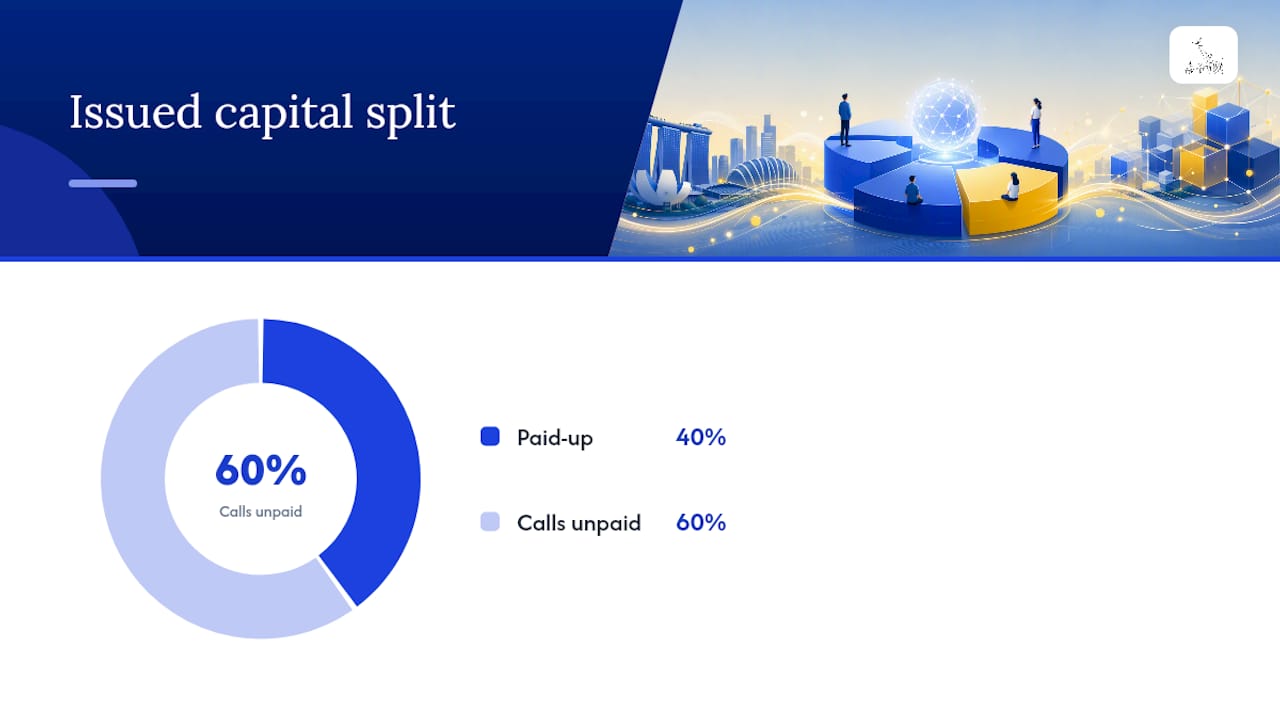
A quick example clarifies the gap between issued and paid-up figures:
A company issues 100,000 shares at S$1 each, giving it S$100,000 in issued share capital.
Shareholders have only paid S$40,000 of that so far.
Paid-up capital on the books is S$40,000, and the remaining S$60,000 sits as calls unpaid until shareholders settle it.
That gap between issued and paid-up figures matters more than most founders expect, particularly when a bank or licensing officer asks to see the actual number on record.
What is the minimum paid-up capital for a company in Singapore?
The statutory floor is unambiguous: a private limited company can be incorporated with a paid-up capital of S$1. ACRA imposes no higher general minimum, and this single figure is what makes Singapore incorporation so accessible for solo founders and small teams.
Certain regulated activities carry their own, much higher floors, and these sit apart from the general company law minimum:
Payment institutions under the Payment Services Act face base capital requirements that scale with licence type, a threshold set and enforced by MAS.
Licensed fund managers must hold minimum base capital tied to the assets they manage.
Travel agency licences and insurance intermediary registrations carry their own sector-specific floors.
Public accounting firms face capital and professional indemnity conditions set by their regulator.
Statistic Callout: Companies with paid-up capital at a certain high threshold are automatically registered as members of the Singapore Business Federation, a threshold often treated as an informal marker of business scale. Always verify current SBF criteria directly, since membership rules can be revised.
None of these regime-specific figures replace the S$1 statutory minimum. They sit alongside it, and only apply if your business activity falls within a regulated category. If you are unsure whether your planned activity triggers one of these thresholds, checking the relevant regulator’s page before you file is worth the ten minutes it takes.
How do you increase paid-up capital in Singapore?
Raising paid-up capital means issuing new shares and getting the paperwork right before, during, and after allotment. ACRA’s guidance on altering share capital confirms the mechanism: a company increases paid-up capital by allotting new shares to existing or new shareholders, then filing that allotment with ACRA.
Check the constitution. Confirm there is no restriction on issuing new shares, and check pre-emption rights that might give existing shareholders first refusal.
Pass the resolutions. Directors typically approve the allotment by board resolution, and shareholders may need to approve it separately depending on the constitution.
Receive payment. Funds (or non-cash consideration) must be paid into the corporate bank account before or as part of the allotment.
File the return of allotment via BizFile+. This is where you record the number of shares, the currency, and the payment mode, as set out in ACRA’s steps for registering via BizFile.
Wait for the payment notification. BizFile+ issues this in your inbox once the filing is endorsed.
Most straightforward allotments are processed quickly once payment clears, though ACRA notes that more complex approvals can take anywhere from around 14 to 60 days. Standard company registration carries a S$300 fee, and share capital lodgements typically carry their own smaller filing charge.
Pro Tip: If your allotment involves non-cash consideration, such as equipment or intellectual property, get an independent valuation before filing. ACRA and your bank will both want to see how that figure was reached, not just what it says on the form.
Reducing paid-up capital is a different and stricter exercise. Because paid-up capital underpins creditor protection, a reduction generally requires a formal resolution, a solvency statement or court approval depending on the method used, and adherence to the same altering share capital framework. Engaging a corporate secretarial firm at this stage is sensible, since the procedural sequencing matters more here than in a straightforward capital increase.
How much paid-up capital should you actually inject?
Banks and regulators look past the S$1 headline figure almost immediately. A corporate bank account application, a licence submission, or an investor term sheet will all ask, implicitly or explicitly, whether your capitalisation matches your stated plans.
A workable formula for setting a realistic figure looks like this:
Twelve to eighteen months of operating burn, covering salaries, rent, and core supplier costs.
Any licence-specific base capital your activity triggers under MAS or another regulator.
A banking cushion, since relationship managers tend to view thin capitalisation as a red flag when opening corporate accounts.
Statistic Callout: Treating capitalisation as a runway calculation, roughly 12 to 18 months of spend plus regulatory buffers, tends to produce better outcomes than aiming for an arbitrary statutory minimum.
Shareholder loans work as a complementary tool once the equity base is set, letting founders keep injected capital lean while topping up cash flow as needed. If the loan runs between related domestic parties, it still needs to reflect arm’s length terms, a point worth raising with your accountant before drawing up the loan agreement.
Consider a services firm applying for a Major Payment Institution licence: S$1 in paid-up capital would not clear MAS’s base capital threshold, let alone convince a bank to open a corporate account. A retail e-commerce start-up with no licensing exposure faces a lighter bar, but still needs enough paid-up capital to cover its first year of stock, salaries, and marketing spend without relying entirely on directors’ personal funds.
How do you check a company’s paid-up capital on ACRA’s records?
Paid-up capital appears on a company’s business profile, the standard extract ACRA maintains for every registered entity. You can pull this information directly through the government’s filing portal.
Search the company name or Unique Entity Number on BizFile+.
Purchase a business profile extract, which lists paid-up capital alongside directors, registered address, and shareholders.
Treat the figure as current as of the last filed allotment or reduction, since updates typically appear on the public record within a few working days of ACRA processing the transaction.
This is also the fastest way to sanity-check a prospective supplier, tenant, or joint venture partner before you sign anything.
Can paid-up capital be withdrawn, and what happens to it in insolvency?
Paid-up capital is not a pool of cash shareholders can simply draw down whenever they like. Dividends must come from retained profits, not from the capital shareholders originally injected, and paying dividends out of paid-up capital would breach the basic solvency protections built into company law.
Dividends require sufficient distributable profits, confirmed by the directors before declaration.
Reducing paid-up capital directly requires the formal procedures described earlier, precisely because creditors rely on that capital as a buffer.
On winding up, paid-up capital ranks behind creditors: shareholders only receive a return of capital once all debts and liquidation costs have been settled in full.
That ordering is the entire point of paid-up capital as a legal concept. It exists to give creditors and regulators a reasonable expectation that the company had real resources behind it at some point, not just a notional figure on an incorporation form.
What does Headington’s team recommend when setting your capital figure?
Founders tend to treat paid-up capital as a formality to get past during incorporation, then get caught out months later when a bank or regulator asks why the figure on record does not match the business they are actually running.
A compact checklist works better than guesswork:
Map your realistic 12 to 18 month burn rate before you file anything.
List every licence or regulatory capital requirement your specific activity might trigger.
Add a banking cushion on top, since relationship managers weigh this heavily.
Decide how much of that total sits in equity versus shareholder loans, based on how much flexibility you want later.
Some corporate secretarial firms work with founders and executives structuring or restructuring Singapore entities across a range of sectors, typically supporting the filings, the bank introductions, and the regulatory liaison that this kind of decision involves. The mechanics are rarely the hard part. The judgement call on how much capital genuinely reflects your business, and how a bank or regulator will read that number, is where experienced advisers tend to add the most value.
— Colin
Setting up your capital structure the right way from the start
If you are incorporating a new entity, restructuring an existing one, or preparing for a licence application, getting the capital structure right from day one saves you a second round of filings later. Some corporate secretarial firms provide corporate secretarial services, legal advisory support, and incorporation assistance for founders and executives structuring entities in and expanding into Singapore, with extensive experience across cross-border corporate work.
Before reaching out, it helps to have a rough sense of your planned business activity, your target paid-up capital figure, and whether any licence or regulatory capital threshold applies to what you are building. Headington’s team can then help you map that figure against banking expectations and regulatory requirements, structure the shareholder agreements and loan arrangements around it, and handle the BizFile+ filings once the numbers are settled. If you are weighing up how much paid-up capital to inject, or need to increase capital in an existing entity, get in touch with Headington Management to talk through your specific structure.
Where to verify these rules directly
The figures and procedures in this guide come from primary regulatory sources, and it is worth bookmarking them for future filings.
ACRA: Deciding on share capital and share types, the authoritative source for the S$1 minimum and payment modes.
ACRA: Altering share capital, covering how to increase or reduce paid-up capital.
ACRA: Registering a local company via BizFile, for the filing workflow, fees, and processing times.
BizFile+, the government portal for company searches, extracts, and filings.
Monetary Authority of Singapore, for licence-specific base capital requirements.
For context on how share class structures interact with company valuation more broadly, MarketCapLens’s explainer on dual-class shares is a useful reference, though it addresses listed company mechanics rather than Singapore private company law specifically.
Sources
FAQ
What is the minimum paid-up capital required for a Singapore company?
The statutory minimum for a private limited company is S$1. Regulated activities such as payment services or fund management carry much higher base capital requirements set by MAS.
How do you check a company’s paid-up capital in Singapore?
Search the company on BizFile+ and purchase a business profile extract, which lists paid-up capital alongside directors and shareholders. The figure updates within a few working days of ACRA processing a relevant filing.
Can you withdraw paid-up capital from a company?
Not directly. Paid-up capital cannot be paid out as dividends, since dividends must come from retained profits, and reducing capital requires a formal procedure under ACRA’s rules on altering share capital to protect creditors.
What is the purpose of paid-up capital?
Paid-up capital demonstrates that shareholders have committed real funds to the company, gives creditors a buffer of protection, and signals financial standing to banks, regulators, and licensing authorities. A realistic figure, built from your projected runway plus any licence requirements, matters far more in practice than the S$1 statutory floor.
What is the difference between paid-up capital and authorised capital?
Paid-up capital is the amount shareholders have actually paid for their shares, while authorised capital was a historical cap on total shares a company could issue. Singapore abolished the authorised capital concept for companies incorporated after 2006, so most companies today have no such ceiling.
Comments