Founders: Practical Resident Director Rules to Avoid Tax Treaty Loss


Yes. Every Singapore-incorporated company must have at least one director who is ordinarily resident in Singapore under Section 145 of the Companies Act 1967, and the obligation applies continuously, not just at incorporation. The immediate next step for foreign founders is to check who in the founding team qualifies, and if nobody does, plan for a nominee director or a locally hired director before you file with ACRA.
TL;DR:
Foreign founders must plan for a resident director before filing, as the requirement is ongoing and failure to comply can lead to enforcement actions.
Only Singapore citizens, permanent residents, or qualifying work pass holders can serve as resident directors, and they must be genuinely contactable residents living in Singapore.
An Employment Pass holder needs a Letter of Consent to become a director, which requires proactive application and is tied to the employment pass validity.
Nominee directors carry full statutory duties and liabilities, with costs, liabilities, and recent regulation changes requiring careful vetting and proper registration.
Companies must sequence director appointments and resignations carefully, document decisions in writing, and review resident director credentials annually to maintain compliance and avoid penalties.
Table of Contents
What the resident director requirement Singapore law actually says
Who qualifies as ordinarily resident, and who is disqualified?
Nominee directors: costs, duties, and the risks nobody mentions
Headington Management: practical tradeoffs and recommended next steps
How Headington Management supports your resident director compliance
What the resident director requirement Singapore law actually says
Section 145 is short, but it carries weight. It requires every company registered in Singapore to have at least one director who is “ordinarily resident” here, meaning the director must live in Singapore as a matter of fact and habit, not just hold a passport that says so. The statute also builds in a safeguard against gaps: a director cannot resign if doing so would leave the company with zero resident directors. That resignation is treated as invalid in law, even if the paperwork is filed.
This is the detail most incorporation guides skip over. It is not a one-time box to tick during registration. It is a standing condition the company must satisfy for as long as it exists. If your resident director moves overseas permanently, loses their pass, or simply steps down without a replacement lined up, the company falls out of compliance the moment that gap opens.
Enforcement is not theoretical. The Registrar has powers to issue directions, levy fines, and ultimately move to strike the company off the register if the breach continues. Practitioner commentary on the statute notes that companies operating without a resident director for extended periods, often cited around six months, face escalating risk of enforcement action against officers and shareholders, not just the company itself.
ACRA applies this at two points:
At registration: the incorporation filing is rejected outright if no qualifying resident director is named.
Post-incorporation: ACRA’s guidance on appointing directors confirms the Registrar can query or act on a company that appears to have lost its resident director through resignation, relocation, or disqualification.
The practical lesson: treat this as a continuous compliance line item, reviewed the same way you’d review a licence renewal, not a formation formality you complete once and forget.
Who qualifies as ordinarily resident, and who is disqualified?
“Ordinarily resident” is not defined by a single bright-line test in the statute, but ACRA’s guidance and market practice treat three categories as qualifying without further argument:
Singapore citizens, regardless of where they’ve lived previously.
Singapore permanent residents (PRs), provided they genuinely reside here.
Holders of qualifying work passes tied to Singapore employment, including the Employment Pass, PEP, and the newer ONE Pass, subject to the constraints covered in the next section.
ACRA’s director eligibility guidance also confirms a director must be a natural person, meaning a company or other legal entity cannot fill this role, however convenient that might sound on paper.
Beyond residency status, a person is automatically disqualified from serving as director if any of the following apply:
They are under 18 years old.
They are an undischarged bankrupt, unless they’ve obtained court or official permission to act.
A court has disqualified them from directorship, whether in Singapore or, in some cases, overseas.
They lack the mental capacity to understand and discharge director duties.
There’s a softer expectation worth flagging too: regulators and banks generally expect the resident director to be genuinely contactable inside Singapore, not a name on a register who never answers calls. This matters practically because ACRA, MOM, and your bank may all need to reach this person directly during compliance checks, and an unreachable resident director creates the same operational risk as having none at all.
Can an Employment Pass holder be a director?
This is where most foreign founders hit their first real obstacle, and it catches almost everyone by surprise. Holding an Employment Pass does not automatically give you the right to serve as director of just any Singapore company. Your EP is tied to your sponsoring employer, and taking up a directorship elsewhere, even in a company you founded yourself, generally requires a Letter of Consent (LOC) from the Ministry of Manpower.
Pro Tip: If you’re an EP holder planning to found a second company, apply for the LOC before you need it, not after ACRA queries your incorporation filing. Retroactive fixes cost far more time than proactive ones.
MOM’s guidance on secondary directorships sets out the practical route:
Employer consent first. Your current EP-sponsoring employer typically needs to have no objection to you taking on the second directorship.
Related-company link helps. LOCs tend to be granted more readily where you hold a shareholding in, or have a demonstrable business relationship with, the new company, rather than an unrelated third-party role.
Validity is tied to your EP. The LOC only lasts as long as your underlying Employment Pass remains valid, so if your EP lapses or is cancelled, your director status under that LOC lapses with it.
This creates a genuine timing problem for founders: you often need a resident director to incorporate, but the LOC process to become one yourself takes time to process, and ACRA won’t wait indefinitely. Founders facing this gap generally choose one of three routes: restructure who sponsors their pass so the LOC becomes straightforward, hire a locally resident employee into the director seat, or bring in a nominee director as a short-term bridge while the LOC or a permanent hire comes through.
Nominee directors: costs, duties, and the risks nobody mentions
A nominee director is someone, often provided through a corporate service provider, who agrees to be named as your company’s resident director without taking an active role in day-to-day management. For founders who can’t yet meet Section 145 through their own team, it’s the fastest legal route to incorporation.
Here’s the part that catches people out: a nominee director is a full statutory director in the eyes of the law. There is no reduced or “sleeping” version of the role that carries less liability. ACRA is explicit on this point: nominees carry the same fiduciary duties, the same exposure to enforcement, and the same personal risk if the company breaches its obligations, as any other director. Treating a nominee as a rubber stamp doesn’t insulate you or your shareholders from anything.
What to expect commercially:
Fees vary by provider and by the risk profile of your business, generally charged as an annual retainer rather than a one-time cost.
Reputable providers require a signed indemnity from the company, protecting the nominee against liabilities arising from your business decisions.
A security deposit is common practice, held against potential enforcement costs or unpaid fees.
Red flags include providers unwilling to document the nominee’s acceptance of duties in writing, or ones offering the role at prices well below market norm, which usually signals the nominee isn’t properly vetted or insured.
The Corporate Service Providers Act 2024 (CSP Act 2024) changed the landscape here materially. It introduced mandatory registration requirements for many nominee director arrangements and sharpened transparency obligations across the sector, meaning nominee relationships that once sat quietly in the background are now subject to far closer regulatory visibility. ACRA also maintains a dedicated register for nominee arrangements, and providers who aren’t properly registered under the new framework are a warning sign worth taking seriously.
Appointing and registering a resident director with ACRA
Getting this right is mostly a matter of sequencing correctly, not paperwork volume.
Confirm eligibility first. Verify citizenship, PR status, or LOC approval before you name anyone in your incorporation filing.
Gather identification and consent documents. ACRA requires proof of identity and the individual’s written consent to act as director.
File through your company secretary. Every Singapore company must appoint a company secretary within six months of incorporation, and this person typically manages the ACRA filing for director appointments and changes.
Never let a resignation create a gap. If your resident director is leaving, appoint and register the replacement before the outgoing director’s resignation takes effect. A resignation that leaves the company with no resident director is legally invalid, so sequencing the replacement first avoids the problem entirely rather than trying to fix it after the fact.
Update MOM where relevant. If the departing or incoming director holds a work pass with an LOC attached, MOM’s records need updating alongside the ACRA filing.
Document the board decision. Keep minutes recording the appointment or resignation; this becomes useful evidence in any later dispute or regulatory query.
Skipping step four is a common compliance error among newly incorporated companies. It’s an easy mistake to make when a resident director resigns unexpectedly, and it’s entirely avoidable with a bit of forward planning.
Meeting Section 145 doesn’t make you tax resident
This is the distinction that trips up founders who assume compliance equals optimisation. Section 145 is a corporate governance requirement enforced by ACRA. Tax residency is a substance test enforced separately by IRAS, and satisfying one says almost nothing about the other.
IRAS applies a “central management and control” test to determine where a company is genuinely managed and controlled, which is the basis for issuing a Certificate of Residence and unlocking treaty relief. A nominee director who never makes a real business decision generally cannot demonstrate this on their own, however cleanly your ACRA filings look.
Steps that actually strengthen a tax residency position include:
Appointing a genuine executive director based in Singapore, rather than relying solely on a nominee, so that real strategic decisions have a documented local origin.
Making one or two senior local hires who can evidence day-to-day management happening here.
Holding board meetings physically in Singapore and keeping minutes that show substantive discussion, not a rubber-stamp signature exercise.
Founders who lack this substance risk more than an administrative inconvenience. A rejected Certificate of Residence can mean losing access to double tax treaty relief entirely, which for a cross-border business can be a materially larger cost than the price of hiring a proper local director in the first place.
Headington Management: practical tradeoffs and recommended next steps
Choosing between a nominee, a local hire, or relocating a founder comes down to two variables: how quickly you need to incorporate, and whether you need Singapore tax residency down the line.
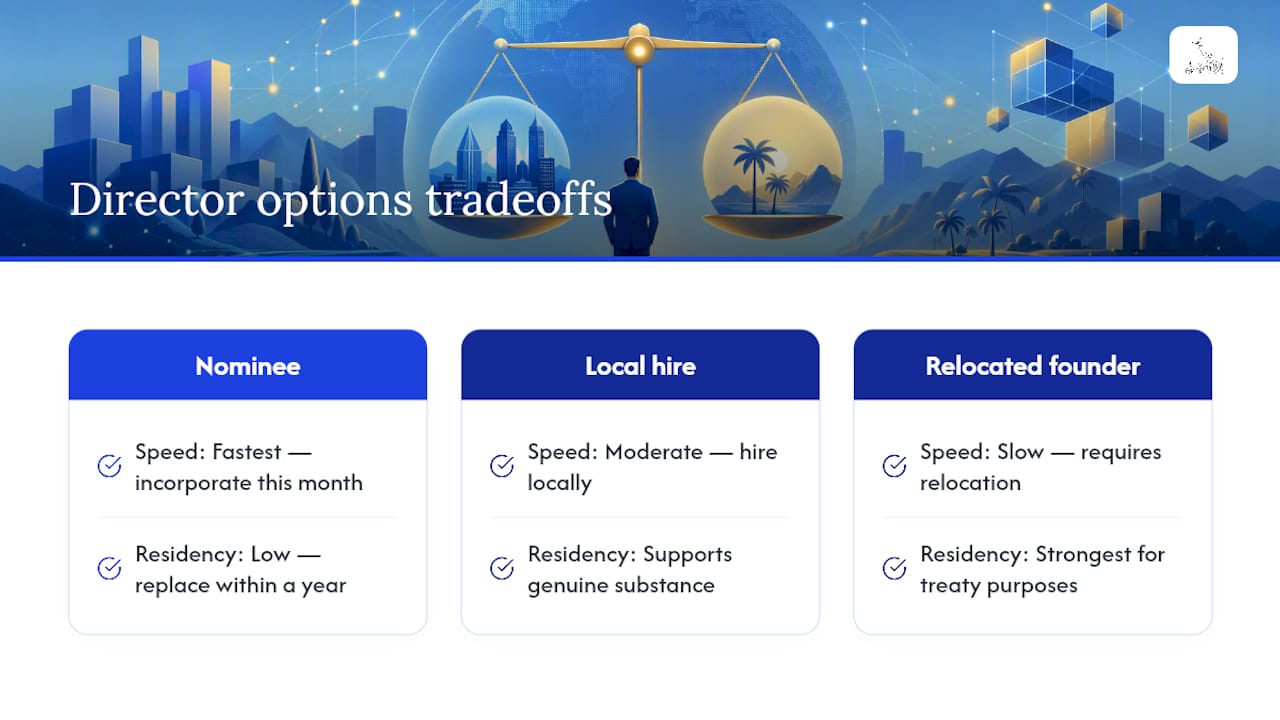
If you need to incorporate this month and tax residency isn’t an immediate concern, a properly vetted nominee director is the fastest legal bridge. If you’re building toward genuine Singapore substance for treaty purposes, that bridge needs an expiry date, ideally replaced within a year by an executive director who actually runs part of the business here.
Good governance habits reduce risk on both fronts: keep board minutes for every material decision, document your nominee’s or director’s acceptance of duties in writing, and review resident director status annually rather than waiting for a lapse to force the issue.
Some advisers have guided founders through exactly this sequencing, from initial incorporation through to building the substance IRAS looks for. If your situation involves an EP holder, a pending LOC, or a nominee arrangement that needs tightening, that’s precisely the kind of structuring worth getting a second opinion on before you file.
A founder’s common mistake, and three quick fixes
A common mistake among founders isn’t ignorance of the law. It’s appointing a nominee director, treating the box as ticked, and never checking in again until something goes wrong, usually an LOC lapsing quietly or a nominee becoming unreachable during a bank query.
Three fixes cost almost nothing and prevent most of this:
Sequence any director replacement before the resignation takes effect, never after.
Put every board decision in writing, even informal ones made over a video call.
Verify your nominee’s credentials and registration status annually, not just at appointment.
For anything involving tax residency or a complex ownership structure, get a second set of eyes on it. The cost of professional review is trivial next to the cost of a rejected Certificate of Residence.
— Colin
How Headington Management supports your resident director compliance
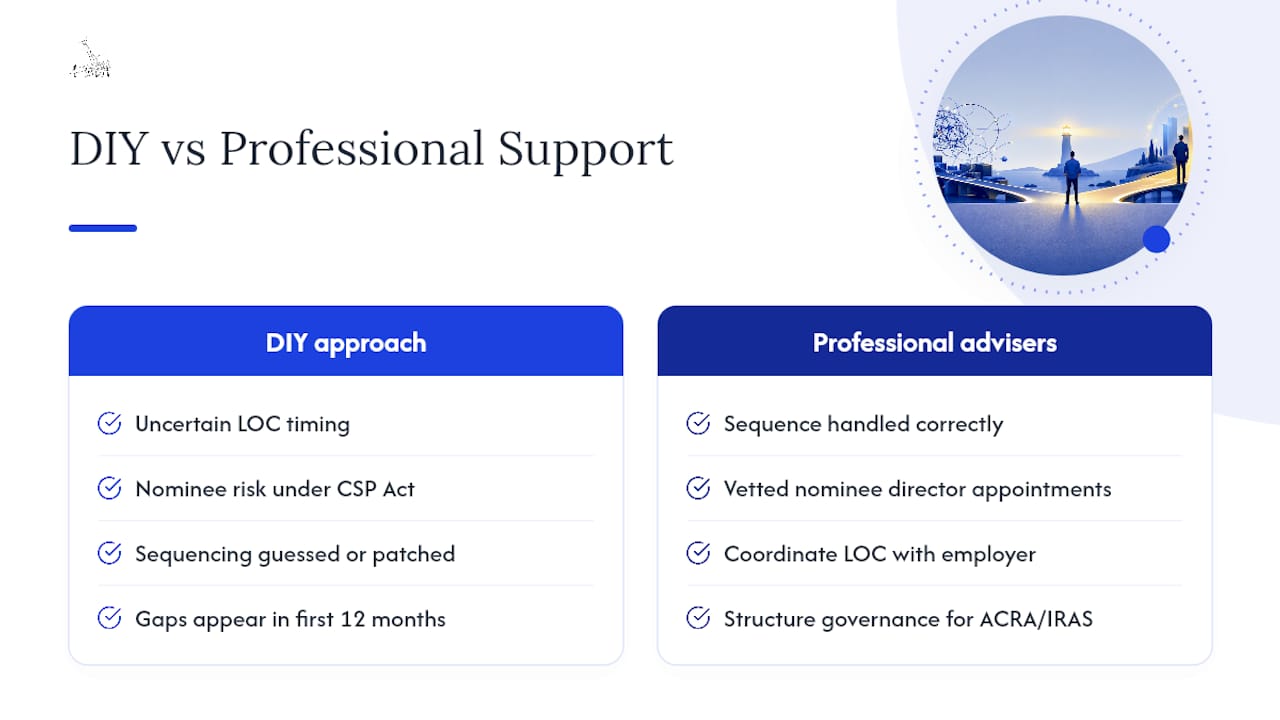
Some service providers offer an alternative to piecing together incorporation advice from forums and generic guides. Where a DIY approach leaves you guessing whether your LOC application will clear in time or whether your nominee arrangement holds up under CSP Act scrutiny, professional advisers handle the sequencing directly, so your resident director requirement is met correctly the first time, not patched after ACRA flags it.

Professional corporate secretarial and cross-border compliance teams incorporate companies, arrange vetted nominee director appointments, coordinate LOC applications with sponsoring employers, and structure governance so it holds up under both ACRA and IRAS scrutiny. That’s the difference between a company that’s merely registered and one that’s genuinely compliant, and it matters most in the first twelve months, when most gaps open. Some advisers with extensive cross-border experience have seen the failure modes described above play out repeatedly, and build the fix in from day one rather than retrofitting it later.
If you’re incorporating in Singapore and unsure whether your team meets Section 145, or you need an LOC and a nominee bridge arranged in parallel, get in touch with Headington Management for a consultation tailored to your structure and timeline.
This article is general information, not a substitute for advice from a qualified lawyer. Consult a qualified legal professional about your own circumstances before acting on anything here.
Sources
FAQ
Can I be a director but not an employee of the company?
Yes. Directorship and employment are legally separate roles; you can serve as a director without drawing a salary or holding an employment contract, though your duties as director still apply in full regardless of employment status.
Who is eligible to become a resident director in Singapore?
Singapore citizens, permanent residents, and holders of qualifying work passes such as the Employment Pass, PEP, or ONE Pass are generally eligible, provided they aren’t disqualified for reasons like being an undischarged bankrupt or under 18.
Can one Employment Pass holder be a director of a company?
An EP holder can serve as director, but usually needs a Letter of Consent from MOM first, since the pass itself only authorises employment with the sponsoring employer, not an automatic secondary directorship.
Can a foreigner be a director of a Singapore company?
Yes, but not the sole director unless they hold a qualifying local residency status. A foreign director without Singapore residency can sit alongside a qualifying resident director, since Section 145 only requires at least one resident director, not that every director be resident.
What happens if a company loses its resident director?
The company falls out of compliance immediately, and the Registrar can issue directions, impose fines, or move towards striking the company off if the gap isn’t resolved, so the replacement should be appointed before any resignation takes effect.
Comments