Founders' practical steps to secure Singapore holding company benefits


Yes, a Singapore holding company delivers material, quantifiable benefits, chiefly a favourable tax posture, cleaner asset protection, and centralised control over a group’s finances and strategy. But those benefits are not automatic. They depend on the holding company demonstrating real economic substance, particularly under Section 10L of the Income Tax Act, or the reliefs you’re counting on can evaporate.
TL;DR:
A Singapore holding company can access treaty benefits and enjoy a low effective tax rate of 17%, but only if it demonstrates real economic substance.
Asset protection relies on strict compliance with corporate formalities, separating liabilities and assets between subsidiaries and the holding entity.
Establishing and maintaining a holding company incurs ongoing costs beyond registration, including compliance, local director, and office expenses, which must be planned from the start.
The main advantages are tax efficiency, liability insulation, and streamlined group treasury management, especially for cross-border and investment-heavy businesses.
Table of Contents
Common pitfalls that erode Singapore holding company tax advantages
What asset protection actually looks like in a Singapore structure
How does Singapore compare to other holding company jurisdictions?
Which industries benefit most from a Singapore holding structure?
Why does Singapore’s stability matter for holding companies?
Which double tax treaties benefit a Singapore holding company most?
Holding company Singapore benefits at a glance
Not every founder needs the same thing from a holding structure. Some want tax efficiency on dividends flowing up from operating subsidiaries. Others need a clean way to separate risk between business lines, or a vehicle to hold shares ahead of a future sale or restructuring. Matching the benefit to your actual situation saves you from paying for structure you don’t need.
The core advantages break down as follows; see our guide on La fiscalité des SCPI expliquée simplement for comparative insights on investment taxation and holding-vehicle tax treatment.
Tax posture: Singapore’s one-tier corporate tax system means dividends paid by a Singapore company are not taxed again in the hands of shareholders, and the country’s dense double taxation agreement (DTA) network can reduce withholding tax on income flowing in from overseas subsidiaries.
Asset protection: a holding company sits between operating risk (trading subsidiaries, contracts, litigation exposure) and the ultimate shareholders, ring-fencing group assets from any single subsidiary’s liabilities.
Treasury and finance centralisation: group cash, intercompany loans, and dividend distributions can be managed through one entity rather than scattered across multiple operating companies, which simplifies reporting and financing decisions.
Succession and exit planning: shares in a holding company are easier to transfer, gift, or restructure ahead of a sale than trying to unwind ownership across several operating entities at once.
Timing matters. An investment holding company (IHC) tends to suit founders planning to hold shares, property, or securities for the long term and collect passive income along the way. A straightforward holding company structure, by contrast, fits better when the driver is a group reorganisation, an upcoming acquisition, or preparing several subsidiaries for a coordinated exit. If your priority is protecting a growing operating business rather than managing a portfolio of investments, the holding company route usually earns its administrative cost faster.
How does Singapore tax treatment affect a holding company?
Singapore taxes corporate profits at a flat 17% rate, though partial exemption schemes and rebates can lower the effective rate for many companies, holding entities included, as IRAS’s corporate tax guidance sets out. Under the one-tier system, dividends distributed to shareholders carry no further tax, and Singapore imposes no withholding tax on dividends paid out to shareholders abroad, whether individuals or corporate parents.
The bigger lever for a holding company is Singapore’s DTA network. When dividends, interest, or royalties flow up from an overseas subsidiary into a Singapore holding company, the relevant treaty can cut the foreign withholding tax rate substantially compared to the default domestic rate. To claim that relief, the Singapore entity typically needs a Certificate of Residence (COR) from IRAS, confirming it is tax resident in Singapore for treaty purposes, and it must usually satisfy a beneficial ownership test showing it is the genuine economic owner of the income, not a pass-through box, as IRAS’s international tax guidance explains.
Then there’s the newer complication founders often miss: Section 10L. Introduced to align Singapore with international expectations around substance, Section 10L can treat gains from the disposal of foreign assets, shares included, as taxable income unless the disposing entity meets an economic substance test. Practitioner analysis on structuring a holding company in Singapore confirms this regime sits alongside the traditional 17% rate and DTA benefits, and it specifically targets pure holding vehicles with thin local presence.
Sitting behind all of this is the Principal Purpose Test (PPT), embedded in many of Singapore’s modern treaties. If claiming a treaty benefit appears to be a main purpose of a transaction or structure, tax authorities can deny relief outright.
A structure that looks efficient on paper but has no local decision-making behind it is exactly what the PPT and Section 10L were designed to catch.
Asset protection and group governance advantages
A holding company’s core legal function is liability separation. If one subsidiary faces a lawsuit, a contract dispute, or insolvency, creditors generally cannot reach into the holding company’s other assets or its other subsidiaries, provided corporate formalities were properly observed. That separation matters most for founders running multiple business lines under one roof, where a problem in a higher-risk unit, such as a trading business exposed to product liability, could otherwise threaten a stable, cash-generative unit sitting beside it.
Centralised treasury is the practical upside that tends to surprise first-time holding company owners. Instead of each subsidiary managing its own banking relationships and cash reserves, dividends and intercompany loans route through the parent, giving the group one consolidated view of liquidity and better leverage when negotiating financing.
Good governance keeps this structure clean:
Board composition should reflect real decision-making authority, not just a name on a register.
Related-party transactions between the holding company and its subsidiaries need documented terms, board approval, and arm’s length pricing where relevant.
Statutory registers, minutes, and intercompany agreements must be kept current and accessible, both for ACRA compliance and for demonstrating genuine substance if a tax authority ever asks.
Which type of Singapore holding company fits your business?
Singapore recognises a few practical variations on the holding company, and picking the right one shapes both your tax exposure and your ongoing compliance workload.
An investment holding company (IHC) is the most common form for founders consolidating dividends, rental income, or interest from a portfolio of investments. IRAS defines an IHC by its principal activity: holding investments rather than trading, which means its income is largely classified as non-trade, with tighter rules on what expenses can be deducted against it.
A financial holding company applies where the group includes regulated financial activities, such as fund management or lending. These structures carry additional regulatory considerations tied to Singapore’s financial services rules and typically need closer coordination with a corporate services adviser from the outset.
A pure equity-holding entity, one that simply owns shares in operating subsidiaries with no trading activity of its own, faces the sharpest substance scrutiny under Section 10L, since it’s the archetype the regime was built to test.
Choosing between them comes down to a few practical questions: what income will actually flow through the entity, what expenses will it incur, will it need financing arrangements of its own, and how much cross-border activity is involved. Founders consolidating three regional trading subsidiaries need a different structure to founders parking a long-term property portfolio.
How do you register a holding company in Singapore?
Setting up a Singapore holding company runs through the same BizFile system operated by the Accounting and Corporate Regulatory Authority (ACRA) that every local company uses, with a few extra considerations for a holding entity’s directors and registered office.
Reserve your company name through BizFile; ACRA checks it against existing registrations before approving it.
File the incorporation application, including registered office address, share capital structure, and director and shareholder details, paying the standard registration fee.
Appoint at least one locally resident director, meeting ACRA’s residency rules, a requirement that becomes doubly important later for demonstrating economic substance.
Secure a registered office in Singapore that stays open to the public for a minimum of three hours during business days, as ACRA’s BizFile guidance specifies.
Set up statutory registers and records at that registered office, including registers of members, directors, and controllers.
Decide whether to engage a corporate service provider (CSP) to handle ongoing filings, annual returns, and compliance deadlines, particularly useful once the group grows beyond one or two subsidiaries.
Processing through BizFile is usually fast, often same-day once documents are in order, but the common pitfall isn’t the filing itself. It’s founders treating the registered office and director appointment as pure formality, then struggling later to show a tax authority that real decisions happen in Singapore. Get the substance planning right at incorporation, not after a compliance query lands.
Common pitfalls that erode Singapore holding company tax advantages
Economic substance is the thread running through nearly every risk a Singapore holding company faces. In practice, it means a locally resident director who actually attends and leads board meetings in Singapore, a real office or serviced address, and staff or contracted advisers who make and implement decisions locally, not simply sign what head office sends over. Practitioner commentary on holding company structuring is blunt about this: benefits are not automatic, and entities must show genuine commercial purpose to rely on DTA relief without falling foul of the PPT.
For investment holding companies specifically, deductible expenses face a ceiling. IRAS guidance treats expenses attributable to investment income as only reasonably deductible, with a practical benchmark of roughly 5% of gross investment income. Overclaiming here is one of the most common triggers for IRAS queries.
Keep board minutes, intercompany contracts, employment records, local invoices, and clear schedules linking expenses to specific investment income streams. That paper trail is what turns “we have substance” into something a tax authority can verify.
Pro Tip: Build your substance evidence file from day one, not when a query arrives. Retroactively reconstructing board minutes or local decision-making records rarely convinces a sceptical tax authority.
What asset protection actually looks like in a Singapore structure
Asset protection through a holding company isn’t a single mechanism. It’s a layered set of legal separations that only hold up if each layer is respected in practice, not just on an organisational chart.
The first layer is limited liability itself: a Singapore private company limits shareholder exposure to the capital invested, so the holding company’s liability for a subsidiary’s debts is generally capped at its shareholding, not its own broader asset base. The second layer is structural distance. Placing valuable assets, intellectual property, property, or core cash reserves, inside the holding company while riskier trading activity sits in separate subsidiaries means a lawsuit or insolvency against one operating unit doesn’t automatically expose the assets sitting one level up.

This only works if the group respects corporate formalities. Courts can pierce the separation between a holding company and its subsidiary where the two are run as if they’re the same entity, shared bank accounts, no independent board decisions, no arm’s length dealing. That’s why the governance points covered earlier, proper minutes, documented related-party terms, distinct board decisions, aren’t bureaucratic box-ticking. They are the evidence that the legal separation is real.
Singapore’s stable court system and well-established company law under the Companies Act give this structure teeth that some jurisdictions can’t match. Disputes over shareholder rights, director duties, and intercompany claims get resolved through a predictable, commercially literate judiciary, which matters enormously if a subsidiary elsewhere in the region ever runs into serious trouble.
How does Singapore compare to other holding company jurisdictions?
Founders weighing Singapore against other hubs, Hong Kong, the Netherlands, or offshore centres like the British Virgin Islands, are usually comparing three things: tax efficiency, treaty access, and reputational standing with banks and regulators.
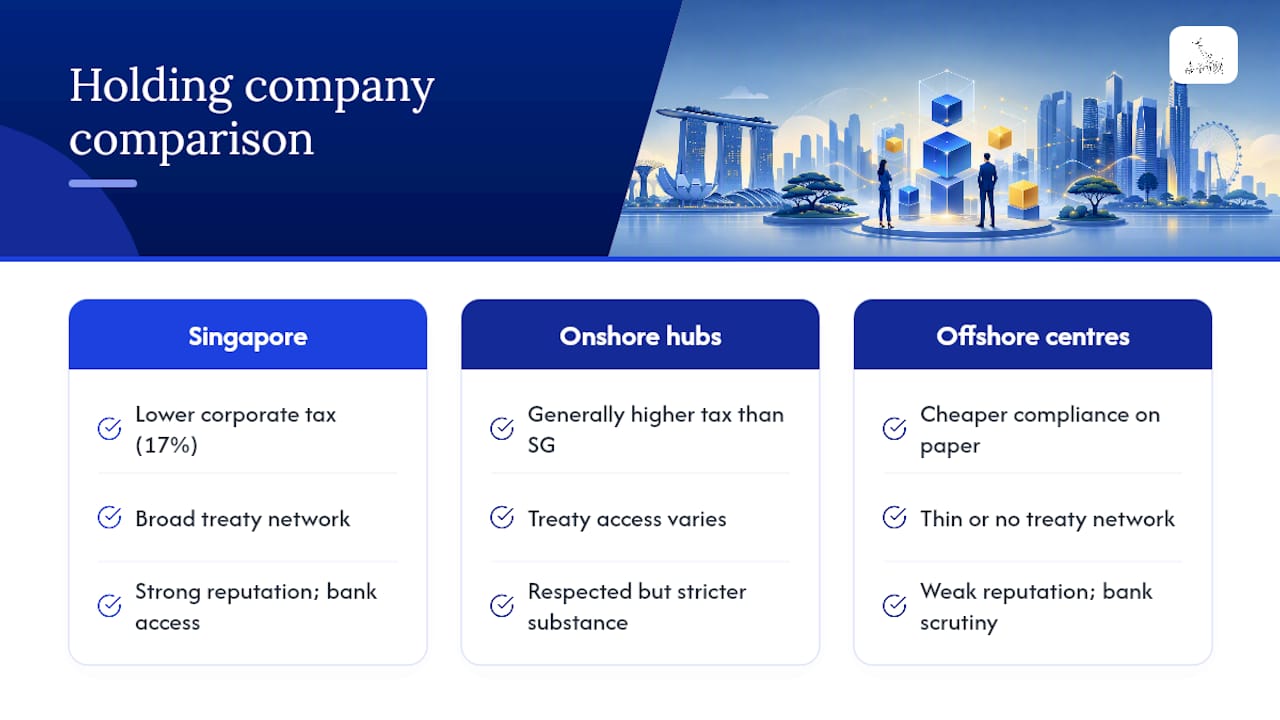
Singapore’s flat 17% corporate rate sits comfortably below many onshore alternatives, and its one-tier tax system with no dividend withholding tax matches or beats most competing hubs on distribution efficiency. Where Singapore pulls ahead is treaty breadth combined with substance requirements that are demanding but achievable for a genuinely active group, rather than the near-impossible substance bar some larger economies now impose.
Traditional offshore centres can look cheaper and lighter on paperwork, but they increasingly struggle with bank account access, reputational scrutiny from counterparties, and treaty networks that are thin or nonexistent. A holding company with no real treaty access often ends up paying more in foreign withholding tax than it saves in local compliance costs.
The practical difference is that Singapore asks you to build something real: a director who shows up, a functioning office, decisions made locally, and in exchange it gives you a credible tax treaty position, a respected regulatory reputation, and banking relationships that don’t raise eyebrows. For founders running an active regional business rather than parking assets in a shell, that trade tends to work firmly in Singapore’s favour.
Which industries benefit most from a Singapore holding structure?
Regional trading and distribution businesses are the most obvious fit. A group running operations across Indonesia, Vietnam, and the Philippines commonly uses a Singapore holding company to consolidate dividends, manage intercompany financing, and access DTA relief on income flowing back from each market, while benefiting from Singapore’s banking infrastructure and legal predictability.
Technology and IP-heavy businesses lean on the structure differently. Holding valuable intellectual property, software, patents, and brand licences in a Singapore entity and licensing them to operating subsidiaries elsewhere can centralise royalty income and simplify how the group manages and defends those assets.
Property and investment portfolios are the classic IHC use case: founders or family offices holding a mix of overseas real estate, listed securities, and private equity stakes, collecting dividends, rent, and interest through one Singapore entity rather than managing each asset separately.
Financial services groups, fund managers, lenders, insurance-adjacent businesses, tend to use financial holding structures specifically because Singapore’s regulatory framework and its standing with the Monetary Authority of Singapore give counterparties confidence that domestic and offshore alternatives sometimes can’t match.
What links all four is cross-border complexity. A single-market business with no foreign subsidiaries rarely needs a holding company at all; the benefits scale with how many jurisdictions, currencies, and regulatory regimes the group actually touches.
Why does Singapore’s stability matter for holding companies?
A holding company is, in a sense, a long-term bet on the jurisdiction housing it. Political stability, predictable regulation, and consistent enforcement of contracts matter more here than in an operating subsidiary, because the whole point of the structure is to sit above disruption, not inside it.
Singapore’s institutional environment, supported by agencies like the Economic Development Board, which outlines the incentives and schemes available to businesses operating there, gives holding companies a genuinely stable base. Regulatory changes tend to be signalled well in advance, tax policy shifts, Section 10L included, come with transition guidance rather than sudden retroactive application, and currency and capital controls that plague some regional alternatives simply aren’t a factor.
This stability compounds. A holding company that expects to sit in place for a decade or more, managing dividends, financing decisions, and eventual exits, benefits disproportionately from a jurisdiction where the legal and tax rules ten years from now are likely to resemble the rules today. Founders who’ve operated group structures through political upheaval in other markets tend to appreciate this more than those setting up their first holding company, precisely because they’ve seen what the alternative costs in legal fees, frozen accounts, and rushed restructuring.
Which double tax treaties benefit a Singapore holding company most?
Singapore’s DTA network is one of the densest in Asia, and the treaties that matter most depend entirely on where your operating subsidiaries actually sit.
For groups with subsidiaries across Southeast Asia, treaties with Indonesia, Vietnam, Thailand, and the Philippines typically offer reduced withholding tax rates on dividends and interest flowing back to the Singapore parent, often a meaningful reduction from each country’s default domestic rate. For groups with a China-facing supply chain or manufacturing base, the Singapore-China treaty is frequently cited by practitioners as one of the more favourable arrangements in the region for dividend and royalty flows.
Treaties with larger economies, India and Japan among them, matter for groups with substantial trading relationships in those markets, particularly around interest and royalty withholding on cross-border financing and licensing arrangements.
None of this works without the Certificate of Residence. Claiming any treaty benefit starts with IRAS confirming the Singapore entity’s tax residency status for that specific treaty, and the entity generally has to clear the beneficial ownership test showing it genuinely owns and controls the income concerned, as IRAS’s international tax guidance sets out. Skip that step, or fail that test, and the treaty rate simply doesn’t apply, regardless of how favourable it looks on paper.
What does a Singapore holding company cost to run?
Setting up is the cheap part. ACRA’s BizFile registration fee sits at a flat $300, and incorporation itself typically completes within a day or two once documents are ready, per ACRA’s registration guidance.
The ongoing costs are where founders underestimate the picture. A Singapore holding company needs annual filing with ACRA, corporate tax filing with IRAS, and a registered office maintained continuously, none of which is optional regardless of how quiet the entity’s activity is in a given year. Add a locally resident director, whether an employee or an engaged nominee, and the cost of maintaining genuine economic substance, office space or a serviced address, local record-keeping, possibly a local employee or contracted adviser handling decisions, and the annual running cost climbs well beyond the incorporation fee.
Many founders choose to engage a corporate service provider (CSP) to manage annual returns, statutory registers, and compliance deadlines rather than handling it in-house, particularly once the group includes more than one or two subsidiaries. That engagement carries its own retainer cost, but it typically works out cheaper than the alternative: a compliance lapse, missed filing, or an economic substance gap that draws IRAS or foreign tax authority attention. Budget for substance and compliance from the outset rather than treating them as an afterthought once the structure is already live.
What Headington sees work in practice
Cross-border scaling, group reorganisations, and separating a growing operating business from riskier ventures are where a Singapore holding company earns its cost. We’re candid with founders that the trade-off is real: administration and substance planning against long-term tax and structural benefit. Our advice is consistent, get the Certificate of Residence application, substance planning, and corporate service provider engagement right from incorporation, not retrofitted once a tax authority asks questions.
— Colin
How Headington helps you build this properly
A holding company only delivers the benefits covered above when the paperwork, the substance, and the ongoing compliance all hold together, and that’s precisely where founders get stuck. Professional corporate services providers handle incorporation, corporate secretarial work, tax compliance, and economic substance advisory as one connected service, so the director appointment, registered office, and COR application are built with Section 10L and treaty claims in mind from day one, not bolted on afterwards.
The engagement path is straightforward: a consultation to map your group structure and goals, a plan covering the right entity type and substance measures, implementation through ACRA and IRAS, then ongoing retainer support to keep filings, registers, and substance evidence current. If you’re weighing whether a holding company fits your situation, get in touch with Headington to talk through the structure that matches your group’s cross-border footprint.
Sources
FAQ
What are the disadvantages of a holding company?
The main drawbacks are added administrative cost, duplicate compliance filings across entities, and the risk of losing tax benefits if the company can’t demonstrate genuine economic substance under rules like Section 10L.
What benefits does a holding company have?
The principal benefits are a favourable tax posture through Singapore’s one-tier system and DTA network, asset protection through liability separation between entities, and centralised control over group treasury and financing.
What is the point of having a holding company?
A holding company separates ownership from operating risk, letting founders protect valuable assets, consolidate dividends and financing decisions, and prepare cleanly for future restructuring, financing, or exit.
What expenses are deductible for investment holding companies in Singapore?
IRAS treats only expenses directly attributable to investment income as reasonably deductible for an IHC, with a practical guide of around 5% of gross investment income as the reasonable ceiling.
Comments