Trademark Registration in Singapore: 2026 Executive Guide
- Colin Tan
- 6 days ago
- 4 min read


Yes, you can register a trademark in Singapore today. File Form TM4 with the Intellectual Property Office of Singapore (IPOS) and expect the registration process in an uncontested case to take several months. The fee is S$280 per class when you adopt pre-approved items from IPOS’ Classification Database, or S$410 per class when you don’t. Registration protects your mark for a decade from the filing date, renewable indefinitely with associated renewal and restoration fees.
Pre-filing checklist:
Run a pre-filing search on the IPOS Digital Hub to clear conflicts
Prepare a clear graphical representation of your mark
Classify goods and services using IPOS’ Classification Database items where possible
File Form TM4 online via the IPOS Digital Hub or IPOS Go Mobile
Respond to any examination report within four months (extendable via Form CM5)
Monitor the two-month publication window for third-party oppositions
Register, then schedule renewal before the 10-year mark
Your immediate action: instruct in-house counsel to run the IPOS pre-filing search and prepare Form TM4, or brief Headington Management to handle filing and ongoing monitoring end-to-end.
Table of Contents
How to file your trademark application online with IPOS
Log into the IPOS Digital Hub at digitalhub.ipos.gov.sg using your Singpass or CorpPass credentials. Select “Apply for trade mark protection in Singapore” and open a new Form TM4 application. You’ll enter your applicant name and address, upload a clear graphical representation of the mark, and list the goods or services by Nice Classification class.
Here’s where fees split: adopt descriptions directly from IPOS’ Classification Database and you pay S$280 per class. Draft your own bespoke descriptions and the fee jumps to S$410 per class. Beyond cost, pre-approved classification items reduce examiner objections and speed processing. Where bespoke language is unavoidable, keep it narrow to limit overlap with prior marks.
After submission, IPOS conducts a formal check followed by a substantive examination against the Trade Marks Act 1998, testing distinctiveness, prior rights, and confusing similarity. If IPOS raises objections, you have four months to respond. A professionally conducted pre-filing clearance search materially reduces the risk of hitting this stage at all.

Pro Tip: If part of your specification faces objection, file Form TM8 to divide the application. Uncontested goods and services proceed to registration while contested items are handled separately, cutting administrative delay.
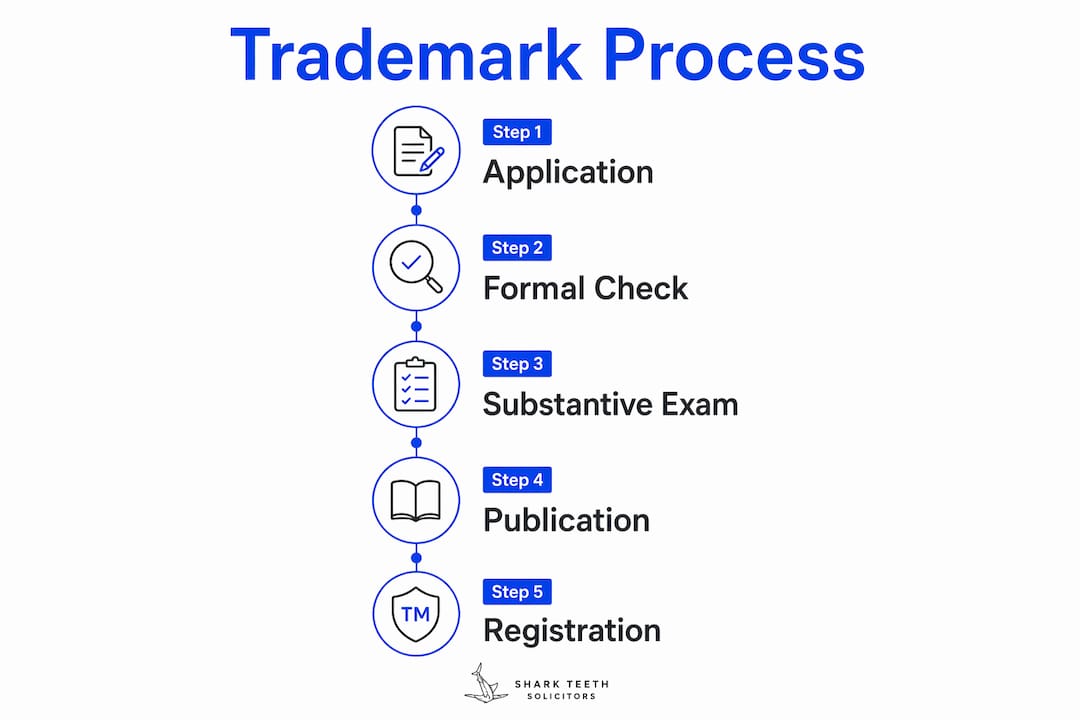
Once accepted, IPOS publishes the application in the Trade Marks Journal for two months, a step that can benefit from professional intellectual property opportunity guidance. Third parties may oppose during this window. No opposition, and IPOS issues your certificate of registration.
What to do after your trademark is registered
Registration is the start, not the finish. Monitor the Trade Marks Journal for new applications that conflict with your mark. Oppositions filed during a competitor’s publication window cost far less than infringement litigation later.
Enforce actively. Singapore’s Trade Marks Act gives registered proprietors the right to take action against unauthorized use, but IPOS does not police infringement on your behalf. That responsibility sits with you. For cross-border protection, file an international application via the Madrid Protocol (Form MM2(E)) through IPOS, paying an administrative fee of S$250 plus WIPO charges in Swiss francs. A Singapore-first filing preserves priority and often makes Madrid designation faster and cheaper than simultaneous national filings across multiple markets.
Set a renewal calendar now. The 10-year window closes faster than most executives expect, and the jump from S$480 to S$700 per class for a late renewal is avoidable with basic calendar management. Additional cost drivers include amendment and division fees under Forms TM27 and TM8, opposition hearing costs, and monitoring program fees. Budget for these alongside IPOS’ base fees from day one.
Headington Management handles trademark filing so you don’t have to

Trademark registration in Singapore is procedurally straightforward on paper. In practice, classification errors, missed examination deadlines, and unmonitored publication windows are where applications stall or fail. Headington Management provides end-to-end IP support: pre-filing searches and clearance, drafting and filing Form TM4, managing IPOS examination responses and oppositions, renewal and monitoring programs, and Madrid Protocol filings for cross-border brand rollouts.
With 25+ years of experience supporting businesses across 90 countries, Headington converts uncertain opposition costs and procedural delays into fixed advisory engagements with predictable timelines. For executives expanding into or out of Singapore, that shift from variable risk to managed process is where professional support earns its fee.
Contact Headington Management to request a scope-of-work estimate or schedule an executive briefing on your trademark strategy.
Key Takeaways
Trademark registration in Singapore requires Form TM4, IPOS fees of S$280 or S$410 per class, and active post-registration monitoring to protect your brand long-term.
Point | Details |
Filing fees | S$280 per class with IPOS Classification Database items; S$410 per class without them. |
Timeline | Uncontested applications take roughly nine months from filing to registration. |
Protection and renewal | Registration lasts 10 years; renew on time at S$480 per class to avoid the S$700 late fee. |
Post-registration duties | Monitor the Trade Marks Journal and enforce your rights actively; IPOS does not police infringement. |
Headington Management | Provides end-to-end filing, examination response, renewal, and Madrid Protocol support across 90 countries. |
Comments