Offshore Company Formation: A Practical Guide for US Owners
- Colin Tan
- Jul 27
- 12 min read


An offshore company can absolutely work for tax efficiency, asset protection, and cross-border banking — but only if you address three things before you file a single document: which jurisdiction actually fits your business model, whether you can pass bank KYC and source-of-funds reviews, and how US reporting obligations (FBAR, FATCA, CFC rules) will affect your structure.
Here is the short version of who should move forward and who should pause:
Proceed if you have a clear business purpose, clean source-of-funds documentation, and a US tax advisor already in the loop.
Proceed with caution if your industry is regulated (financial services, crypto, pharma) or if your transaction history is thin — banks will scrutinize both.
Pause if you cannot explain where your initial capital came from, or if you are hoping an offshore entity will simply make US taxes disappear. It will not.
Next step for everyone: draft a concise business plan and contact a reputable corporate service provider (CSP) before choosing a jurisdiction.
The jurisdictions covered below — BVI, Belize, Seychelles, Cayman Islands, Panama, Mauritius, and Delaware — each have distinct trade-offs. So do the US frameworks that follow you regardless of where you incorporate: FBAR/FATCA and CFC rules apply to US persons who own or control foreign entities and accounts. Headington Management covers all of these dimensions, and the sections below explain exactly how.
Table of Contents
Which offshore jurisdiction actually fits your business?
Offshore company registration supports international expansion, tax optimization, asset protection, and multi-currency banking — but only when the jurisdiction matches the business purpose. The table below maps each major jurisdiction to the criteria US owners care about most.
Jurisdiction | Best for | Corporate tax outcome | Economic substance / local director | Banking friendliness | Typical setup + annual fees | Privacy / nominee | US-owner compliance burden |
BVI | Holding, IP, investments | — | Substance rules apply for certain activities; nominee directors available | Moderate — reputation is solid but banks apply enhanced due diligence | $1,500 setup; $1,500/year | Strong nominee availability | Medium — Forms 5471/5472 likely; FBAR if account held |
Cayman Islands | Funds, SPVs, institutional structures | — | Substance rules apply; local economic-substance filings required | Good for institutional clients; retail/SME banking harder | — | Strong | High — fund-level reporting, FATCA registration often required |
Panama | Trading, holding, asset protection | — | No formal substance law for most IBCs | Moderate — improving but some banks cautious | — | Strong; bearer shares abolished | Medium |
Belize | Low-cost IBC, e-commerce, consulting | — | Minimal substance requirements | Lower — some banks treat Belize as higher risk | — | Strong | Medium — same US reporting applies |
Seychelles | Low-cost holding, IP | — | Minimal for IBCs; substance rules evolving | Lower — similar bank friction to Belize | — | Strong | Medium |
Mauritius | Africa/Asia trading, holding with DTTs | — | Substance requirements; local director often needed | Better than pure tax havens — treaty network helps | — | Moderate | Medium-high — treaty positions require substance |
Delaware (US) | US operations, VC-backed startups, IP holding | State: no foreign-income tax deferral; federal tax applies | No offshore substance rules; standard US compliance | Excellent | — | Moderate | High — full US federal and state tax reporting |
A few trade-offs worth naming directly. Belize and Seychelles are cheap and fast to incorporate in, but banks and US regulators treat jurisdictions differently based on reputation and substance rules — so the savings on formation fees can evaporate if you spend months trying to open a bank account. BVI sits in a middle ground: well-regarded, with a functioning substance framework, and generally accepted by major banks. Cayman is the gold standard for funds and institutional structures but is overkill (and expensive) for a small trading company. Mauritius is underused by US entrepreneurs despite offering genuine double-tax treaty access for operations in Africa and Asia.
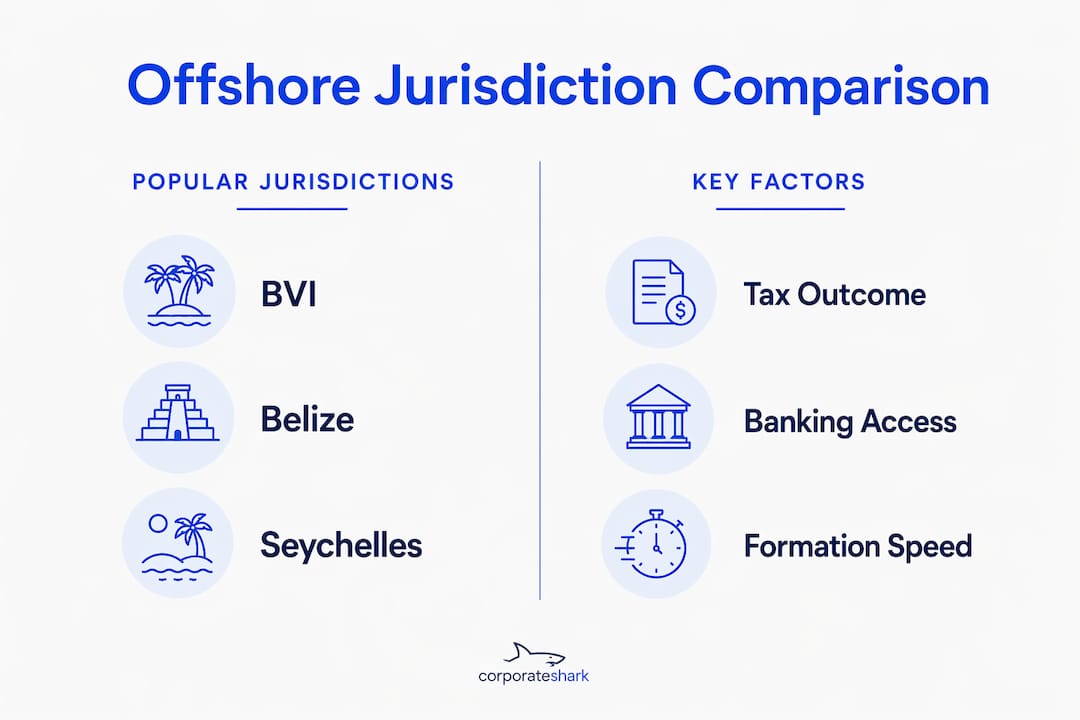
Delaware deserves a mention here because it is technically a domestic US structure, not an offshore one—but it appears on most jurisdiction lists because non-US founders use it to access US banking and investors. For a US owner, Delaware offers no foreign-income tax deferral.
Pro Tip: If your primary goal is banking access rather than tax efficiency, weight jurisdiction reputation over formation cost. A BVI or Mauritius entity will open more doors at correspondent banks than a Belize IBC at the same price point.
How to form an offshore company, step by step

The sequence below reflects how a well-run formation actually works — two parallel tracks running simultaneously, not a linear queue.
Track A: Incorporation
Define your objectives. Trading company, holding structure, IP vehicle, or investment fund? The answer determines entity type (IBC, LLC, or limited company) and jurisdiction.
Select jurisdiction and entity type. Match the jurisdiction to your banking needs, treaty requirements, and substance capacity. IBCs work well for holding and international trade; LLCs offer more flexibility for active trading and investments.
Engage a corporate service provider. Your CSP handles name reservation, drafts the Memorandum and Articles of Association, and liaises with the local registrar. Give them a notarized passport copy, proof of address, and your ownership structure from day one.
Submit incorporation documents. The CSP files with the registrar. In BVI, Belize, and Seychelles, this step often completes in one to five business days.
Receive Certificate of Incorporation. Once issued, you have a legal entity. Apostille or legalization may be needed for use in certain countries — confirm this with your CSP before filing.
Register for economic-substance reporting where required (BVI, Cayman, Mauritius). Missing this step is one of the most common post-formation errors.
Track B: Banking readiness (start this on day one, not after incorporation)
Prepare your banking packet — business plan, ownership chart, source-of-funds evidence, sample contracts or invoices, and compliance questionnaire responses.
Submit to bank(s). KYC review, enhanced due diligence if required, and account approval. This is where most timelines stretch.
Post-formation compliance. Annual filings, registered office maintenance, accounting records, and US tax reporting (Forms 5471/5472, FBAR).
Documents commonly required for both formation KYC and bank KYC:
Certified/notarized passport copy for each director and beneficial owner
Proof of residential address (utility bill or bank statement, dated within three months)
Corporate business plan with expected transaction types and volumes
Proof of source of funds (bank statements, audited accounts, or investment records)
Ownership chart showing ultimate beneficial owners
References from existing bankers or professional advisors (some banks require these)
Where apostilles apply — typically when documents issued in one country are used in another — factor in an extra three to ten business days.
What does offshore company formation actually cost?
Fee ranges vary based on jurisdiction, entity complexity, and nominee use; costs include government and registrar fees, CSP formation fees, registered agent and nominee director fees, document certification, bank account setup fees, and ongoing annual compliance and accounting costs.
On timelines: incorporation in Belize or Seychelles can be very quick. BVI usually takes several business days. Cayman and Mauritius may require a few weeks for incorporation due to regulatory review. Bank account approval is the most variable step and can take considerably longer, especially if documentation is incomplete or enhanced due diligence applies.
Ask any provider upfront: what is included in the formation fee, what triggers additional charges, and whether banking coordination is a separate service or bundled. Providers who cannot answer these questions clearly are a red flag.
Banking readiness is the real bottleneck — here is how to clear it
Incorporation is the easy part. A company that cannot open a bank account is effectively non-functional for international operations, and banks have tightened KYC requirements substantially over the past decade. The practical gate is not the registrar — it is the compliance officer at the bank.
What banks commonly require before approving a corporate account:
Certified ID and proof of address for every director and beneficial owner
Certificate of Incorporation, Memorandum and Articles of Association, and register of directors
Ownership chart showing the full beneficial-ownership chain
Detailed business plan: what the company does, who its customers are, expected transaction volumes and currencies
Source-of-funds documentation: bank statements, audited accounts, or evidence of investment capital
Sample contracts, invoices, or letters of intent from clients or suppliers
Compliance questionnaire (most banks issue their own)
Professional references (some correspondent banks require these)
Three practical steps that shorten bank timelines:
Prepare the banking packet before you incorporate. Treat it as step zero. A complete, well-organized packet submitted on day one of the bank application cuts review time significantly.
Use payment-processor transaction history. If you have Stripe, PayPal, or similar records showing consistent revenue, include them. Banks treat this as strong source-of-funds evidence.
Consider a fintech multi-currency account as an interim solution. Providers like Wise Business or Airwallex can hold and convert multiple currencies while your traditional bank application is in review. This keeps operations moving.
Pro Tip: Build one master banking packet — certified documents, business plan, ownership chart, source-of-funds evidence — and share it with both your CSP and your bank. A single reusable packet avoids the back-and-forth that adds weeks to the process.
Industry practitioners consistently report that bank account approval, not incorporation, is the primary cause of operational delays in offshore setups — often outlasting the formation process by weeks or months.
What US owners must report and pay — before you structure anything
Forming an offshore entity does not reduce your US tax obligations. US rules including FBAR, FATCA, CFC provisions, and Forms 5471/5472 frequently apply and require detailed reporting of foreign entities and accounts. Getting this wrong is expensive.
The main frameworks to know:
FBAR (FinCEN Form 114): Required if you have signature authority or a financial interest in foreign bank accounts with an aggregate value exceeding $10,000 at any point during the year. Filed annually with FinCEN, not the IRS.
FATCA (Form 8938): Separate from FBAR; reports specified foreign financial assets above threshold amounts. Filed with your federal tax return.
Controlled Foreign Corporation (CFC) rules: If you own more than 50% of a foreign corporation (by vote or value), it is a CFC. Subpart F income and GILTI (Global Intangible Low-Taxed Income) provisions can cause current US taxation of the entity’s earnings even without a distribution.
Form 5471: Filed by US persons who are officers, directors, or shareholders in certain foreign corporations. Penalties for non-filing start at $10,000 per form per year.
Form 5472: Required for foreign corporations with US shareholders or US-connected transactions.
Structure matters enormously here. A holding company that passively holds assets generates different US tax outcomes than an active trading entity. Where value is created — where employees work, where decisions are made — affects whether income is characterized as Subpart F, GILTI, or something else entirely.
Practical steps: keep detailed corporate records from day one, budget for US filing costs (Form 5471 preparation alone can run $1,500–$3,000 per year with a qualified CPA), and treat US compliance as a line item in your offshore structure budget.

Nominee directors, registered agents, and virtual offices — what they actually do
A nominee director is a person or entity that appears on public company records in place of the actual owner. A nominee shareholder holds shares on behalf of the beneficial owner under a declaration of trust. A registered agent is the locally licensed entity that maintains the company’s official address and receives regulatory correspondence — required in virtually every offshore jurisdiction.
Privacy benefits are real: in jurisdictions with public registries, nominees keep your name off searchable records. But the trade-offs matter.
When nominees make sense:
Low-profile holding structures with no regulated activities
Jurisdictions where a local director is required for substance compliance
Situations where the beneficial owner has a legitimate privacy interest (not concealment)
When nominees raise red flags:
Regulated industries (financial services, gaming, healthcare) where regulators expect to see real controllers
Bank applications — most banks now require disclosure of the ultimate beneficial owner regardless of nominee arrangements
Any situation where the nominee arrangement could be characterized as concealing ownership from regulators or creditors
Risks to manage if you use a nominee:
Execute a clear nominee agreement and deed of trust before the company is formed
Maintain a documented beneficial-owner register internally
Obtain an indemnity from the nominee and ensure your CSP holds copies of all agreements
Disclose the beneficial owner to the bank — nominees do not provide banking privacy, only registry privacy
Pro Tip: A limited-scope nominee arrangement — where the nominee appears on the registry but a power of attorney gives the beneficial owner full operational control — is the standard approach for legitimate privacy structures. Make sure your CSP documents this properly from day one.
How to choose a formation provider you can actually trust
The difference between a $300 online registrar and a full-service CSP is not just price — it is whether you get a working company or a certificate that cannot open a bank account.
Checklist for evaluating any provider:
Licensed local registered agent in your target jurisdiction (verify with the local registry)
Demonstrable experience with US-owner structures and US reporting coordination
In-house compliance capability — not just outsourced to a third party
Banking coordination services: do they provide introductions, prepare banking packets, and follow up with the bank?
Transparent, itemized pricing with no hidden renewal fees
Clear nominee policies and documented beneficial-owner procedures
Post-formation support: annual filings, economic-substance reporting, accounting
Questions to ask before you sign anything:
What is your typical timeline from engagement to Certificate of Incorporation?
What documents will you prepare, and what do I need to provide?
Who handles KYC on your end, and who interfaces with the bank?
Do you provide banking introductions, and which banks do you work with?
What happens if the bank rejects the application — do you have alternatives?
What are your escalation contacts and response-time commitments?
Red flags:
Guaranteed bank account promises (no legitimate provider can guarantee this)
Opaque pricing with “contact us for a quote” on every line item
Reluctance to discuss source-of-funds procedures
No physical office or local contacts in the jurisdiction
Pressure to decide quickly or pay before receiving a written scope of work
The decision framework is straightforward: if your structure is simple and banking is not a concern, a commodity registrar may suffice. If you need banking coordination, economic-substance support, or US-compliance coordination, a full-service CSP is worth the premium.
Why Headington Management is built for this
Headington Management brings over 25 years of experience in cross-border expansion and corporate and legal advisory services, with in-house experts covering 90 countries. That breadth matters when a client’s structure spans a BVI holding company, a Mauritius operating subsidiary, and US reporting obligations simultaneously.
For offshore formations specifically, Headington’s services include:
Jurisdiction analysis and entity-type selection
Full incorporation and registered office services
Nominee director and corporate secretarial services
Banking coordination and banking-packet preparation
Economic-substance compliance and annual filing support
US-compliance coordination (working alongside your US tax advisor)
For next steps, visit Headington Management to request a consultation or outline your structure for an initial assessment.
Key Takeaways
Banking readiness and US reporting obligations are the two factors that determine whether an offshore structure delivers its intended benefits — jurisdiction choice matters, but only after these are addressed.
Point | Details |
Banking is the real gate | Incorporation can complete in days; bank account approval often takes weeks or months without a complete KYC packet. |
US reporting follows you | FBAR, FATCA, CFC rules, and Forms 5471/5472 apply regardless of where you incorporate — budget for US filing costs. |
Jurisdiction trade-offs are real | BVI and Mauritius offer better banking access than Belize or Seychelles despite higher formation costs. |
Provider quality determines outcomes | A CSP that cannot coordinate banking or economic-substance reporting is not a full-service provider. |
Headington Management | Offers jurisdiction advice, incorporation, banking coordination, and US-compliance support across 90 countries. |
The pitfalls most people walk straight into
The most common mistake is treating incorporation as the finish line. Clients arrive with a Certificate of Incorporation from a low-cost provider and no bank account, no banking packet, and no awareness that their Belize IBC has been sitting idle for four months. The formation was fast. Everything after it stalled.
The second most common mistake is skipping the US tax conversation until after the structure is built. Restructuring a CFC after the fact — or discovering that Subpart F income has been taxable for two years without reporting — is far more expensive than getting the advice upfront.
A pattern worth naming: clients who use interim fintech accounts (multi-currency accounts from established providers) while their traditional bank application is in review keep their operations moving. Those who wait for a traditional bank account before transacting lose months of revenue. The fintech account is not a permanent solution, but it is a practical bridge while the correspondent banking relationship is established.
One more: nominee arrangements that are not properly documented. A nominee agreement that lives in a drawer and has never been disclosed to the bank provides no real protection and creates liability for everyone involved. Document it, disclose the beneficial owner to the bank, and keep the records current.
Headington Management can handle your offshore setup end to end
When you have read this far, you already know the two things that sink most offshore structures: a weak banking packet and a US tax situation that was never properly planned. Headington addresses both from day one.
With 25+ years of cross-border advisory experience and in-house coverage across 90 countries, Headington handles jurisdiction selection, full incorporation, registered office and nominee services, banking-packet preparation, and ongoing compliance — including coordination with your US tax advisor on FBAR, FATCA, and CFC reporting. Fees are transparent and itemized; once you share your business purpose and target jurisdiction, Headington can provide a sample cost estimate before you commit to anything.
The next step is a short consultation. Bring your business plan, a rough sense of your transaction volumes, and any questions about your source-of-funds documentation. Request a consultation and get a clear scope and timeline within days, not weeks.
Useful sources for further research
The sources below back the factual claims in this article and are worth bookmarking for deeper research.
Regulatory and legal detail:
FinCEN FBAR guidance — best starting point for US owners on FBAR, FATCA, CFC rules, and Forms 5471/5472
Offshore company registration overview — covers AML/KYC requirements and economic-substance rules across jurisdictions
Offshore LLC and IBC entity types — practical breakdown of entity structures and their use cases
Banking preparation and formation process:
Wise: how to open an offshore company — the most practical guide to the formation sequence and banking-readiness documentation
Air Corporate: KYC and formation documents — detailed list of documents required for formation and bank KYC
Jurisdiction comparison:
Top jurisdictions for offshore companies — covers BVI, Belize, Seychelles, Cayman, Panama, Mauritius, and Delaware with trade-off analysis
Provider and service follow-up:
Headington Management — for jurisdiction advice, incorporation, banking coordination, and ongoing compliance support across 90 countries
Comments