Share Buyback Singapore: A Director's Compliance Guide
- Colin Tan
- 2 days ago
- 10 min read


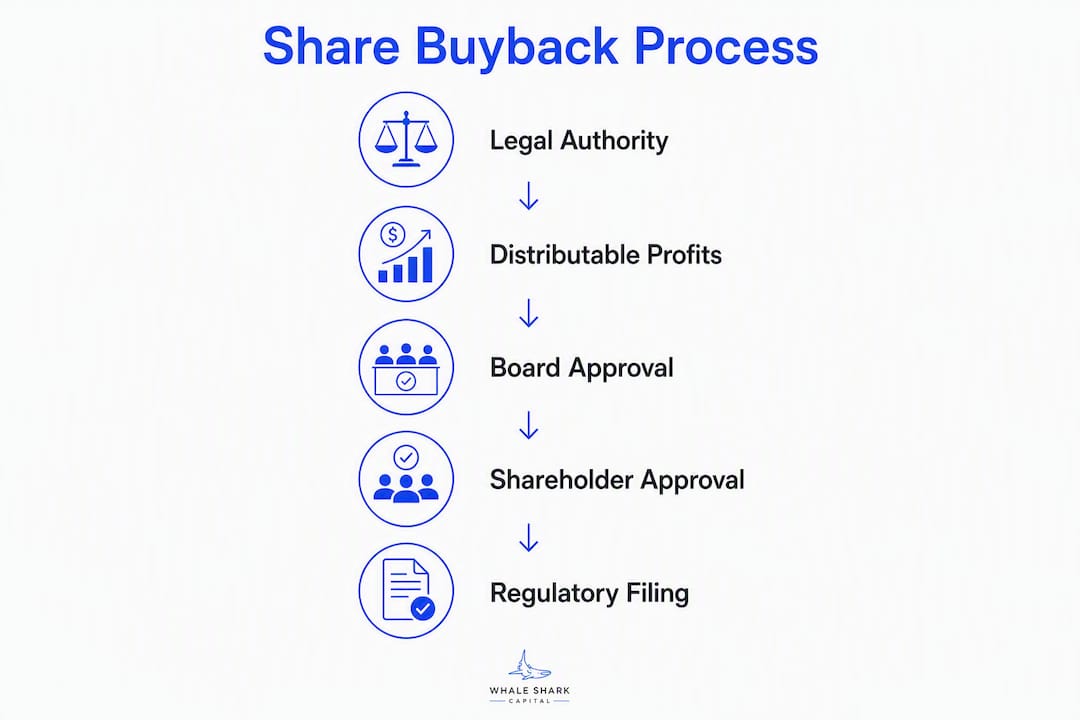
Yes, Singapore companies can repurchase their own shares. The Companies Act (Singapore) explicitly permits it, but three checks must clear before you execute: your constitution authorizes the buyback, you have sufficient distributable profits to fund it, and you have the right shareholder approval in place. Skip any one of these and the transaction is unlawful, regardless of how clean the paperwork looks afterward.
The single most important check is the distributable profits test. Using share capital or share premium to fund a share buyback in Singapore without a court-approved capital reduction is a statutory breach. Confirm your retained earnings figure with your accountant before the board resolution is drafted, not after.
Table of Contents
What the Companies Act says about share repurchases in Singapore
ACRA and BizFile filing requirements you cannot afford to miss
How on-market and off-market buybacks work for SGX-listed companies
Funding, stamp duty, and tax considerations for Singapore buybacks
Board approvals, directors’ duties, and handling conflicts of interest
What the Companies Act says about share repurchases in Singapore
The Companies Act is the primary statute governing every share repurchase in Singapore. ACRA enforces the filing obligations, and SGX rules layer on top for listed issuers.
Core definitions directors need
A share buyback (also called a share repurchase) is a transaction where a company purchases its own issued shares from existing shareholders. Once repurchased, those shares can either be cancelled (reducing total issued capital) or held as treasury shares, which remain issued but carry no voting rights and receive no dividends while held.

Redeemable preference shares are a special category: they are issued on terms that allow the company to redeem them, so the buyback mechanism is built into the share terms from the start. Non-redeemable preference shares and ordinary shares require a separate statutory buyback process.
Statutory limits that apply
Share class | Buyback limit between consecutive AGMs | Treasury share cap |
Ordinary shares | 20% of total issued ordinary shares | |
Non-redeemable preference shares | buyback limited to a portion of total issued in that class | treasury shares capped at a portion of total in that class |
Redeemable preference shares | buyback has no statutory limit | treasury shares capped at a portion of total in that class |
The 20% cap resets at each AGM. A private company that misses its AGM does not get a rolling extension. The 10% treasury share cap is a hard ceiling: if holding repurchased shares as treasury shares would push the aggregate above 10% of that class, the company must cancel the excess rather than retain it.
Pro Tip: If your company has not held an AGM within the statutory period, the 20% buyback window may be narrower than you expect. Confirm the AGM date and issued share count before calculating your buyback limit.
ACRA and BizFile filing requirements you cannot afford to miss
ACRA requires a formal notice of purchase or acquisition filed through BizFile+ within 30 days of the acquisition date. Missing that window is not a technicality — late filings can trigger regulatory consequences and leave your register in a legally uncertain state.
Filing sequence
Confirm the buyback is complete and the consideration has been paid.
Log into BizFile+ and select the “Notice of Purchase or Acquisition of Own Shares” transaction.
Enter the required particulars: acquisition date, number of shares acquired, class of shares, consideration paid per share, and the pre- and post-acquisition issued capital figures.
Submit and retain the transaction reference number.
Update the Electronic Register of Members (EROM) to reflect the reduced share count (or the treasury share holding, if shares are retained rather than cancelled).
If shares are cancelled, update the company’s share capital figure in the register accordingly.
Common filing mistakes to avoid
Using the board resolution date as the “effective date” instead of the actual acquisition/settlement date.
Omitting the pre-acquisition and post-acquisition issued capital figures, which ACRA requires to verify the 20% limit.
Filing the notice but forgetting to update the EROM separately — both steps are required.
Treating treasury shares and cancelled shares identically in the register: they have different accounting treatments and different register entries.
Delaying the filing because the stamp duty payment is still pending. The 30-day filing clock runs from acquisition, not from stamp duty settlement.
How on-market and off-market buybacks work for SGX-listed companies
For SGX-listed companies, the mechanics split into two routes: on-market purchases and off-market purchases. The distinction matters because the approval requirements, pricing rules, and disclosure obligations differ between them.

On-market purchases are executed through SGX’s Ready Market or Unit Share Market via a licensed broker. The company buys its own shares at prevailing market prices, subject to the price limits set in the shareholder mandate. Off-market purchases take three forms for unlisted companies: an equal access scheme (all shareholders offered the same terms), a selective off-market purchase (requires a special resolution and strict abstention rules for interested parties), or a contingent purchase contract (also requires a special resolution).
Shareholder authority for an on-market buyback mandate is typically granted by ordinary resolution at the AGM, with the mandate specifying the maximum number of shares and the maximum price. That mandate lapses at the next AGM unless renewed.
Reporting obligations for listed companies
SGX requires same-day or next-day announcement of each day’s buyback transactions. The announcement must include:
Field | What to report |
Date of purchase | Actual trading date |
Number of shares purchased | Volume for that day |
Purchase price range | Lowest and highest price paid |
Average purchase price | Weighted average for the day |
Total shares held as treasury shares | Running cumulative figure |
Percentage of issued shares | Post-purchase percentage |
Pro Tip: Run buybacks outside trading blackout windows (typically 30 days before quarterly or half-year results). Buying during a blackout period when directors hold material non-public information creates market-abuse exposure that no shareholder mandate can cure.
Funding, stamp duty, and tax considerations for Singapore buybacks
The funding rule is straightforward but frequently misapplied. A company must fund a share buyback from distributable profits — retained earnings that have not been committed to dividends or other obligations. Share capital and share premium accounts are off-limits unless the company first completes a capital reduction under the Companies Act, which is a separate statutory process involving either a special resolution (for solvent companies using the solvency statement route) or a court order. Treating a buyback as a shortcut to capital reduction is a common and costly mistake.
Stamp duty on share buybacks: IRAS charges 0.2% of the purchase price or the net asset value (NAV) of the shares, whichever is higher. For instruments executed in Singapore, payment is due within 14 days of execution.
For private companies, IRAS uses NAV-based valuation where the target company holds property, and the NAV must be calculated from accounts dated within 24 months of the transfer. If your accounts are older than that, you need updated financials before the stamp duty computation is valid.
Other costs to budget for beyond stamp duty
Brokerage commissions (on-market buybacks only): charged per transaction by the executing broker.
Legal and advisory fees: drafting resolutions, reviewing constitutional authority, and preparing the solvency statement.
ACRA filing fees: payable through BizFile+ at the time of lodgment.
Accounting fees: updating the register, reconciling share capital accounts, and preparing the post-buyback financial disclosures.
SGX announcement preparation costs (listed companies): IR advisory or legal fees for drafting compliant announcements.
For cross-border shareholders, Singapore’s tax and compliance framework adds another layer: withholding tax treatment on the buyback proceeds may differ depending on the shareholder’s tax residency.
Board approvals, directors’ duties, and handling conflicts of interest
A share buyback requires two layers of approval: a board resolution authorizing the transaction, and shareholder approval at the level the Companies Act and your constitution require. For a standard on-market buyback mandate, an ordinary resolution at the AGM suffices. A selective off-market purchase requires a special resolution, and the interested shareholder (the one selling back shares) must abstain from voting.
Directors’ core duties in a buyback
Directors must satisfy themselves on three points before signing off:
Solvency: the company must be able to pay its debts as they fall due after the buyback. A solvency statement is required for certain buyback types, and signing one without proper financial review exposes directors to personal liability.
Bona fides: the buyback must be in the company’s best interests, not a mechanism to benefit a particular shareholder at the expense of others.
Accurate disclosure: shareholders voting on the resolution must receive complete and accurate information about the proposed terms, price limits, and the company’s financial position.
Conflict-of-interest controls
Where a director is also a selling shareholder, that director must declare the conflict and abstain from both the board vote and the shareholder vote (for selective off-market purchases). Document the abstention in the board minutes and the shareholder meeting minutes. For private companies where the buyback price is not set by a public market, an independent valuation reduces the risk of a later challenge that the price was unfair to remaining shareholders.
Pro Tip: Never rely on a verbal confirmation from your auditor that distributable profits are sufficient. Get a written computation tied to the latest signed accounts, and attach it to the board resolution as an exhibit.
A practical step-by-step checklist for directors
Lodge the ACRA notice — File the notice of purchase or acquisition through BizFile+ within 30 days of the acquisition date.
Pro Tip: Build a simple transaction log that tracks each buyback tranche: date, volume, price, cumulative treasury share percentage, and ACRA filing reference. If ACRA or SGX ever queries the transaction, that log is your first line of defense.
Risks and common pitfalls in Singapore share buybacks
The most damaging mistakes tend to cluster around three areas: funding, filing, and stamp duty.
Insufficient distributable profits is the highest-risk error. A company that executes a buyback when retained earnings are inadequate has effectively made an unlawful return of capital. Directors can face personal liability, and the transaction may be voidable. The fix is simple: get the written computation before the resolution, not after.
Treating a buyback as a capital reduction is a structural error that surfaces most often in restructuring contexts. Capital reduction is a distinct statutory process with its own filing routes, timelines, and in some cases court involvement. A buyback does not substitute for it, and conflating the two can leave the company’s capital structure in a state that neither process has properly authorized.
Late ACRA filings are common when companies treat the 30-day window as a soft deadline. It is not. Delayed or missing notices can result in statutory penalties and create gaps in the register that complicate future share transactions or due diligence.
Stamp duty errors typically arise in two ways: using the purchase price when NAV is higher (understating the duty), or failing to update the NAV calculation when accounts are stale. IRAS can assess additional duty plus penalties if the computation is wrong.
Pro Tip: If a buyback is part of a broader restructuring, get a written opinion from a corporate lawyer on whether the transaction is a buyback, a capital reduction, or both, before any documents are signed. The two processes have different statutory consequences, and conflating them in the paperwork is harder to unwind than it looks.
How Headington supports your share buyback in Singapore
Running a compliant share buyback in Singapore involves more moving parts than most directors expect: constitutional checks, distributable profits computations, solvency statements, BizFile+ filings, stamp duty coordination, and register updates, all on overlapping deadlines.
Headington’s corporate secretarial and legal advisory team handles the full execution sequence. With 25+ years of experience and in-house experts across 90 countries, Headington manages BizFile+ filings, drafts board and shareholder resolutions, coordinates stamp duty payment with IRAS, and provides SGX announcement support for listed clients. For private companies, the team covers solvency and distributable profits checks, off-market agreement drafting, and post-transaction register updates.
Engagements typically start with a fixed-fee scoping call to assess your company’s constitutional position, share structure, and timeline. From there, Headington can manage the full transaction on a project basis or support your in-house team on specific steps. To discuss your buyback or get a case assessment, contact Headington Management directly.
Key Takeaways
A lawful share buyback in Singapore requires distributable profits, constitutional authority, the correct shareholder approval, a timely ACRA filing, and stamp duty payment at 0.2% of purchase price or NAV, whichever is higher.
Point | Details |
Distributable profits are mandatory | Fund the buyback from retained earnings only; share capital requires a separate capital reduction process. |
20% limit applies between AGMs | Ordinary and non-redeemable preference shares are capped at 20% per AGM cycle; redeemable preference shares have no such limit. |
ACRA notice within 30 days | Lodge the notice of purchase via BizFile+ within 30 days of acquisition and update the EROM. |
Stamp duty at 0.2% | IRAS charges 0.2% on the higher of purchase price or NAV; pay within 14 days for Singapore-executed instruments. |
Headington manages full execution | Headington handles BizFile+ filings, resolutions, stamp duty coordination, and SGX announcements for listed clients. |
Why a staged approach to buybacks reduces execution risk
The directors who run into trouble with share buybacks in Singapore are rarely the ones who lack legal knowledge. They are the ones who compress the process: they get verbal comfort on distributable profits, skip the written solvency check, and treat the ACRA filing as something to sort out later. Later becomes 35 days, and a straightforward transaction now has a compliance gap attached to it.
What actually reduces execution risk is sequence discipline. The constitutional check, the distributable profits computation, and the solvency statement are not formalities to tick off in parallel with the broker instruction. They are preconditions. The broker instruction comes after them, not alongside them.
Headington’s approach with clients is to stage the process deliberately: confirm the legal authority first, document the financial position second, then execute. That sequence sounds obvious, but under time pressure from shareholders or a deal timeline, it is the first thing that gets compressed. Twenty-five years of corporate advisory work across Singapore and 90 other jurisdictions has shown that the cost of unwinding a defective buyback is always higher than the cost of doing it right the first time.
Useful sources for Singapore share buyback rules
Official sources to consult before taking any formal action:
Companies Act (Singapore) — AGC Singapore Statutes Online: the primary statutory text governing buybacks, treasury shares, and capital reduction. Check Part IV for the relevant provisions.
ACRA — Buying back shares: ACRA’s procedural guidance covering funding rules, BizFile+ filing steps, and the notice of purchase requirements.
BizFile+ — Shares instruction guide: step-by-step filing instructions for share-related transactions, including buyback notices.
Comments