Company Strike Off Singapore: A Director's Guide
- Colin Tan
- 5 days ago
- 12 min read


If your Singapore company has stopped trading and has no outstanding debts, unpaid taxes, or ongoing legal proceedings, striking it off the ACRA register is a legitimate and cost-free way to close it. The formal term is deregistration, and the process runs through ACRA’s BizFile+ eService, which is free to use. The total timeline typically runs 4–6 months, including a mandatory 3-month objection window after ACRA approves the application and publishes a notice in the Government Gazette.
Before you file, work through these four steps:
Clear all tax obligations. File any outstanding corporate tax returns and settle liabilities with the Inland Revenue Authority of Singapore (IRAS). An unresolved IRAS objection will cause your application to lapse after two months.
Resolve CPF liabilities. Confirm with the CPF Board that all employee contributions have been paid and no outstanding notices remain.
Settle or formally notify creditors. Pay all debts or document that none exist. Outstanding charges registered against the company must be removed.
Update your registered address and BizFile+ inbox. ACRA sends review letters to the company’s registered office. An outdated address can delay or derail the process.
Once those items are clear, you can file via BizFile+ directly or engage a corporate service provider (CSP) like Headington to manage the filing and regulator liaison on your behalf.
Table of Contents
What does striking off actually mean, and how does it differ from winding up?
What pre-filing obligations can trigger an IRAS or CPF objection?
When should you choose MVL or dormant status instead of striking off?
How Headington can support your company strike-off in Singapore
Headington’s strike-off service gets it done without the back-and-forth
What does striking off actually mean, and how does it differ from winding up?
Striking off is the removal of a company from the ACRA register. Once ACRA publishes the final notice in the Government Gazette, the company ceases to exist as a legal entity. No liquidator is appointed, no formal asset distribution process runs, and no court order is required. It is the simplest form of Singapore company dissolution, designed specifically for companies that are genuinely dormant or have never traded.
That simplicity is also its limitation. Striking off is not a substitute for a proper winding-up process when real liabilities or assets are involved.
Striking off vs. Members’ Voluntary Liquidation vs. creditors’ winding up
Route | Best for | Who handles liabilities | Formal asset distribution | Typical cost |
Striking off | Dormant companies, no assets or liabilities | Directors confirm none exist | No | Free (ACRA fee) |
Members’ Voluntary Liquidation (MVL) | Solvent companies with assets to distribute | Court-appointed liquidator | Yes | Liquidator fees apply |
Creditors’ winding up | Insolvent companies | Court-appointed liquidator | Yes, creditors first | Court and liquidator costs |
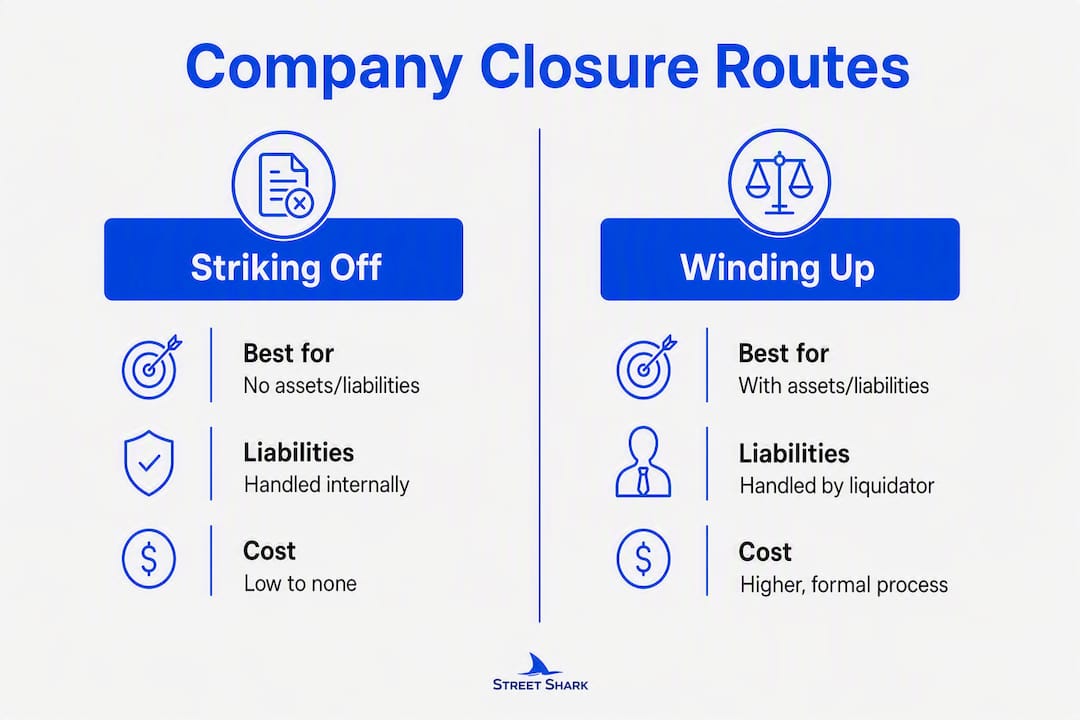
The Companies (Striking Off) Regulations 2015 set out the statutory conditions under which ACRA may strike off a company. Those conditions are strict: the company must have no outstanding liabilities, no assets, and no unresolved regulatory issues. If your company holds intellectual property, property, or has creditors who have not been formally settled, MVL is the appropriate route. Striking off a company with undisclosed assets or liabilities is not just procedurally wrong; it exposes directors to personal liability and potential disqualification.
Does your company qualify for strike off?
ACRA’s eligibility criteria are specific. A company qualifies only if it meets all of the following:
Has ceased trading or never commenced business
Has no outstanding debts or liabilities (including to trade creditors)
Has no assets (cash, property, receivables, or intellectual property)
Has no ongoing or pending legal proceedings
Has no unresolved issues with government agencies, including IRAS and the CPF Board
Has up-to-date company information on file with ACRA (registered address, officer details)
Outstanding annual returns do not automatically disqualify a company from striking off, but unresolved filings can prompt agency objections that stall the process. Filing them before you apply removes that risk.
Who can submit the application?
A director or authorized officer of the company may file directly through BizFile+. When a CSP files on the company’s behalf, the endorsement rules differ slightly: the CSP must confirm that majority director consent has been obtained before submitting. For direct filings, all directors (or a majority, depending on the company’s constitution) must endorse the application through BizFile+ within a short endorsement window of submission. If endorsements are not completed within that window, the application lapses and must be resubmitted.
Before filing, verify the following through BizFile+:
Check the company’s outstanding filings and compliance status under the BizFile+ eService dashboard
Confirm with IRAS that all corporate tax returns are filed and no outstanding assessments exist
Check whether any charges are registered against the company with ACRA and arrange for their removal
How to apply to strike off a company via BizFile+
The application is filed through the “Apply to Strike Off Business Entity” eService on BizFile+. Here is the full process from start to dissolution.
Log in to BizFile+ using your Singpass and navigate to the striking off eService. You will need the company’s Unique Entity Number (UEN), the date business ceased, the reason for striking off, and a confirmation that all eligibility criteria are met.
Submit the application. The system will prompt you to confirm that the company has no assets, no liabilities, no ongoing proceedings, and no unresolved government agency issues. These are statutory declarations, not formalities.
Directors endorse within a short endorsement window. Each director required to endorse will receive a BizFile+ notification. If any director fails to complete endorsement within the 14-day window, the application lapses. For CSP-filed applications, the CSP must have secured director consent before submission.
ACRA reviews the application. ACRA will conduct its own checks, which may include sending letters to the company’s registered office or officers’ residential addresses. An incorrect registered address can cause delays or failure, so update it before filing if needed.
First Government Gazette notice. If ACRA approves the application, it publishes a notice in the Government Gazette. The 3-month objection window begins from this date. The company remains “Live” on the register during this period.
Objection window closes. If no valid objections are received from IRAS, the CPF Board, creditors, or other parties, ACRA proceeds to the final step.
Final Government Gazette notice. ACRA publishes a second notice, and the company is formally struck off. It ceases to exist as a legal entity from this date.
Pro Tip: Notify IRAS in writing at the same time you file the BizFile+ application. A proactive written notification to IRAS, referencing the company’s UEN and confirming that all returns are filed and liabilities settled, often prevents a formal objection and speeds up clearance for straightforward cases.
If you need to withdraw an application after filing, this can be done through BizFile+ before the final Gazette notice is published. If an application lapses (due to failed endorsements or an unresolved objection), you must start a new application after clearing the underlying issue.
What pre-filing obligations can trigger an IRAS or CPF objection?
This is where most applications run into trouble. The obligations are not complicated, but they require active verification rather than assumption.

Tax clearance with IRAS
IRAS requires all outstanding corporate income tax returns to be filed and all tax liabilities settled before it will clear a strike-off application. If IRAS identifies an outstanding issue after the first Gazette notice, it will lodge a formal objection. The company then has two months to resolve the matter. If the issue is not cleared within that two-month window, the ACRA application automatically lapses and the company must reapply from the beginning after resolving the tax matter. That restart adds months to the process and creates additional administrative cost.
Common IRAS-related triggers include: unfiled estimated chargeable income (ECI) notices, outstanding Form C or Form C-S returns, unresolved tax assessments, and tax credits that have not been claimed or transferred.
CPF Board clearance
All employer CPF contributions for past employees must be paid in full. Any outstanding CPF notices, late payment interest, or unresolved disputes with the CPF Board will prompt an objection. Request a formal clearance confirmation from the CPF Board before filing.
Creditors and registered charges
Creditors have the right to object during the Gazette window. Notify all known creditors in writing before filing and document their acknowledgment. Any charges registered against the company with ACRA must be formally discharged and removed from the register before or at the time of filing.
Pro Tip: Keep copies of every clearance document: IRAS tax clearance letters, CPF contribution statements, creditor acknowledgments, and charge discharge documents. ACRA does not require you to upload all of these at filing, but they are your evidence if an objection surfaces during the Gazette window or if a liability claim arises after dissolution.
Outstanding annual returns are a common oversight. While they do not automatically bar a strike-off application, filing them before you apply removes one potential trigger for an agency objection.
What happens after a company is struck off?
Once the final Government Gazette notice is published, the company ceases to exist. Several practical consequences follow.
The company’s legal personality ends. It can no longer enter contracts, hold property, sue, or be sued in its own name.
Tax credits vest to the Insolvency and Public Trustee’s Office (IPTO). If the company had outstanding tax credits at dissolution, those amounts transfer to IPTO. Shareholders may apply to IPTO to claim them, though processing fees may apply.
Directors remain personally accountable for pre-dissolution conduct. Striking off does not extinguish personal liability for acts committed while the company was live.
Director risks
Directors who file inaccurate declarations to meet the striking-off criteria face regulatory investigations by ACRA. Beyond that, there is a less widely known disqualification risk: a director involved in three or more companies that were struck off within a five-year period may face a five-year disqualification from managing companies in Singapore. This makes accurate pre-filing checks not just good practice but a matter of personal professional risk.
Restoring a struck-off company
Restoration is possible but not automatic. Two routes exist:
Administrative restoration. Available within a statutory window after dissolution, subject to meeting ACRA’s conditions: clearing all outstanding documents and fees, and in some cases obtaining consent from the Official Receiver.
Court restoration. Available where administrative restoration is not possible or the statutory window has passed. The applicant must satisfy the court that restoration is just and equitable.
The Companies (Striking Off) Regulations 2015 set out the conditions for both routes. Restoration is not a quick fix; it requires legal preparation and can take several months. If there is any realistic chance the company will need to be revived, consider maintaining it as a dormant company instead of striking it off.
When should you choose MVL or dormant status instead of striking off?
Striking off is the right choice for genuinely dormant companies with clean books. For anything more complex, it is the wrong tool.
Situation | Recommended route |
No assets, no liabilities, ceased trading | Striking off |
Solvent company with assets to distribute to shareholders | Members’ Voluntary Liquidation (MVL) |
Insolvent company with creditors | Creditors’ winding up |
Company may resume trading in future | Maintain as dormant company |
Company holds IP, property, or has pending contracts | MVL or formal winding up |
Branch office ceasing operations | Voluntary deregistration of branch |
Members’ Voluntary Liquidation involves appointing a liquidator to formally distribute assets to shareholders after settling all creditors. It provides legal finality and creditor protection that striking off cannot. The cost is higher (liquidator fees apply), but for a company with meaningful assets, MVL is the only route that properly protects directors from future claims.
Maintaining a dormant company is worth considering when the company has no current activity but may be needed again. A dormant company must still file annual returns and meet basic compliance obligations, but it preserves the legal entity and avoids the cost and delay of reincorporation later.
Creditors’ winding up applies when the company cannot pay its debts. This is a court-supervised process and is not voluntary in the same sense as striking off or MVL.
The practical test: if your company holds any asset with real value, has any creditor who has not been formally settled, or is involved in any dispute, do not attempt striking off. The short-term convenience is not worth the director liability exposure.
Pre-filing checklist and realistic timeline
Checklist before you file
Work through every item before submitting the BizFile+ application:
File all outstanding corporate tax returns with IRAS and obtain written confirmation of nil outstanding liabilities.
Pay all CPF contributions and obtain a clearance statement from the CPF Board.
Notify all known creditors in writing and obtain written acknowledgments.
Remove all registered charges from the ACRA register.
Update the company’s registered address and officer details on BizFile+.
Prepare final board resolutions authorizing the strike-off application.
Confirm all director endorsements are ready to be completed within a short endorsement window of filing.
Identify any outstanding tax credits and decide whether to claim them before dissolution or allow them to vest to IPTO.
Retain copies of all clearance documents, final accounts, and correspondence with creditors.
Timeline from filing to dissolution
Milestone | Estimated duration |
Director endorsements | Up to the short endorsement window from filing |
ACRA review and approval | Typically a few weeks |
First Government Gazette notice published | Within the typical 4–6 months timeline |
Objection window | 3 months from first Gazette notice |
Final Government Gazette notice and dissolution | Shortly after objection window closes |
Total typical timeline | 4–6 months |
During the objection window, maintain communication with shareholders and any creditors who were notified. If an objection is lodged, address it promptly. A two-month cure period applies for IRAS objections; missing that window means starting over.
How Headington can support your company strike-off in Singapore

Headington provides end-to-end corporate secretarial and compliance services for companies closing down in Singapore, including the full company strike-off process. With 25+ years of experience and in-house experts covering 90 countries, Headington handles the details that typically cause applications to stall or lapse.
Services relevant to striking off include:
Pre-filing compliance audit. A review of your company’s tax, CPF, and creditor position before any application is submitted.
IRAS and CPF Board liaison. Coordinating clearance requests and responding to agency queries on your behalf.
BizFile+ filing and director endorsement management. Preparing and submitting the application, tracking endorsements, and managing the endorsement window.
Creditor notification support. Drafting and documenting creditor communications to reduce objection risk.
Restoration assistance. If a struck-off company needs to be revived, Headington can advise on the administrative or court restoration process.
Headington is worth engaging when the company has had any trading activity, holds any asset (including IP), has had employees, or when directors want certainty that the application is filed correctly the first time.
Key Takeaways
Striking off a Singapore company is free and straightforward when the company is genuinely dormant, but IRAS and CPF clearance must be confirmed before filing to avoid a lapse that forces a full restart.
Point | Details |
Eligibility is strict | The company must have ceased trading, no assets, no liabilities, and no unresolved government agency issues. |
IRAS objection causes a restart | An unresolved IRAS objection after the Gazette notice gives you two months to fix it; miss that window and the application lapses. |
Endorsement window | All required director endorsements must be completed within a short endorsement window of filing or the application lapses. |
Total timeline is 4–6 months | The mandatory objection window after ACRA approval drives most of that duration. |
Headington handles the process | Headington provides end-to-end strike-off support, including IRAS/CPF liaison and BizFile+ filing, for directors who want it done right the first time. |
The mistake most directors make when closing a company
The conventional wisdom around striking off treats it as a simple administrative task: file the form, wait a few months, done. In practice, the applications that fail almost always fail for the same two reasons: directors assume their tax position is clean without confirming it in writing with IRAS, and they file with an outdated registered address that causes ACRA’s review letters to go unanswered.
Both of these are avoidable with a single afternoon of preparation. The IRAS clearance step in particular gets underestimated because companies that have been dormant for a year or two assume there is nothing to file. But IRAS may still have an estimated chargeable income notice or an unfiled Form C-S on record. A phone call or written confirmation before filing costs nothing. An application lapse costs months.
There is also a subtler point that rarely gets discussed: the five-year disqualification risk for directors involved in multiple struck-off companies. Most directors are unaware of it. If you are a director of several dormant entities and plan to close more than one, the sequence and accuracy of your declarations across all of them matters. Getting one wrong does not just affect that company; it can affect your ability to direct any company in Singapore for five years.
The right approach is to treat the pre-filing checklist as a compliance exercise, not a formality. If the company’s history is at all complex, engaging a CSP to run the audit before you file is the lower-risk path.
Headington’s strike-off service gets it done without the back-and-forth
Directors who have been through a failed or lapsed strike-off application know how much time the restart costs. Headington’s end-to-end service covers the full company closure process in Singapore: pre-filing compliance audit, IRAS and CPF clearance coordination, BizFile+ filing, director endorsement tracking, and creditor notification. You get a single point of contact who knows where applications typically stall and handles it before it becomes your problem.
With 25+ years of corporate advisory experience across 90 countries, Headington brings the same rigor to a straightforward strike-off as it does to complex cross-border restructuring. Whether your company is a simple dormant entity or one with a more involved history, the process is the same: get the pre-filing position right, file once, and close cleanly. To get started, contact Headington for a consultation and a pre-filing compliance review.
Useful sources and further reading
The following official sources are the primary references for Singapore company deregistration. Consult them directly for the most current procedural guidance.
ACRA: Striking off a local company — ACRA’s main guidance page covering eligibility, the Gazette process, objection handling, and restoration options.
BizFile+: Apply to Strike Off Business Entity — The BizFile+ instruction page for the striking-off eService, including application fields, endorsement rules, and the free filing process.
IRAS: Companies Applying for Strike Off / to Cease Registration — IRAS guidance on tax clearance requirements, the two-month objection cure period, and what triggers a formal IRAS objection.
Companies (Striking Off) Regulations 2015 — The statutory text setting out the legal conditions for striking off, objection procedures, and restoration criteria under the Companies Act.
Insolvency Office (MinLaw) — Relevant for cases involving asset vesting to the Insolvency and Public Trustee’s Office after dissolution, and for court restoration applications.
This article provides general information about the Singapore company strike-off process and does not constitute legal or tax advice. Confirm current requirements with ACRA, IRAS, and the CPF Board directly, or consult a qualified corporate advisory professional before filing.
Comments