Share transfer in Singapore: legal steps and deadlines


A share transfer in a Singapore private company takes legal effect only when ACRA updates the electronic register of members (EROM) under section 126(3) of the Companies Act 1967. Signing an instrument of transfer, however carefully drafted, does not itself pass legal title to the buyer.
Two deadlines run alongside this. You must e‑stamp the instrument via IRAS within 14 days if it was executed in Singapore, or 30 days if executed overseas, with duty charged at the standard rate set by IRAS on the higher of the sale price or the shares’ net asset value. Separately, the transfer notification must go to ACRA via BizFile+ within 14 days of the transfer.
Sign a proper instrument of transfer and pass a board resolution approving it
E‑stamp the instrument with IRAS and pay the duty due
Lodge the transfer on BizFile+ for ACRA to update the EROM
The transfer isn’t legally complete until ACRA updates the register — everything else, including signing and stamping, is preparation for that single event.
Key Takeaways
A share transfer in Singapore is only legally effective once ACRA updates the electronic register of members, and missing the IRAS or BizFile+ deadlines puts that effective date at risk.
Point | Details |
Legal effect | Title passes only when ACRA updates the EROM under section 126(3), not on signing. |
Stamp duty deadline | E‑stamp within 14 days locally or 30 days if executed overseas, at 0.2% on the higher of price or NAV. |
ACRA filing deadline | Lodge the transfer notification on BizFile+ within 14 days of the transfer date. |
Biggest delay risk | Incomplete or stale accounts feeding the NAV working sheet, which triggers IRAS queries. |
Professional support | Headington Management drafts instruments, runs NAV calculations, and handles IRAS and BizFile+ filings for complex or cross‑border transfers. |
Table of Contents
What is the legal basis for a share transfer in Singapore?
Every private company share transfer in Singapore sits on three pillars of the Companies Act 1967, and directors who skip any of them expose the company to a defective registration. Section 126 requires a company to be given a proper instrument of transfer before it may register any transfer, and section 126(3) is explicit: the transfer does not take effect until the Registrar updates the EROM.
Section 157A gives directors, not shareholders, the power to manage the company’s affairs, which is why board approval is a genuine legal checkpoint and not a formality. Section 128 allows directors to refuse to register a transfer, provided they issue a refusal notice within the statutory period and the refusal is grounded in the company’s constitution.
Section 126: proper instrument required; EROM update determines legal effect
Section 157A: directors control company affairs, including approving transfers
Section 128: directors may refuse registration, but must notify the parties formally
Signature alone never transfers legal title. The gap between “signed” and “registered” is exactly where disputes and defective transfers usually originate, which is why the board’s role deserves as much attention as the paperwork itself.
What documents do you need for a share transfer?
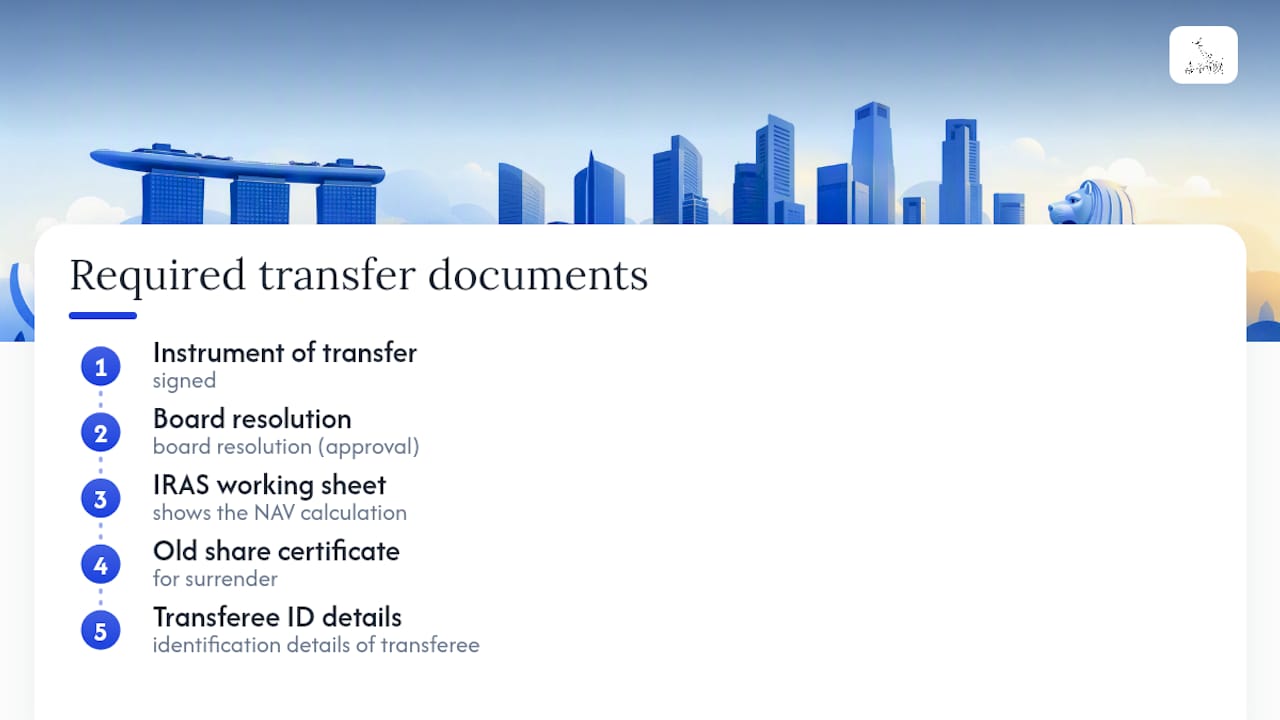
Gathering the right paperwork before you start prevents the single biggest cause of delay: IRAS queries on incomplete figures. Prepare the following before executing anything:
Instrument of transfer — the proper instrument under section 126, naming transferor, transferee, share class, number of shares, and consideration paid.
Board resolution — passed by the directors approving the transfer, ideally recording the date and confirming that any pre‑emption or constitutional checks were completed first.
IRAS working sheet — built from the company’s latest audited or management accounts, used to calculate net asset value (NAV) per share.
Old share certificate — surrendered by the transferor for cancellation once the transfer is registered.
Transferee identification details — NRIC or passport number, full legal name and residential address, required for the EROM entry.
Evidence of consideration — a sale and purchase agreement or equivalent record showing the price paid, since IRAS compares this against NAV.
A shareholders’ agreement, if one exists, often adds a further layer: pre‑emption rights or transfer restriction clauses that must be satisfied before the board can even consider the transfer.
How do you complete the share transfer process step by step?
The mechanics are straightforward once you understand who does what and in what order. Most delays come from sequencing errors, not legal complexity.
Negotiate and document the sale. The seller and buyer agree price and terms, usually in a sale and purchase agreement, which also supports the IRAS working sheet later.
Prepare and sign the instrument of transfer. Both parties execute the instrument; the company secretary typically drafts this to match the register’s existing details exactly.
Pass the board resolution. Directors approve the transfer, check the constitution for pre‑emption rights, and confirm no other shareholder holds a right of first refusal.
E‑stamp with IRAS. Submit the instrument and working sheet for stamping, either before or shortly after board approval, but always before lodging with ACRA.
Surrender the old share certificate. The transferor hands this to the company secretary for cancellation.
Lodge on BizFile+. The company secretary files the transfer notification with ACRA within 14 days of the transfer date.
Confirm EROM update. Once ACRA processes the filing, the register reflects the new shareholder and the transfer becomes legally effective.
Company secretaries usually run steps 2, 5, and 6; directors own step 3; the transacting parties handle steps 1 and 4 jointly. Where multiple share classes or several transfers between the same parties are involved, ACRA requires each transfer to be entered separately on BizFile+, which lengthens the filing stage but rarely the approval stage.
Realistic timing runs one to two weeks from signing to EROM update, with most bottlenecks arising from unclear accounts feeding the NAV calculation or a delayed board meeting. Practitioners consistently flag the working sheet as the step most likely to stall a transfer.
Pro Tip: Start the NAV calculation the same week you draft the instrument, not after signing. IRAS queries on the working sheet are the most common reason transfers sit unregistered for weeks longer than they should.
How is stamp duty calculated on a share transfer?
Stamp duty is charged on the instrument itself, not on the transaction as a whole, and IRAS applies a rate of 0.2% on the higher of the purchase price or the net asset value of the shares transferred. That “higher of” test matters: a nominal or discounted sale price does not reduce duty if the company’s NAV per share is greater.
Duty component | Basis |
Rate | 0.2% |
Valuation test | Higher of sale price or NAV |
Local execution deadline | 14 days from signing |
Overseas execution deadline | 30 days from signing |
Building the working sheet means pulling the company’s latest balance sheet, dividing net assets by total issued shares, and multiplying by the number of shares transferred. Companies with multiple share classes, preference shares carrying different entitlements, or recent capital changes should query IRAS directly before submitting, since a standard NAV calculation can misstate value across classes.
E‑stamping runs through IRAS’s e‑stamping portal using form E4A. Missing the deadline triggers penalties that scale with how late the stamping occurs, so treat the 14 or 30‑day window as a hard limit, not a guideline.
How do you file a share transfer with ACRA?
BizFile+'s “Update shares information” eService is where the transfer becomes real in the eyes of the law. The company secretary enters transferor and transferee details, the share class and number transferred, and the transfer date, and files this within 14 days of the transfer taking place.
Each transfer between the same two parties needs its own separate entry, even if they happen on the same day
ACRA cannot accept a backdated transfer date; the effective date is fixed by when the EROM is actually updated
Processing is generally quick once the filing is accepted, though ACRA may query mismatched share numbers against the company’s existing register
Additional filings are needed where the transfer accompanies a capital change, a new class of shares, or the issue of fresh share certificates
Until ACRA confirms the update, the buyer holds no legal title, regardless of what the signed instrument says. This is the single fact every director and shareholder needs to internalise before treating a transfer as “done”.
What common mistakes delay a share transfer?
Most disputes over Singapore share transfers trace back to one of a small handful of avoidable errors, and nearly all of them are procedural rather than substantive.
Treating a signed instrument as sufficient, when legal title only vests on EROM update
Feeding stale or incomplete accounts into the NAV working sheet, triggering IRAS queries
Forgetting to surrender the old share certificate, which stalls the company secretary’s records
Missing a pre‑emption right in the constitution, which can void the board’s approval retrospectively
Filing late on BizFile+ and losing track of the 14‑day window
Before submission, check the constitution for transfer restrictions, verify the instrument matches the register exactly, confirm the board resolution is dated and signed, and confirm e‑stamping is complete before lodging.
Pro Tip: If a shareholders’ agreement exists, read its pre‑emption clause before drafting anything. A transfer that ignores a right of first refusal can be challenged even after the EROM update.
When should you bring in professional support for a share transfer?
Complex NAV calculations, cross‑border parties needing overseas execution, multi‑class share structures, or any hint of dispute between shareholders are the situations where professional help earns its cost quickly.
Headington has supported cross‑border corporate transactions for over 25 years, with in‑house experts covering 90 countries, drafting instruments, calculating NAV, liaising with IRAS, and lodging BizFile+ filings so directors avoid registration errors.
Have your accounts, existing register, and constitution ready before engaging an adviser.
What happens to shares when a shareholder dies or loses capacity?
Death or incapacity does not transfer shares automatically. Instead, the shares fall into the deceased’s estate and are dealt with through probate or letters of administration before any transfer can proceed. The executor or administrator, once granted legal authority by the court, steps into the deceased’s position and can instruct the transfer on the estate’s behalf.

The process still runs through the same statutory machinery: a proper instrument of transfer must be prepared, the board must approve it, and IRAS stamping and BizFile+ lodgement still apply in the ordinary way. What changes is who signs. Instead of the original shareholder, the grant of probate or administration authorises the executor to execute the instrument, and the company secretary should retain a certified copy of that grant on the company’s file.
Incapacity works similarly but through a different legal route. Where a shareholder loses mental capacity, a court-appointed deputy or a donee under a Lasting Power of Attorney can act in their place, provided the authority covers dealing with shares. Directors should verify the scope of that authority carefully before registering any transfer, since acting on an invalid or overly narrow appointment risks the same defective registration problems as any other procedural shortcut.
Private companies with shareholders’ agreements often include specific succession clauses covering exactly this scenario, sometimes granting other shareholders a right to purchase the deceased’s shares at a formula price. Checking for such a clause before assuming the executor has free rein to sell to an outside party is a step worth taking early, not after the estate has already found a buyer.
What does the evidence actually tell you about share transfers?
The paperwork around a Singapore share transfer is not the hard part. Most directors can draft an instrument, hold a board meeting, and fill in a working sheet without difficulty. The hard part is timing, and specifically the gap between “signed” and “registered” that too many business owners treat as a formality rather than a legal cliff edge.
Conventional advice tends to focus heavily on the instrument itself: get the wording right, get the signatures right, move on. That misses where transfers actually go wrong. The failures Headington sees repeatedly involve NAV disputes, missed pre‑emption clauses buried in old shareholders’ agreements, and directors who assume a signed document settles the matter before ACRA has touched the register.
If you take one thing from this guide, prioritise the NAV calculation and the constitution check before you draft anything. Both take longer than expected and both can unravel a transfer that looked complete on paper.
Headington Management: a direct route to a clean transfer
Handling a transfer yourself works fine for a simple, single‑class transaction between cooperative parties. It gets harder fast once cross‑border execution, multiple share classes, or a disputed valuation enters the picture, and that is where most self‑managed transfers stall.
Headington’s corporate secretarial and legal advisory team drafts the instrument, runs the NAV calculation against your company’s accounts, liaises directly with IRAS on stamping, and lodges the BizFile+ filing so the EROM update happens without a procedural misstep. With over 25 years of cross‑border experience across 90 countries, Headington is built specifically for the transfers that involve an overseas party, a tight deadline, or a valuation dispute, rather than treating every transfer as a standard template. If your transfer involves any of those complications, get in touch with Headington Management to scope the filing and timeline before you sign anything.
Sources
FAQ
Can I transfer shares to another person in Singapore?
Yes, provided you follow a proper instrument of transfer, secure board approval, e‑stamp it with IRAS, and lodge the filing on BizFile+ within 14 days so ACRA can update the register.
What are the rules for transfer of shares?
Section 126 of the Companies Act requires a proper instrument before registration, and the transfer only takes legal effect once ACRA updates the electronic register of members; directors can refuse registration under section 128 where the constitution allows it.
What documents do you need for a share transfer?
You need a signed instrument of transfer, a board resolution, an IRAS working sheet showing the NAV calculation, the old share certificate for surrender, and the transferee’s identification details.
Can I transfer my shares to another person?
Yes, but the transfer is incomplete in law until it clears IRAS stamping and ACRA’s BizFile+ filing, so signing alone does not pass legal title, however genuine the agreement between the parties.
Do I need professional help for a share transfer?
Straightforward, single‑class transfers between cooperative parties are often manageable in‑house, but complex NAVs, overseas execution, or multiple share classes are exactly where firms like Headington Management add value through drafting, IRAS liaison, and BizFile+ lodgement.
Comments