Share Purchase Agreement Singapore: Template & Clause Guide

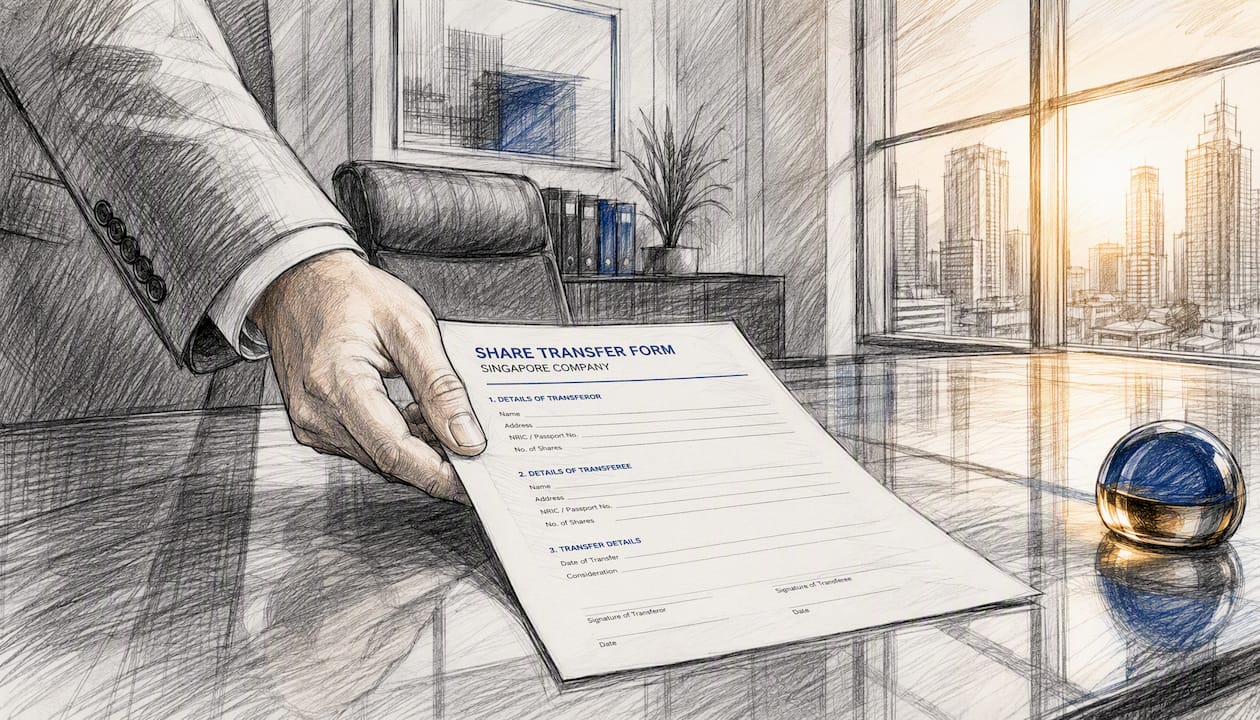
A Singapore-law SPA skeleton gives you a legally grounded starting point for any private share transaction. Download the Headington-reviewed template below, then follow three steps before you use it: read every schedule carefully to confirm the share details match your cap table, check your company’s constitution and any existing shareholder agreements for pre-emption rights or transfer restrictions, and instruct a Singapore-qualified lawyer for any clause that involves earn-outs, regulated entities, or cross-border tax.
Before you sign anything: A template SPA is a baseline, not a finished contract. The disclosure letter, conditions precedent, and indemnity caps are where deals succeed or unravel — and those sections require transaction-specific drafting every time.
Read all schedules (share lists, disclosure letter, completion accounts) before circulating the draft.
Confirm your company’s constitution and any shareholders’ agreement for transfer restrictions or pre-emption rights.
Instruct counsel for bespoke issues: earn-outs, MAS-regulated targets, cross-border structures, or any deal above S$5 million, as deals of this size typically require qualified legal advice before the SPA is signed.
Table of Contents
What is a share purchase agreement in Singapore?
A share purchase agreement (SPA) is the primary contract governing the sale and transfer of shares in a Singapore-incorporated company. It records the commercial terms, allocates risk between buyer and seller, and sets out the mechanics for completing the transaction. Unlike an asset sale, which transfers individual assets and liabilities by item, an SPA transfers ownership of the company itself — the buyer acquires the shares and, with them, the company’s entire history, including undisclosed liabilities.
Under Singapore practice, the SPA is a commercial record, not the legal instrument of transfer. A separate share transfer form must be executed, stamped under the Stamp Duties Act, and lodged with the company for registration. The Companies Act then requires the company to register the transfer, typically within 30 days. ACRA’s BizFile+ system reflects the updated shareholding once the register of members is amended.
Private M&A. The most common use case: a founder or investor sells all or part of their stake in a private limited company to a strategic or financial buyer.
Minority purchase. A new investor acquires a minority stake, often alongside a shareholders’ agreement that governs governance rights, drag-along, and tag-along provisions.
Management buyout. The management team acquires the business from existing shareholders, frequently with leveraged financing and more complex earn-out structures.
Secondary sale. An existing investor sells their stake to another investor without the company itself being a party to the transaction.
For listed companies on SGX, share transfers happen through CDP or custodian accounts and follow exchange settlement rules rather than a private SPA. The MoneySense guide to shares explains how SGX trades settle through CDP on the second business day after trade, a fundamentally different process from the negotiated completion mechanics in a private deal.
What does a Singapore SPA template contain?
A well-drafted Singapore SPA template covers every stage of the transaction, from the commercial agreement to post-closing obligations. The GenieAI share sale agreement template and comparable Singapore-law precedents consistently include the following principal clauses and schedules.
Principal clauses
Representations and warranties — factual statements by the seller about the company’s condition.
Governing law and dispute resolution — Singapore law, and typically SIAC arbitration or Singapore courts.
Schedules and attachments
Schedule 1: Details of the shares (share class, number, par value, seller’s title).
Schedule 2: Seller’s warranties (the full warranty list, cross-referenced to the disclosure letter).
Schedule 3: Completion obligations (documents to be delivered by each party).
Schedule 4: Completion accounts or locked-box accounts.
**Schedule 5: Disclosure letter (cross-references to specific warranty disclosures).
Schedule 6: Share transfer form (executed instrument for stamping and registration).
Schedule 7: Form of board resolutions approving the transfer.
Sample clause callouts
The purchase price clause in a typical Singapore SPA reads along these lines:
For tranche consideration structures — common in deals with earn-outs or phased payments — public SEC-filed sale and purchase agreements show how cash and share consideration can be split across closing tranches with separate completion mechanics for each.
Which SPA clauses do parties negotiate most?
The commercial terms get agreed quickly. The real negotiation time goes into five areas: purchase price mechanics, conditions precedent, representations and warranties, indemnities, and the disclosure letter.
Purchase price mechanisms
Three structures dominate Singapore private M&A:
Completion accounts fix the price by reference to the company’s actual financial position at closing. The buyer gets a true picture of net assets or working capital on the day, but the parties must agree on accounting policies and a dispute resolution mechanism for any adjustment. This is the most common structure for deals where the target’s working capital fluctuates.
Locked-box sets the price at a historical balance sheet date and prohibits the seller from extracting value (through dividends, management fees, or related-party transactions) between that date and closing. Sellers prefer it because the price is certain; buyers accept it when they trust the historical accounts and can negotiate tight leakage provisions.
Earn-outs tie part of the price to post-closing performance. They suit acquisitions where the seller is staying on to run the business, but they generate disputes if the earn-out metrics are not precisely defined. In Singapore deals, earn-out periods of 12–24 months are typical, and the SPA must specify exactly which accounting standards apply and who controls decisions that affect the metric.
Representations and warranties
Representations and warranties (R&Ws) are the seller’s factual statements about the company. They cover title to shares, corporate existence, financial statements, tax compliance, material contracts, litigation, employees, IP, and environmental matters. Duane Morris and Selvam’s analysis of R&Ws in Singapore SPAs notes that sellers typically provide these warranties and often indemnities based on due diligence findings, while buyers push for broad coverage and longer survival periods.
Survival periods in Singapore practice typically run 18–24 months for general warranties, with fundamental warranties (title, capacity, authority) surviving for the limitation period under the Limitation Act (six years for contract claims). Tax warranties often survive until the relevant tax assessment period closes.
Caps and baskets. Sellers negotiate an aggregate liability cap (commonly 100% of the purchase price for general warranties, with a higher or uncapped limit for fraud and fundamental warranties). Buyers accept a de minimis threshold (individual claims below a floor are ignored) and a basket or deductible (aggregate claims must exceed a threshold before the seller pays).
Materiality qualifiers. Sellers insert “material adverse effect” or “material” qualifiers to narrow warranty scope. Buyers push back on these because they create uncertainty about what triggers a breach.
Indemnities and the disclosure letter
A specific indemnity covers a known, defined risk — a pending tax assessment, a disclosed litigation, or an environmental liability. It pays out dollar-for-dollar on the defined trigger, without the buyer needing to prove breach of warranty. General indemnities cover broader categories of loss.
The disclosure letter is where the real risk allocation happens. Sellers use it to carve out known liabilities from the warranty regime: anything properly disclosed in the letter cannot form the basis of a warranty claim. Parties routinely spend more time negotiating the disclosure letter than the warranty schedule itself, because it effectively shifts identified risks back to the buyer. A seller who discloses a pending regulatory investigation in the disclosure letter is protected from a warranty claim on that point — the buyer’s remedy is to renegotiate the price or walk away, not to sue post-closing.
The disclosure letter is not a formality. It is the document where sellers protect themselves from warranty claims on known issues. Buyers who treat it as boilerplate and fail to cross-reference each disclosure against the relevant warranty are accepting risks they may not have priced.
Pro Tip: In Singapore practice, experienced advisers often run a “disclosure letter audit” before signing: map every item in the disclosure letter to the specific warranty it qualifies, confirm the disclosure is specific enough to be effective, and flag any disclosure that is so broad it amounts to a general disclaimer. A vague disclosure (“the company is subject to various regulatory requirements”) rarely qualifies a specific warranty effectively.
How does completion work on a Singapore share transfer?
Completion is the day the deal closes: shares transfer, money moves, and the buyer takes control. Getting it right requires a coordinated checklist because several things must happen simultaneously.
What does a Singapore SPA transaction typically cost and how long does it take?
Typical transaction timeline
Phase | Typical Duration | Key Activities |
Due diligence | 2–6 weeks | Financial, legal, tax, and commercial review of the target |
SPA negotiation | 2–4 weeks | Term sheet, first draft SPA, negotiation rounds |
Conditions precedent | 1–8 weeks | Regulatory approvals, pre-emption waivers, third-party consents |
Signing to completion | 1–4 weeks | CP satisfaction, completion mechanics, funds transfer |
Post-closing | 4–8 weeks | Stamping, ACRA filings, completion accounts, transitional assistance |
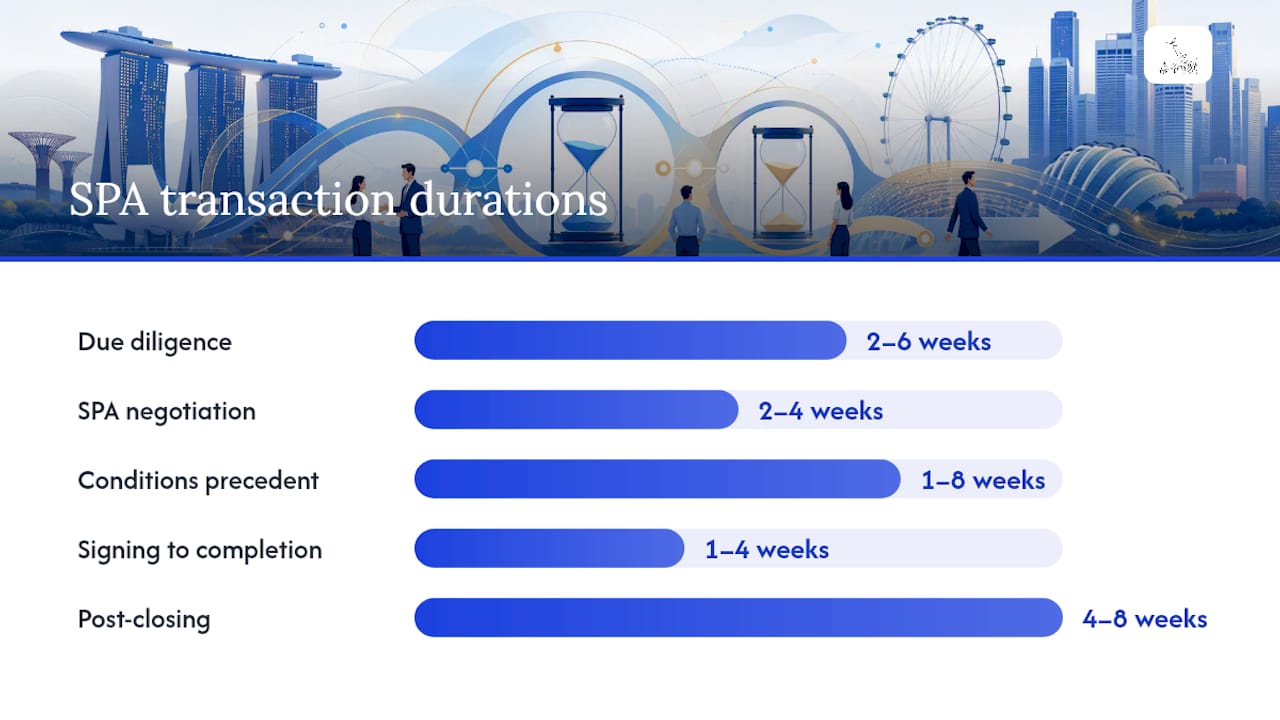
A straightforward private sale with no regulatory approvals and a clean due diligence can close in six to eight weeks from first draft to completion. Add a MAS approval or a CCCS filing and the timeline extends materially — regulatory processes in Singapore are thorough and do not compress on request.
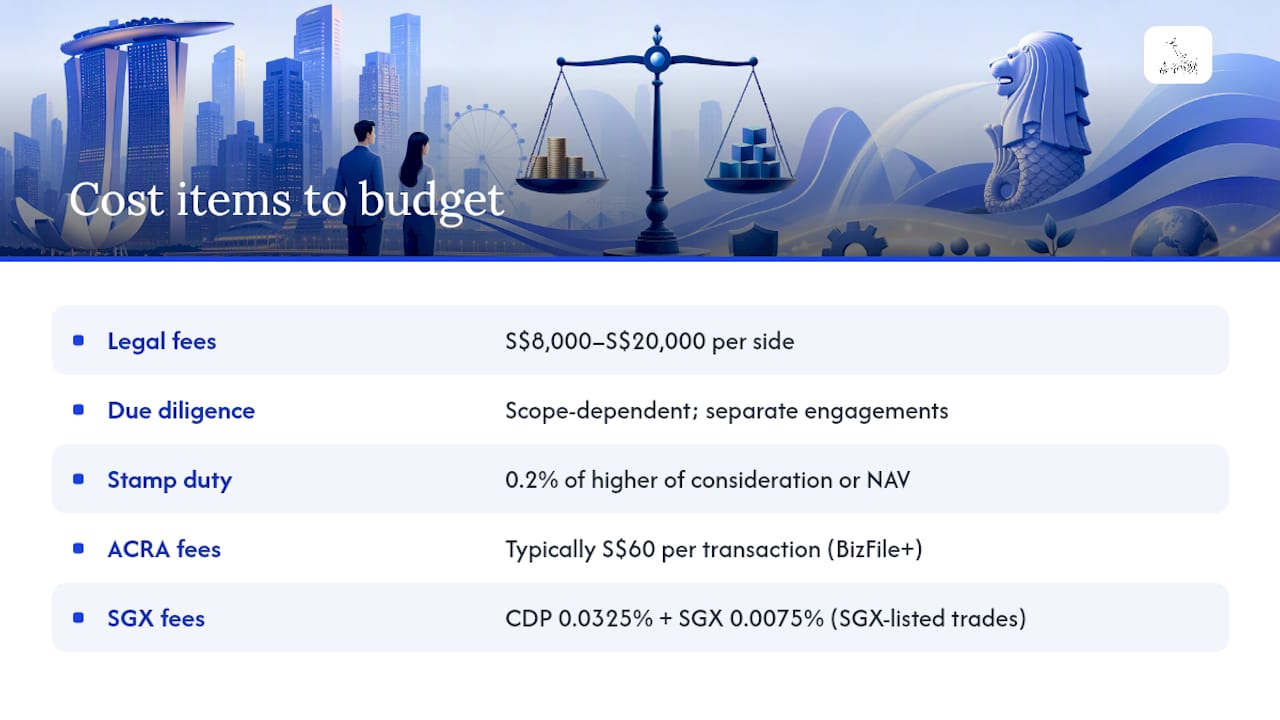
Cost items to budget
Legal fees vary by deal complexity. A simple share sale with standard warranties might cost S$8,000–S$20,000 in legal fees for each side. Complex deals with earn-outs, cross-border elements, or regulated targets can run significantly higher. Always request a written fee estimate and ask whether the firm offers capped or staged billing — many Singapore firms will agree to a fixed fee for the SPA drafting phase and time-and-materials for negotiation.
Due diligence costs depend on scope. Financial due diligence by an accounting firm, legal due diligence by counsel, and commercial due diligence by a consultant are each separate engagements. For smaller deals, buyers often combine financial and legal due diligence with one adviser.
Stamp duty on the share transfer form is assessed at 0.2% of the higher of the consideration or the net asset value of the shares, payable to IRAS. This is typically borne by the buyer unless the SPA provides otherwise.
ACRA filing fees for updating the register of members and director changes are modest (typically S$60 per transaction on BizFile+) but must be budgeted and tracked.
Note on market trading fees: For context, SGX-listed share trades carry a CDP clearing fee of 0.0325% and an SGX trading fee of 0.0075% of trade value. Private SPA transactions carry no exchange fees, but stamp duty, legal fees, and due diligence costs are substantially larger in absolute terms.
Escrow and agent fees apply when part of the consideration is held in escrow pending CP satisfaction or completion accounts. Escrow agents typically charge a flat fee or a percentage of the escrow amount.
Pro Tip: Request a written fee estimate from your legal adviser before engagement, and ask specifically whether the estimate covers the disclosure letter negotiation — that is often where the most billable hours accumulate and where cost overruns occur.
What are the Singapore legal checkpoints for a share transfer?
Several statutory requirements can stop or delay completion if they are not addressed early. Missing any of them creates legal risk for both parties.
Stamp Duties Act
The share transfer form is a stampable instrument. Under the Stamp Duties Act, instruments executed in Singapore must be stamped within 14 days of execution. The rate is 0.2% of the higher of the consideration or the net asset value of the shares. Unstamped instruments are inadmissible as evidence in Singapore courts and attract penalties for late stamping.
Regulatory approvals
MAS approval — is required for acquisitions of shareholdings in MAS-regulated entities (banks, insurers, capital markets licensees) above prescribed thresholds. The SPA should include a CP for MAS approval and a longstop date that accounts for MAS’s review timeline.
CCCS merger control — applies where the transaction meets the Competition Act’s thresholds. Singapore does not have mandatory pre-merger notification, but parties to transactions that may substantially lessen competition should consider a voluntary notification to CCCS.
Pro Tip: Check sector-specific approvals in the first week of due diligence, not after the SPA is signed. A change-of-control clause in a government licence or a key contract can add months to the timeline and, in some cases, make the transaction structurally impossible without a restructure.
How should buyers and sellers negotiate a Singapore SPA?
Negotiation is risk allocation. Every clause is a question of who bears what loss if something goes wrong after closing.
Buyer priorities
Buyers want broad warranties that cover every material aspect of the business, with long survival periods and high (or uncapped) liability limits for fundamental representations. They push for specific indemnities on known risks identified in due diligence, escrow or holdback arrangements to secure post-closing claims, and carve-outs from the liability cap for fraud, wilful concealment, and fundamental warranties.
A buyer’s strongest negotiating lever is the due diligence report. If due diligence reveals issues, the buyer can demand specific indemnities, price reductions, or additional CPs rather than accepting a warranty that may be difficult to enforce post-closing.
Seller priorities
Sellers want narrow warranties with materiality thresholds, short survival periods (12–18 months for general warranties), aggregate liability caps at or below the purchase price, and a basket or deductible that filters out small claims. The disclosure letter is the seller’s primary defensive tool: a well-drafted, specific disclosure against each warranty limits the seller’s post-closing exposure to matters the buyer already knew about.
Sellers also push for a “knowledge qualifier” on warranties — limiting liability to matters within the seller’s actual knowledge rather than constructive knowledge. Buyers resist this because it rewards sellers who deliberately avoid finding out about problems.
Red flags during negotiation
Watch for these signals during SPA talks: An incomplete or vague disclosure letter is the most common red flag — it usually means the seller has not done the work to identify known liabilities, or is deliberately keeping disclosures broad to preserve flexibility. Evasive answers on tax compliance history, undisclosed litigation, or unusual escrow timeline requests (very short or very long) all warrant deeper due diligence before proceeding.
An unusually short longstop date on conditions precedent is another warning sign. It can indicate the seller is under financial pressure and may not be able to satisfy all CPs in the agreed timeframe. Buyers who accept a short longstop without confirming CP satisfaction timelines risk losing their deposit or being forced to complete on unfavorable terms.
Sample clauses and a pre-signing checklist
Copy-ready sample clauses
These short excerpts illustrate standard drafting. Replace all bracketed placeholders with transaction-specific details before use.
Purchase price adjustment clause
Editing note: Replace “Threshold” with a negotiated figure. Agree the accounting policies for Completion Accounts in Schedule 4 before signing — disputes over accounting treatment are the most common source of post-closing litigation.
Key representation (title warranty)
Editing note: Confirm the seller’s title against the register of members before signing. If shares are held on trust or subject to a pledge, additional representations and releases are required.
Limited indemnity clause
Editing note: Specific indemnities should be tied to a defined, identified risk. A general indemnity without a cap is rarely agreed in Singapore practice.
Escrow wording
Editing note: Agree the escrow period and release mechanics with the escrow agent before signing. Confirm the escrow agent’s fee structure.
Completion mechanics wording
Editing note: Specify the completion location and time. Confirm bank details for the telegraphic transfer in writing at least two business days before completion.
Pre-signing checklist
Confirm all parties have authority to sign (board resolutions, POAs if signing by attorney).
Verify the share details in Schedule 1 against the current register of members.
Confirm the company’s constitution permits the transfer and that pre-emption rights have been waived or satisfied.
Check all conditions precedent are either satisfied or have a clear satisfaction plan with a realistic longstop date.
Review the disclosure letter line by line and cross-reference each disclosure to the specific warranty it qualifies.
Confirm stamp duty funds are available and the share transfer form is ready for execution.
Verify ACRA filing obligations and assign responsibility to the corporate secretary.
Confirm escrow arrangements are in place if applicable.
When should you instruct a Singapore lawyer or corporate adviser?
A template SPA is a starting point. These are the situations where you need qualified counsel before you proceed:
Complex warranties or indemnities: — If the due diligence has identified material issues (litigation, tax exposures, regulatory non-compliance), the indemnity and disclosure letter drafting requires a lawyer who understands Singapore’s limitation and liability framework.
Headington supports transactions at every stage: SPA drafting and review, disclosure letter strategy, completion mechanics, corporate secretarial filings with ACRA, and post-closing compliance. The practical engagement process is straightforward: share the term sheet or heads of terms, the target company’s ACRA profile, and any existing shareholders’ agreement, and Headington’s team can assess the transaction structure and advise on the appropriate level of support.
Key Takeaways
A Singapore SPA is a commercial record and a risk-allocation instrument — the disclosure letter, indemnity caps, and completion mechanics determine who bears what loss if something goes wrong after closing.
Point | Details |
Use the template as a baseline | The SPA skeleton is a Singapore-law starting point; every transaction needs clause-level customization before signing. |
Disclosure letter is critical | Sellers use it to carve out known liabilities; buyers must cross-reference every disclosure against the specific warranty it qualifies. |
Stamp within 14 days | The share transfer form must be stamped with IRAS within 14 days of execution in Singapore; late stamping attracts penalties. |
Instruct counsel early | Regulated targets, earn-outs, cross-border tax, or deals above S$5 million require qualified legal advice before the SPA is signed. |
Headington for end-to-end support | Headington provides SPA drafting, disclosure letter review, completion support, and ACRA secretarial filings for Singapore share transactions, including those with a value above S$5 million, where legal oversight is especially important. |
The part of the SPA that most people underestimate
Most buyers spend their energy on the warranty schedule. They negotiate hard on the list of representations, push for broad coverage, and feel satisfied when the seller agrees to 30 warranties covering everything from financial statements to environmental compliance. Then they skim the disclosure letter.
That is the wrong priority. The warranty schedule tells you what the seller is promising. The disclosure letter tells you what the seller is not promising. A seller who agrees to a comprehensive warranty schedule and then discloses every known issue in the disclosure letter has effectively given the buyer very little protection. The buyer knew about the problems before signing and accepted them by proceeding.
The practical implication is that due diligence and disclosure letter review should happen in parallel, not sequentially. When the due diligence team identifies a risk, the legal team should immediately check whether that risk is disclosed in the disclosure letter and whether the disclosure is specific enough to be effective. A vague disclosure (“the company is subject to various tax inquiries”) is unlikely to qualify a specific warranty about tax compliance. A specific disclosure (“IRAS has issued a query dated [date] regarding the company’s GST treatment of [specific transaction], details of which are in the Data Room at reference [●]”) is effective.
The other underestimated clause is the longstop date on conditions precedent. Parties agree a longstop date, assume the CPs will be satisfied in time, and then discover that a regulatory approval or a third-party consent is taking longer than expected. A well-drafted SPA gives each party the right to terminate if the longstop date passes without CP satisfaction, with clear provisions on what happens to any deposit. Without that clarity, a missed longstop date becomes a dispute.
Headington handles the SPA process so you can focus on the deal
Drafting a Singapore-compliant SPA, managing the disclosure letter negotiation, and coordinating completion filings with ACRA are time-intensive tasks that pull founders and in-house counsel away from the commercial decisions that actually move the deal forward.
Headington’s corporate and legal advisory team covers the full SPA process: drafting and reviewing the agreement, advising on disclosure letter strategy, preparing completion documents, and handling all ACRA secretarial filings post-closing. With 25+ years of experience across 90 countries and in-house experts based in Singapore, Headington gives you a single point of contact for the legal, secretarial, and compliance work that a share transaction requires.
The engagement starts with a brief call to review your term sheet and the target company’s structure. From there, Headington’s team scopes the work, provides a written fee estimate, and moves directly into drafting. To get started, contact Headington and share your deal summary — the team typically responds within one business day.
Useful sources
The following official and high-authority sources support the legal and procedural claims in this article. Consult them directly for the most current rules and thresholds.
This article provides general information about Singapore share purchase agreements and is not legal advice. Rules, thresholds, and regulatory requirements change. Confirm current requirements with ACRA, IRAS, MAS, or a qualified Singapore lawyer before proceeding with any transaction.
Comments