Reverse charge GST Singapore: a compliance guide for finance teams


If you’re a GST-registered business in Singapore that buys services or low-value goods from an overseas supplier, and you can’t claim full input tax, you must self-account for GST as if you were the supplier. That’s reverse charge GST Singapore in a single sentence, and it’s been part of the regime since 1 January 2020 for imported services, extended to imported low-value goods since 1 January 2023.
The immediate action is straightforward: treat the purchase as an output supply, recognise output tax, then claim input tax if you’re entitled to it. Give your GST registration number to overseas vendors early, so you’re not double-charged foreign GST on top of your own reverse charge liability.
Three triggers decide whether a transaction is caught:
You’re GST-registered and not entitled to full input tax credit.
The purchase is an imported service or a low-value good.
The purchase is made in the course or furtherance of your business.
Miss any one of these three, and reverse charge doesn’t apply. Meet all three, and you have a reporting obligation on your next GST return.
Key Takeaways
Reverse charge GST in Singapore requires GST-registered businesses without full input tax entitlement to self-account for output tax on imported services and low-value goods.
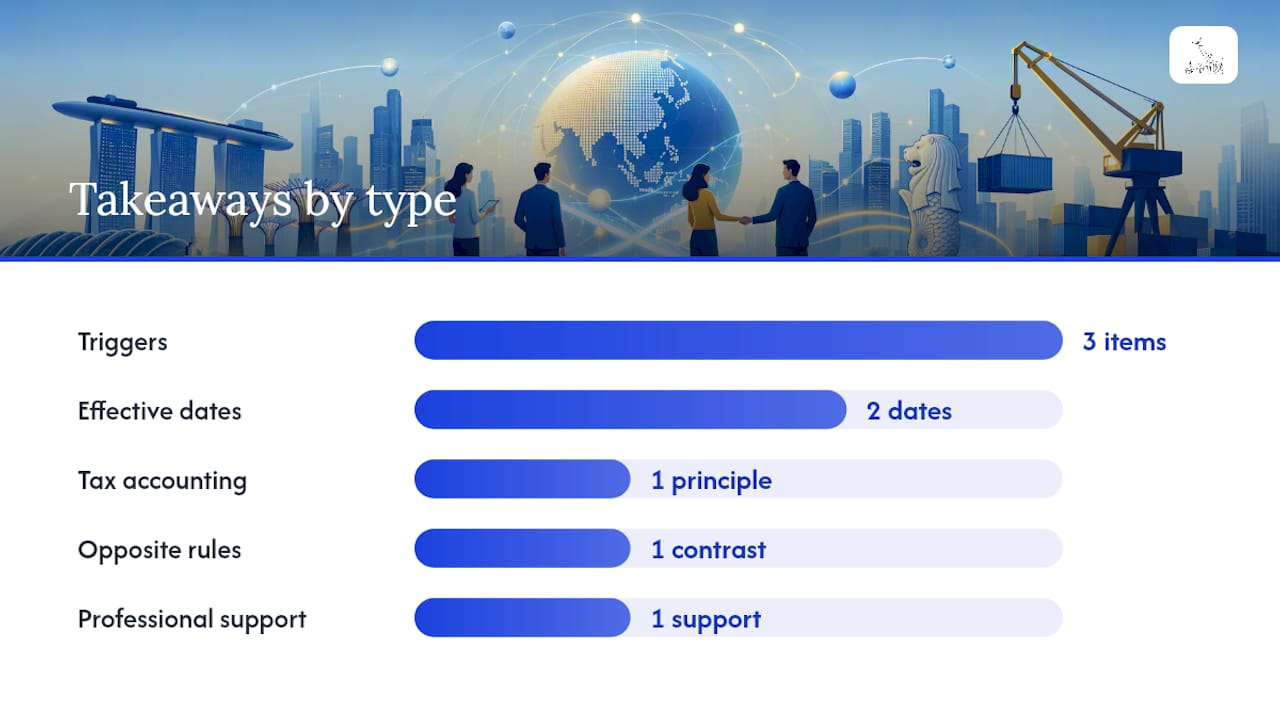
Point | Details |
Three triggers decide liability | GST registration, an imported service or low-value good, and incomplete input tax entitlement together determine exposure. |
Effective dates matter | Imported services have been caught since 1 January 2020, low-value goods since 1 January 2023. |
Output and input tax move together | Recognise output tax as if you were the supplier, then claim input tax where you’re entitled, in the same GST return. |
OVR and reverse charge are opposites | OVR taxes B2C supplies at the overseas vendor; reverse charge taxes B2B supplies at the recipient. |
Get professional support | Headington helps finance teams build vendor onboarding checks and journal templates so reverse charge reporting stays consistent. |
Table of Contents
Why Singapore applies reverse charge GST
GST is a tax on consumption within Singapore, not on where the supplier happens to sit. That gap gave offshore suppliers an unintended pricing edge over local ones.
IRAS/gst-and-digital-economy/local-businesses) closed it by requiring the GST-registered recipient, rather than the overseas supplier, to account for the tax. The scope, at a glance:
Imported (distantly taxable) services — reverse charge since 1 January 2020.
Imported low-value goods — reverse charge since 1 January 2023.
Legal basis — the Goods and Services Tax Act and its subsidiary regulations, with IRAS issuing the administrative guidance that finance teams actually work from day to day.
Reading IRAS’s e-Tax guides alongside the Act itself is the fastest way to reconcile “what the law says” with “what IRAS expects on the return.”
Who must account for reverse charge GST in Singapore?
Liability hinges on a specific combination of facts about your business, not just the nature of the purchase. Run through these conditions for any overseas invoice before deciding how to book it:
You are GST-registered (compulsorily or voluntarily).
You are not entitled to full input tax credit — typically because you make exempt supplies, receive non-business income, or are partially exempt.
The supply is an imported service or a low-value good, not a locally sourced one.
The purchase is made in the course or furtherance of your business, not for personal use.
Registration becomes compulsory once taxable turnover crosses S$1 million in a 12-month period, but voluntary registration is common among businesses that import services regularly. Registering voluntarily brings reverse charge exposure with it, so factor that into the decision rather than treating registration and reverse charge as separate questions. If your annual imports of services are modest, it’s still worth tracking them against the registration threshold each year, because growth in overseas procurement can tip a previously unregistered entity into compulsory territory.
What supplies count as reverse charge GST?
Two categories are caught: imported (distantly taxable) services, and imported low-value goods. Distantly taxable services are anything a supplier delivers to you without needing a local physical presence at the time of supply, which covers most digital and remote services. Low-value goods are physical items imported by air or post with a value at or below S$400 that would otherwise not attract import GST at the border.
Typical examples finance teams encounter:
Remote software subscriptions and SaaS billed by an overseas vendor.
Consultancy, legal, or design work delivered from outside Singapore.
Low-value parcels bought directly from an overseas online retailer.
Purchases routed through electronic marketplaces or redeliverers, where the marketplace operator may itself be liable for GST instead of you.
The 1 January 2020 and 1 January 2023 effective dates matter for transition periods. A handful of exclusions apply, most notably goods already covered by existing import relief schemes, so check the specific treatment for low-value goods before assuming a given parcel is caught.
How do you account for reverse charge GST?
The mechanic is simple once it clicks: you wear two hats on the same transaction. You act as the “supplier” and recognise output tax, and you act as the “recipient” and claim input tax where you’re entitled to it, both in the same accounting period.
Identify the GST-exclusive value of the imported service or low-value good.
Calculate output tax at the prevailing GST rate on that value.
Post the output tax entry in your GST return.
Simultaneously claim input tax on the same amount, but only to the extent you’d normally be entitled to recover input tax on that type of expense.
A worked example: your business buys overseas consultancy services worth S$10,000. Output tax at 9% is S$900. If you’re fully taxable, you claim the same S$900 as input tax, so the net cash impact is zero, though both figures still need to appear on your return. If you’re 60% taxable (partially exempt), you can only recover S$540 of that input tax, leaving S$360 as a real cost.
Typical journal entries include:
Imported services on supplier invoice: debit expense, debit input tax (recoverable portion), credit output tax payable, credit accounts payable.
Prepaid overseas services: recognise the reverse charge at the earlier of invoice or payment, not when the service is consumed.
Low-value goods via marketplace: check first whether the marketplace, not you, is the party required to account for GST.
Pro Tip: Tag every overseas vendor in your accounting system at setup, noting whether they’re GST-registered locally, whether they’ve charged foreign GST already, and your own recovery percentage for that expense category. It turns a manual monthly review into a five-minute reconciliation.
When is a reverse charge supply treated as made?
Time of supply for reverse charge purposes is generally whichever comes first: the date the invoice is issued, or the date consideration is paid. This determines which GST accounting period the transaction falls into, which matters most around quarter-end when an invoice dated in one period is paid in the next.
Valuation follows the GST-exclusive value of the supply, converted to Singapore dollars at the exchange rate applicable on the time of supply where the original invoice is in a foreign currency. A few practical wrinkles:
Prepayments trigger the tax point on payment, even before the service is delivered.
Revised invoices from an overseas supplier (a credit note, a corrected amount) should trigger a corresponding adjustment to your output and input tax entries in the period the revision is recognised.
Reimbursement arrangements, where a related overseas entity recharges costs, need careful review to confirm whether the recharge itself constitutes a separate imported service.
The Goods and Services Tax (General) Regulations set out the statutory detail behind these timing rules, including transitional treatment for supplies that straddled the 2020 and 2023 implementation dates.
How do you report and document reverse charge transactions?
Reverse charge output tax and input tax both appear on your regular GST F5 return, in the same boxes used for local output and input tax. There’s no separate return for reverse charge, which is precisely why weak internal tracking causes so many quiet errors.
Keep the following on file, ready for an IRAS review:
Original overseas supplier invoices, in the invoicing currency and converted amount.
Proof of payment dates, to substantiate your time-of-supply calculation.
Correspondence confirming the nature of the service (useful for disputes over whether something is “imported service” or excluded).
Marketplace or redeliverer statements, where a platform was involved.
Internal memos supporting your input tax recovery percentage, particularly if you’re partially exempt.
IRAS generally expects supporting records to be retrievable for the standard statutory retention period, so build that into your document management policy rather than relying on individual staff to archive invoices.
How does reverse charge interact with Overseas Vendor Registration?
Overseas Vendor Registration (OVR) and reverse charge solve the same underlying problem from opposite directions, and mixing them up is one of the most common errors finance teams make.
OVR: the overseas vendor (or the electronic marketplace it sells through) registers for GST in Singapore and charges GST directly on B2C supplies to non-GST-registered consumers.
Reverse charge: the B2B recipient, if GST-registered and not fully entitled to input tax, self-accounts for GST because the overseas vendor generally isn’t required to charge it.
Where an electronic marketplace operator or redeliverer is involved, they may be treated as the supplier for GST purposes, shifting the obligation away from you entirely. Before assuming reverse charge applies, check the invoice: if it already shows Singapore GST charged by a registered overseas vendor, you shouldn’t also self-account, or you’ll pay the tax twice.
Worked examples and a practical checklist
Example 1: imported consultancy service. Your Singapore company engages an overseas consultant for S$20,000, fully taxable business. Output tax: S$1,800 (9%). Input tax claimed in full: S$1,800. Net cash impact: nil, but both entries are still declared on the return.

Example 2: low-value goods via marketplace, partially exempt business. You buy S$300 of goods online for a business that recovers 70% of input tax. Output tax: S$27. Input tax recoverable: S$18.90. Net cost to the business: S$8.10, small individually, but material once repeated across hundreds of similar purchases a year.
A checklist worth pinning to your month-end process:
Flag all overseas supplier invoices during AP processing.
Confirm GST registration number was provided to the vendor at onboarding.
Calculate output tax and apply your current input tax recovery rate.
Post both entries in the same GST return period as the time of supply.
File supporting documents against the transaction reference.
Escalate to an external tax adviser or raise a query with IRAS directly when a transaction sits in a genuine grey area, such as a bundled contract mixing local and overseas components.
What are the penalties for getting reverse charge GST wrong?
Omitted reverse charge reporting carries the same enforcement risk as any other GST understatement: penalties and interest on the tax that should have been declared, calculated from the original due date. Partial exemption status turns reverse charge from an administrative exercise into a genuine cash cost, which is exactly where most disputes with IRAS originate.
Practical habits reduce the risk considerably:
Reconcile imported spend against your reverse charge log every month, not just at year-end.
Retain vendor evidence proving the nature and value of each imported supply.
Document your input tax recovery methodology in an internal memo, updated whenever your exempt supply ratio changes.
If you discover a past omission, voluntary disclosure to IRAS before an audit typically results in more favourable treatment than waiting to be caught.
How Headington approaches reverse charge compliance for clients
Most reverse charge issues we see stem from the same root cause: nobody flagged the overseas invoice as different from a local one until the GST return was already being prepared. Our approach starts earlier than that, at vendor onboarding, where we capture supplier GST status and recovery treatment before the first invoice even arrives, then apply consistent journal templates and a periodic review cycle so nothing slips through at quarter-end.
If your finance team wants a compliance health check or help setting up that process from scratch, get in touch and we’ll walk through your current exposure.
Get reverse charge GST right without adding headcount
Reverse charge compliance rarely fails because of complicated transactions. It fails because there’s no consistent process linking vendor onboarding, invoice tagging, and GST return preparation, and that gap tends to widen as a business scales its overseas spend.
Headington has spent many years supporting businesses expanding in and out of Singapore, and reverse charge GST sits squarely inside that cross-border remit, alongside entity setup, payroll, and broader compliance advisory. Rather than leaving your team to interpret IRAS guidance and the GST Act in isolation, Headington builds the vendor onboarding checks, journal templates, and periodic reviews into your existing accounting workflow, so reverse charge becomes routine rather than a quarterly scramble. If your import volumes have grown, or you’ve never had your reverse charge treatment reviewed, contact Headington to arrange a compliance review or a fixed-fee implementation project tailored to your GST profile.
Sources
This article is general information, not a substitute for advice from a qualified financial advisor. Consult a qualified financial professional about your own circumstances before acting on anything here.
FAQ
What is reverse charge in GST, with an example?
Reverse charge shifts the responsibility for accounting GST from the supplier to the recipient. If a Singapore business buys S$10,000 of consultancy from an overseas firm, it declares S$900 output tax itself, then claims input tax if entitled, rather than the overseas firm charging GST.
What is a GST reverse charge?
It’s a mechanism where a GST-registered recipient, rather than the seller, accounts for GST on specific imported services and low-value goods, treating the purchase as if it had made the supply itself.
Who is liable to pay GST under reverse charge?
The GST-registered recipient is liable, but only when it isn’t entitled to full input tax credit, the purchase is an imported service or low-value good, and the purchase is for business purposes.
How is reverse charge different from Overseas Vendor Registration?
Reverse charge applies to B2B imports where the recipient self-accounts for GST, while OVR requires the overseas vendor or marketplace to charge GST directly on B2C sales to consumers.
Does reverse charge apply if I can claim full input tax?
You still declare the output tax, but if you’re fully entitled to recover input tax, the net cash cost is nil, though the reporting obligation on your GST return remains.
Comments