ONE Pass Singapore: eligibility and how senior talent applies


The ONE Pass (Overseas Networks & Expertise Pass) is a personalised five-year work pass that lets top-tier global talent work for multiple employers, run a business, and sit on boards in Singapore without switching passes each time. You qualify one of two ways: earning a fixed salary of at least S$30,000 a month for 12 consecutive months (the salary route), or demonstrating outstanding achievement in your field even without that income (the achievement route). The Ministry of Manpower (MOM) assesses every application, submitted through the myMOM portal, with issuance handled via the Employment Pass Services Centre (EPSC) and entry cleared by the Immigration & Checkpoints Authority (ICA).
If your monthly pay has sat below S$30,000, don’t assume you’re out of the running.
Salary route: S$30,000/month fixed pay for 12 straight months, or a credible offer at that level
Achievement route: demonstrable international recognition, without a fixed income test
Core benefit: one personal pass covers multiple roles, employers, and directorships for five years
Start by pulling together 12 months of payslips or your strongest achievement evidence (awards, patents, senior academic posts). If your case sits in the grey zone between the two routes, that’s precisely where specialist advice earns its fee.
Key Takeaways
The ONE Pass rewards applicants who match one of two clear tests, a fixed S$30,000 monthly salary from an established employer or documented international achievement, and who prepare evidence accordingly.
Point | Details |
Two qualifying routes | Salary route needs S$30,000/month fixed pay for 12 months; achievement route needs documented international recognition. |
Established company test | Employer must show market cap ≥ US$500m or revenue ≥ US$200m, a common cause of rejection. |
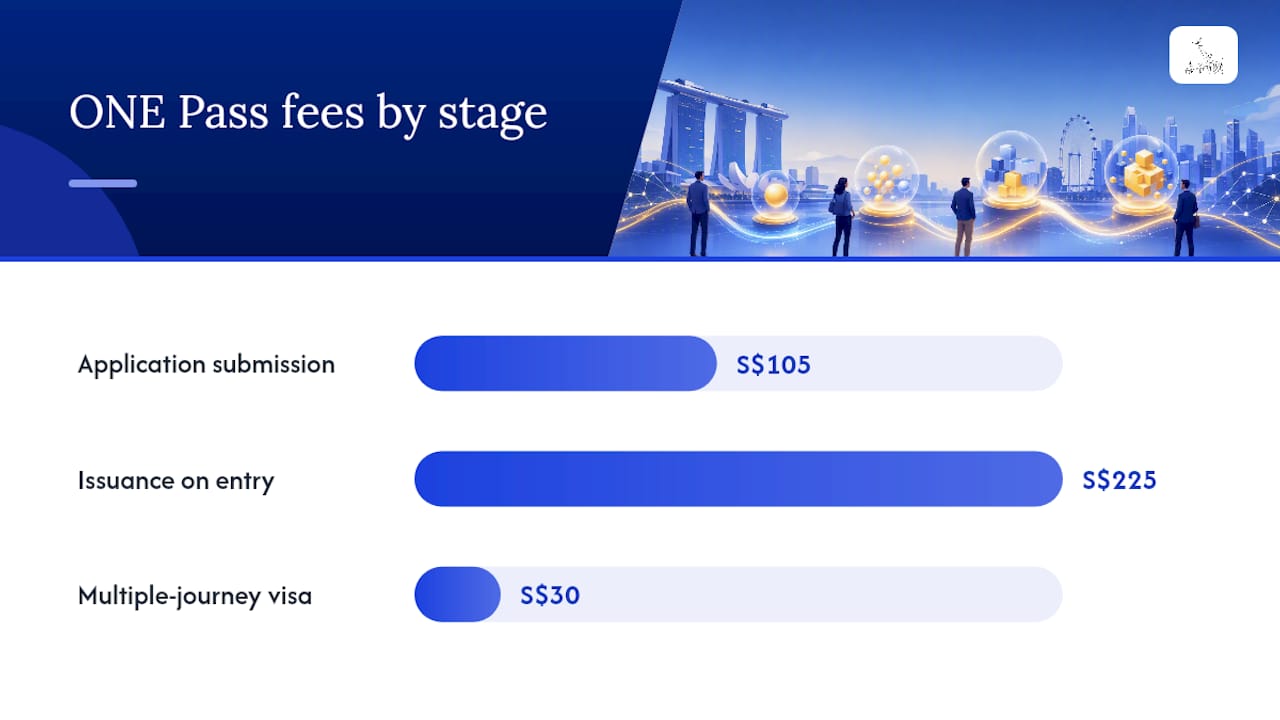
Total government fee | S$330 covers application (S$105) and issuance (S$225) for the main applicant. |
Not a PR shortcut | ONE Pass enables a PR application, but ICA assesses every case individually with no guaranteed timeline. |
Specialist support | Headington Management assembles document and achievement dossiers and advises on incorporation and PR strategy alongside applications. |
This article is general information, not a substitute for advice from a qualified lawyer. Consult a qualified legal professional about your own circumstances before acting on anything here.
Table of Contents
Who qualifies for the ONE Pass through salary or achievement?
Can you switch employers or take on multiple roles under ONE Pass?
What are the tax and CPF implications of holding a ONE Pass?
What evidence has worked for the outstanding-achievement route?
How Headington Management supports your ONE Pass application
What are the key facts about the Singapore ONE Pass?
The ONE Pass runs for an initial five years, renewable if you continue contributing meaningfully to Singapore’s economy. Holders can work multiple jobs simultaneously, start and operate their own company, and accept board seats, all under one pass rather than juggling separate approvals for each role.
Validity: 5 years from issuance, renewable
Rights: concurrent employers, self-employment, board appointments
Family: dependants can accompany you on linked passes
Fees: S$105 at application, S$225 at issuance — S$330 total for the main applicant
Processing: roughly 4 weeks for standard salary-route cases
The S$30,000 monthly salary threshold is the headline figure that separates ONE Pass from Singapore’s Employment Pass, whose minimum qualifying salary sits far lower. That gap is deliberate: MOM designed ONE Pass for a narrow band of senior executives and specialists, not general skilled migration.
Point | Details |
Validity period | Five years from issuance, with renewal tied to continued economic contribution |
Total government fee | S$330 (S$105 application plus S$225 issuance) for the main applicant |
Standard processing time | Around 4 weeks for salary-route cases; achievement-route cases often take longer |
Who qualifies for the ONE Pass through salary or achievement?
MOM checks the salary route mechanically: 12 consecutive months of a fixed monthly salary at or above S$30,000, ending immediately before your application. Bonuses, commissions, and other variable pay generally don’t count towards the threshold, so a total package of S$40,000 with a large annual bonus baked in can fail if the fixed component alone sits at S$28,000.
If you don’t yet have 12 months at that level, a credible prospective Singapore employer offering S$30,000 or more can substitute, provided the offer looks genuine and well-documented (signed contract, defined start date, clear job scope).
The trickier hurdle is the “established company” test. MOM requires your employer, current or prospective, to have a market capitalisation of at least US$500 million or annual revenue of at least US$200 million. A founder drawing S$35,000 a month from their own three-person startup will not clear this bar, no matter how strong the payslips look. This is, by most practitioner accounts, where salary-route applications most often stumble, because applicants assume income alone settles the question.
For candidates whose employer can’t meet that size test, the outstanding-achievement route is the alternative worth exploring. MOM looks for evidence of genuine international standing:
Major international awards or honours in your field
Peer-reviewed publications or citations showing academic impact
Senior positions at globally recognised institutions
Patents with commercial or scientific significance
National-level cultural, sporting, or entrepreneurial recognition
This route rewards applicants who can document impact across multiple independent sources rather than a single credential. A Nobel-adjacent research prize carries more weight paired with citation counts and institutional letters than standing alone.
Pro Tip: Don’t submit achievement evidence as a loose bundle of certificates. Build a one-page narrative that ties each document to a specific claim of impact, then attach the supporting evidence behind it. MOM officers are assessing stature quickly; a curated dossier reads faster and lands better than a folder of unexplained attachments.
What documents does a ONE Pass application need?
Salary-route applicants should gather 12 months of payslips, any available tax statements, a signed employment contract, and evidence the employer meets the established-company test (annual report excerpts, stock exchange listing details, or audited revenue figures).
Achievement-route applicants need the opposite emphasis: award certificates, citation records, institutional letters confirming your role and standing, media coverage, patent filings, and conference invitations that corroborate your profile.
Every applicant, regardless of route, also needs a valid passport, recent photographs, education certificates, an up-to-date CV, and professional references who can vouch for your standing.
Payslips (12 months) and tax records, where available
Signed employment contract or credible offer letter
Employer financial evidence (annual report, revenue disclosure)
Achievement evidence: awards, patents, publications, institutional letters
Passport, photographs, CV, education certificates
The most common delay isn’t a missing document. It’s a document that doesn’t answer the exact question MOM is asking, such as a payslip showing gross pay without breaking out the fixed component.
Pro Tip: Have any non-English documents professionally translated and, where relevant, notarised before submission. MOM’s officers won’t chase you for a translation; they’ll simply request more information, and that single round-trip can add weeks to your timeline.
How do you apply for a ONE Pass and how long does it take?
Applications run through the myMOM portal, MOM’s digital eServices platform. Employers or appointed employment agents typically handle submission on behalf of the applicant, though self-employed and business-owner applicants can submit directly.
Submit your application via myMOM eServices, paying the S$105 application fee
MOM reviews your salary or achievement evidence, often requesting clarification if documentation is incomplete
Approved applicants receive an In-Principle Approval (IPA), valid for a limited entry window
Enter Singapore within the IPA validity period
Complete biometrics and issuance formalities, arranged through the EPSC or relevant eService, paying the S$225 issuance fee
Receive your physical pass card and register for digital pass access
Stage | Fee | Typical timing |
Application submission | S$105 | Day 1 |
MOM assessment | Included above | Up to 4 weeks (standard); longer for achievement-route cases |
Issuance on entry | S$225 | Within IPA validity window |
Optional multiple journey visa | S$30 | At issuance, if applicable |
You can apply from overseas before relocating; the IPA is designed precisely for that purpose, giving you a defined window to wind up affairs abroad before entering Singapore to complete issuance.
Pro Tip: Compile your entire submission before you start the myMOM application rather than uploading documents piecemeal. Applications that arrive complete on day one move through cross-agency checks noticeably faster than those answered in instalments, because each round of information requests resets part of the review queue.
What can family members do on a ONE Pass?
Your spouse and unmarried children under 21 can typically accompany you on a Dependant’s Pass, with older or step-children sometimes eligible for a Long-Term Visit Pass (LTVP) instead. Both are designed to move with your five-year ONE Pass timeline rather than requiring separate renewal cycles.
Spouses on a Dependant’s Pass can generally apply for a Letter of Consent to work in Singapore without needing their own separate work pass, a meaningful advantage over many other visa categories where a spouse’s employment rights are far more restricted.
Spouse: Dependant’s Pass, with Letter of Consent enabling work
Children: Dependant’s Pass or LTVP, depending on age and relationship
School enrolment and healthcare registration should be arranged early, ideally alongside your own issuance appointment
Government messaging around ONE Pass consistently frames it as a family-friendly relocation instrument, not a solo-executive pass, which is worth factoring into your planning if a full household move is on the table.
Does the ONE Pass lead to renewal and PR eligibility?
Renewal isn’t automatic. MOM expects continued, demonstrable contribution, whether that’s sustained salary at or near the original threshold, active business operations, or a Singapore company employing local staff. Treat the five-year term as a runway to build that track record, not a guaranteed extension.
Maintain salary or business activity that mirrors your original qualifying basis
Document local economic contribution, particularly local hiring if you run a company
Apply for renewal well before expiry to avoid a gap in status
On Permanent Residence, be realistic: the ONE Pass is not a fast-track PR scheme. It makes you eligible to apply, but the Immigration & Checkpoints Authority (ICA) assesses every PR application case-by-case, weighing factors well beyond your pass type. Most advisers suggest building at least 18 to 24 months of demonstrable residence, contribution, and local ties before applying, though ICA gives no published guarantee at any duration.
What happens if your ONE Pass application is rejected?
Rejections usually trace to one of three causes: insufficient fixed-salary evidence, an employer that fails the established-company test, or achievement evidence that reads as competent rather than exceptional.
Review the rejection reason MOM provides and identify which evidentiary gap it points to
Where the issue is fixable (missing payslips, unclear employer financials), gather stronger documentation and consider a fresh application rather than a formal appeal
Where you believe MOM’s assessment was wrong on the facts, use MOM’s appeal channel with new or clarified evidence
After issuance, notify MOM promptly of any change in employment, personal details, or if you need to cancel the pass
How should you prepare a ONE Pass evidence dossier?
The strongest applications treat evidence gathering as a project with a timeline, not a last-minute scramble.
T minus 8 weeks: collect 12 months of payslips or your core achievement documents, and identify any gaps early
T minus 4 weeks: obtain certified copies, notarised employer letters, or audited financials where the established-company test applies
T minus 1 week: review the full submission for consistency between your CV, contract, and supporting evidence before uploading to myMOM
MOM’s officers respond better to certified copies and notarised letters than to scanned originals with no verification trail, particularly for employer financial evidence.
Pro Tip: If your fixed salary sits close to S$30,000 but your employer clearly won’t pass the established-company test, don’t wait another year hoping for a pay rise. Pivot early to building an achievement-route dossier instead, since that evidence takes months to assemble properly and rushing it under deadline pressure rarely produces a compelling submission.
Headington Management’s advisory team works with senior executives and founders navigating exactly this kind of borderline case, pairing document preparation with the corporate structuring decisions that often sit alongside a ONE Pass application.
How does ONE Pass renewal work in practice?
Renewal happens roughly every five years, and MOM does not treat it as a formality. The assessment mirrors your original qualifying basis: salary-route holders should expect MOM to check whether your fixed pay has held near or above the original S$30,000 threshold, while achievement-route holders need to show continued relevance and standing in their field rather than resting on the honours that got them in originally.
Business owners face a distinct test. If you used the ONE Pass to run your own company, MOM will look at whether that business now employs local Singaporeans, generates genuine revenue, and shows signs of durability rather than existing purely as a vehicle for your own pass. A company with zero local hires after five years sends a weaker signal than one that has grown a small Singaporean team.
Practically, that means renewal planning should start well before your fourth anniversary, not in the final months. If your salary has drifted below the threshold, or your business hasn’t built local employment, you have time to correct course. Waiting until the renewal window opens to discover a gap leaves little room to fix it.
There’s no published fixed formula for renewal decisions, and MOM assesses cases individually. The safest strategy is treating your entire five-year term as evidence-building for renewal, keeping the same standard of documentation you used at application: clear salary records, employer financials, or a dossier tracking your continued professional impact.
Can you switch employers or take on multiple roles under ONE Pass?
This is where ONE Pass genuinely outperforms almost every other Singapore work pass. Because it’s personalised to you rather than tied to a single employer, you can work for multiple companies at once, take on board appointments, and start your own business, all without applying for a fresh pass each time.

An Employment Pass holder who changes jobs typically needs an entirely new application, often with a fresh assessment against the point-based Complementarity Assessment Framework. ONE Pass holders skip that cycle entirely. Switch employers, add a second consulting role, or accept a non-executive directorship, and none of it requires MOM’s fresh approval in the way an EP change would.
That flexibility has practical limits worth understanding. You still need to notify MOM of significant changes to your employment or personal circumstances, and your renewal assessment will look at what you actually did with that flexibility. Holding five different part-time roles that collectively fail to demonstrate meaningful contribution to Singapore won’t strengthen a renewal case, even though none of those roles individually required fresh MOM sign-off.
For portfolio-career professionals, fund managers with multiple directorships, or founders running more than one venture, this single feature often justifies the ONE Pass over a standard Employment Pass even where the salary threshold is a stretch to prove.
What are the tax and CPF implications of holding a ONE Pass?
ONE Pass holders are taxed under Singapore’s ordinary personal income tax rules; the pass itself carries no special tax regime. Your tax residency status, and therefore your rate, depends on how many days you spend in Singapore each calendar year, not on your pass category. Anyone earning at the S$30,000 monthly level should expect to sit well into Singapore’s top personal tax bands once resident, and should consult IRAS directly for current rates and residency tests rather than relying on general guidance.
CPF (Central Provident Fund) contributions apply differently depending on your employment structure. As an employee drawing salary from a Singapore-registered employer, standard CPF contribution rules apply in the same way they would for any other work pass holder, though foreigners on work passes are generally not required to contribute to CPF in the way Singapore citizens and permanent residents are. If you’re running your own business under the ONE Pass, your CPF position depends on whether you’re structured as an employee of your own company or purely as a director, a distinction worth clarifying with a qualified adviser before you set up payroll.
Multiple concurrent roles, one of ONE Pass’s defining features, can complicate both tax and CPF treatment. Income from several sources needs to be reported and, in some cases, withheld correctly at each paying entity. This is precisely the kind of structuring question where getting professional advice before you start juggling roles saves considerably more than it costs.
What evidence has worked for the outstanding-achievement route?
MOM doesn’t publish a scoring rubric for the achievement route, but the categories it recognises are consistent: international awards, senior academic or research leadership, significant patents, and national-level recognition in culture, sport, or entrepreneurship.
A useful way to think about it: a senior scientist with a modest salary but multiple peer-reviewed patents and a named professorship at a globally ranked university presents a materially stronger achievement case than someone with a single regional award and no independent corroboration. MOM is looking for convergent evidence, several independent sources pointing to the same conclusion about your standing, rather than one impressive credential asked to carry the whole application.
Applicants sometimes assume creative or cultural achievement doesn’t fit neatly into a framework built around salary and corporate scale, but MOM’s own eligibility guidance explicitly includes major cultural and sporting honours alongside academic and business achievement. A internationally recognised film director or an Olympic-level athlete with genuine, documented standing sits just as validly in this route as a research scientist, provided the supporting evidence, award citations, media coverage, institutional confirmation, is assembled with the same rigour.
The applicants who succeed here tend to treat the achievement dossier as a legal brief rather than a CV: every claim backed by an independent, checkable source, arranged so an MOM officer with limited time can verify stature quickly.
Who should actually pursue the ONE Pass?
The clearest fit is senior executives, founders of scaling businesses, fund managers, and internationally recognised specialists whose careers genuinely span multiple roles or borders. If your ambitions are narrower, a single Singapore role at a stable employer, a standard Employment Pass will likely serve you better with less documentation burden. Pro Tip: treat the five-year term as the opening phase of a longer residency and tax strategy, not a one-off approval. Headington Management has advised on corporate immigration projects of this scale for clients establishing or restructuring their Singapore presence.
How Headington Management supports your ONE Pass application
Assembling a ONE Pass application that survives MOM’s scrutiny on the first pass takes more than a document checklist. It takes someone who’s seen exactly which employer financials satisfy the established-company test and which achievement dossiers actually read as convincing to an assessing officer.
That’s the gap Headington fills. Our team handles document assembly and employer verification for the salary route, builds achievement-route dossiers that present evidence the way MOM expects to see it, and advises on the company incorporation and PR strategy questions that typically sit alongside a ONE Pass decision. An initial consultation starts with an eligibility assessment against both routes, a realistic timeline for your specific case, and a clear breakdown of engagement fees before any work begins. If you’re weighing whether your salary history or achievement record clears the bar, book a consultation with Headington Management and get a straight answer before you submit anything to MOM.
Sources
FAQ
What is a ONE Pass in Singapore?
The ONE Pass is a five-year personalised work pass letting high-earning professionals or internationally recognised talent work for multiple employers, run a business, and hold board seats in Singapore under one approval.
What is the purpose of the ONE Pass?
It’s designed to attract senior executives, founders, and top-tier specialists whose careers span multiple roles or borders, giving Singapore a route to anchor global talent without tying them to a single employer.
What is the salary threshold for the Singapore ONE Pass?
Applicants qualifying via the salary route need a fixed monthly salary of at least S$30,000 for 12 consecutive months, or a credible Singapore job offer at that level, from an employer meeting MOM’s established-company test.
Can a ONE Pass holder apply for PR?
Yes, but the pass isn’t a fast-track. ICA assesses every Permanent Residence application case-by-case, and most advisers suggest building 18 to 24 months of demonstrable contribution before applying.
Can existing work pass holders apply for a ONE Pass?
Yes. Employment Pass holders and others already working in Singapore can apply for a ONE Pass if they meet either the salary or achievement route, and firms like Headington Management can assess whether that switch makes sense for your situation.
Comments