Are non-compete clauses enforceable in Singapore law?


Non-compete clauses in Singapore are only enforceable when they pass a two-stage test: the employer must prove a legitimate proprietary interest, and the restraint must be reasonable in scope, duration and geography. Most fail on overreach. If you have been served a restraint notice, check when the clause was signed, preserve every relevant document, avoid making admissions, and contact the Ministry of Manpower or TAFEP for guidance before you respond.
TL;DR:
Non-compete clauses in Singapore must pass a two-stage test: proving a legitimate proprietary interest and demonstrating reasonableness in scope, duration, and geographic reach.
Courts assess reasonableness based on the necessity of duration, the geographic area aligned with business operations, activity restrictions, and employee seniority and access to confidential information.
Broad non-compete clauses are increasingly likely to be struck down if narrower, specific restrictions like non-solicitation or confidentiality clauses already protect the employer’s interests.
Employees should preserve all relevant documents and avoid admissions within the first 48 hours of legal threats, while employers should draft precise and proportionate restraints backed by clear documentation.
Employers benefit from regular contract reviews and tailored restraint clauses that reflect actual business risks to avoid costly disputes and enforcement challenges.
Table of Contents
What is the two-stage test for a non compete clause in Singapore?
Singapore courts start from a presumption that runs against you if you are the employer: a restraint of trade clause is prima facie void. To rescue it, you need to clear two hurdles, both established by the Court of Appeal in Man Financial v Wong Bark Chuan David, which remains the anchor authority for every restrictive covenant dispute heard since.
Stage one asks whether you have a legitimate proprietary interest worth protecting. The courts recognise three categories:
Trade secrets or genuinely confidential technical or commercial information
Trade connections, meaning client or supplier relationships the employee built using your resources
A stable, trained workforce, though this ground demands real evidence of a niche industry or heavy training investment
Stage two asks whether the restraint is reasonable between the parties and consistent with the public interest in people being able to work. A clause can satisfy stage one and still fail stage two if it is drafted too broadly.
The Ministry of Manpower has confirmed that enforceability is entirely fact-dependent. There is no statutory cap on duration or geography. Judges decide case by case, weighing your role, seniority, and access to sensitive information against what the clause actually restricts you from doing.
How do courts judge duration, geography and seniority?
Once a legitimate interest is established, reasonableness becomes a question of degree. Courts examine four things in roughly this order of importance.
Duration. A restraint must run no longer than needed to neutralise the advantage gained from confidential information or client relationships. Courts assess duration based on necessity in each case without a fixed statutory limit.
Geographic reach. Courts expect the geographic scope to mirror where the business genuinely operates rather than an aspirational or overly broad area, with wide bans often challenged.
Activity and scope. A restriction tied to the employee’s actual role, such as “solicit named clients you served” fares far better than a blanket ban on working anywhere in the same industry.
Seniority and access. A regional sales director who owned the client relationship is far more likely to be restrained than a junior analyst with no client-facing role and no access to pricing strategy.
Employers also need to show their working, not just assert it. That means naming the specific confidential information at risk, producing client lists rather than gesturing at “the industry,” and documenting real investment in training rather than treating every hire as automatically restrainable.
Pro Tip: If your contract restrains you from working in an entire sector rather than from approaching specific clients or using specific information, that breadth alone is often enough to get the clause struck down or narrowed.

Is a non-solicitation clause different from a non-compete?
Yes, and the distinction decides most disputes. A non-solicitation clause stops you approaching named or identifiable clients for a period after you leave. A confidentiality clause stops you using or disclosing specific proprietary information. Neither stops you from working for a competitor outright, which is precisely why courts prefer them.
A non-compete clause is the blunter instrument: it bars you from taking any role in a defined industry or with a defined competitor, regardless of whether you would ever touch the employer’s clients or secrets. Two recent High Court decisions have hardened the courts’ scepticism towards that blunt approach.
Shopee and MoneySmart both saw broad non-compete clauses struck down, with the court reiterating what practitioners call the Stratech rule: where a narrower covenant, such as non-solicitation or confidentiality, would already protect the employer’s genuine interest, a wider non-compete is treated as unnecessary and therefore unenforceable.
The NUS law review’s analysis of this trend notes that employers increasingly need to particularise exactly what trade secret or client connection is at risk, rather than relying on generic assertions about competitive harm.
Where confidentiality and non-solicitation clauses already cover the ground, a non-compete stops doing legal work and starts doing reputational work, discouraging a departure the employer has no real right to prevent.
The practical lesson for anyone drafting or challenging a contract: narrower, more specific covenants survive; broad ones increasingly do not.
What should employees do when a non-compete clause is invoked?
If a former employer sends a warning letter or threatens legal action, how you respond in the first 48 hours matters more than almost anything that follows.
Preserve everything. Keep your signed contract, any variation letters, emails referencing the clause, and records of what you actually did in the role.
Check the clause’s history. Was the restraint in your original offer letter, or was it added later, perhaps during a promotion or restructuring, without fresh consideration? A restraint bolted on without something given in exchange is far weaker.
Avoid admissions. Do not confirm details of your new role, client contacts, or start date in writing until you have taken advice; anything you say can be used to establish breach.
Explore negotiated outcomes. Employers sometimes accept carve-outs for named clients, a shortened sit-out period, or a paid buy-out of the restraint rather than pursue litigation neither side wants.
Escalate appropriately. For general guidance on your rights, contact TAFEP or the Ministry of Manpower. For an actual legal threat or draft settlement, instruct an employment lawyer before you sign anything.
What remedies can employers actually get?
Employers who believe a departing employee is about to breach a restraint typically seek an interim injunction to stop the conduct before damage occurs. Courts grant these only where the breach is imminent and clear, and the employer carries the burden of proving both the legitimate interest and the reasonableness of the restraint at that early stage.
Where a clause is found too broad, judges will not rewrite it for you. The blue-pencil doctrine allows a court to delete a clearly severable word or phrase, leaving a coherent restriction behind, but it will not redraft an unreasonable clause into a reasonable one.
Many disputes settle after an initial warning letter, before litigation costs escalate
Injunctions are granted more readily where breach is obvious and imminent
Litigation timescales and legal costs push both sides toward negotiated outcomes in the majority of cases
The practical reality: a well-drafted, narrow clause deters breach and settles quickly if challenged; a broad one invites exactly the fight it was meant to avoid.
How should employers draft enforceable restraint clauses?
If you are the one drafting the contract, the safest commercial practice in Singapore has shifted noticeably towards precision over breadth.
Draft non-solicitation and confidentiality clauses first, and add a non-compete only where those two genuinely cannot protect the interest at stake
Name specific clients, technologies, or information categories where you can justify doing so, rather than describing an entire market or sector
Keep records of training investment, client introduction history, and any specialised access the employee had, since this is the evidence a court will ask for if you ever need to enforce the clause
Provide clear consideration for any restraint, particularly one added after the original contract or attached to a retrenchment settlement, since a restraint without something given in exchange is weak on its face
Review legacy contracts on a rolling basis, rather than waiting for a departure to discover the clause is outdated or unenforceable
Pro Tip: Build restraint review into your onboarding and offboarding paperwork rather than treating it as a one-off drafting exercise. Contracts signed five years ago rarely reflect the role the employee holds today, and that mismatch is exactly what courts pick apart.
Getting this right at drafting stage costs far less than fighting it out after someone has already left.
Why proportionate restraints protect employers better than broad ones
Overly broad non-compete clauses do more damage to employers than the departing employee. They make recruitment harder, because candidates increasingly ask to see restraint terms before signing, and they generate litigation risk that a narrower clause would have avoided entirely. A clause you can never actually enforce is worse than no clause at all, because it creates a false sense of protection.
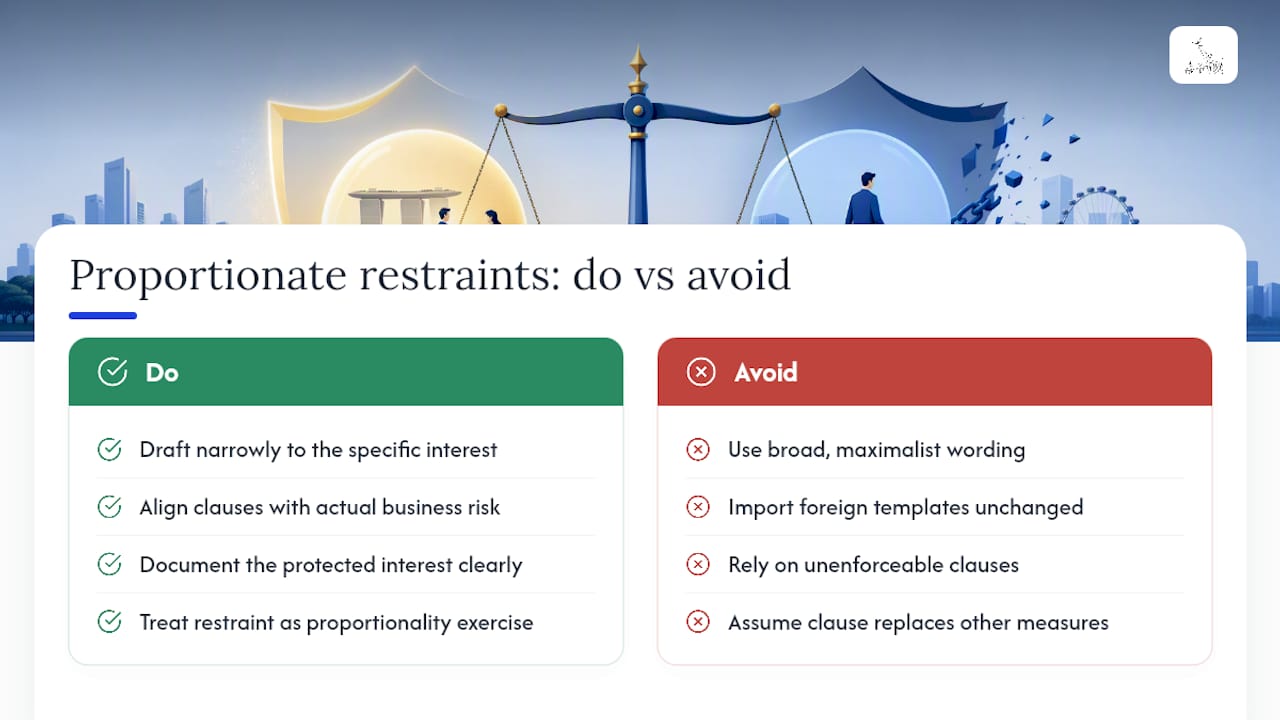
The businesses that get this right treat restraint clauses as a proportionality exercise, not a maximalist one. They ask what specific interest genuinely needs protecting, then draft to that, rather than reaching for the broadest wording available and hoping it survives challenge. Cross-border employers in particular tend to overreach, importing restraint templates from jurisdictions with different legal traditions and applying them unchanged to Singapore contracts.
Headington’s advisory work with expanding businesses consistently shows the same pattern: clients who align contractual protection with actual business risk, rather than generic industry practice, spend far less time in dispute and far more time focused on growth. Proportionate restraints, backed by clear documentation of the interest they protect, are not a compromise. They are simply the version of the clause that survives contact with a court.
— Colin
How Headington can help with contract review and drafting
Getting a restraint clause right the first time is considerably cheaper than defending or challenging one after someone has already resigned. Headington Management supports employers and employees across Singapore with employment contract review, bespoke restraint drafting tailored to specific roles and interests, and practical support when a dispute over enforceability arises.
A typical first engagement starts with a diagnostic review of your existing contracts or the clause you have been asked to sign, flagging where scope, duration, or consideration create exposure, then setting out the specific fixes needed to bring it in line with current Singapore case law. For businesses expanding into Singapore for the first time, this sits alongside Headington’s broader corporate secretarial, compliance, and employment advisory services, giving you one point of contact rather than a patchwork of separate providers. If a restraint clause is sitting unresolved in your contracts or in your inbox right now, visit Headington Management to arrange a review before it becomes a dispute.
Sources
This article is general information, not a substitute for advice from a qualified lawyer. Consult a qualified legal professional about your own circumstances before acting on anything here.
FAQ
Is a non-compete clause enforceable in Singapore?
Only if it passes the two-stage test: the employer must show a legitimate proprietary interest and prove the restraint is reasonable in duration, geography and scope. Broad clauses frequently fail this test.
How do you get around a non-compete clause?
Check whether the clause was properly supported by consideration, whether it protects a genuine interest rather than just competition generally, and whether narrower clauses like non-solicitation already cover the same ground; many broad non-competes are unenforceable for exactly these reasons.
Can my employer terminate me immediately for breaching a non-compete?
Termination terms depend on your employment contract, not the restraint clause itself; a suspected breach of a non-compete is usually pursued separately through negotiation or civil claim rather than instant dismissal.
What is considered a non-compete clause?
It is a contractual restriction that stops you working for a competitor or in a defined industry for a set period after you leave, distinct from narrower non-solicitation clauses (which restrict approaching specific clients) and confidentiality clauses (which restrict using specific information).
Comments