GST registration in Singapore: when and how to register


You must register for GST in Singapore if your taxable turnover exceeded S$1,000,000 in a calendar year (the retrospective test), or you reasonably expect it to exceed S$1,000,000 in the next 12 months (the prospective test). Both tests trigger compulsory registration/gst-registration-deregistration/do-i-need-to-register-for-gst). There are additional edge cases for overseas vendors selling low‑value goods or digital services into Singapore, who may fall under the Overseas Vendor Registration (OVR) regime even without a local presence.
If either test applies to you, do not wait. Here is what to do right now:
Run the numbers today. Use the IRAS GST registration calculator against your last 12 months of taxable turnover.
Pull your UEN and revenue records. You’ll need your ACRA business profile details and month‑by‑month revenue figures to complete the application accurately.
Check your Corppass access. You cannot submit anything on myTax Portal without the correct Corppass authorisation tied to your UEN.
The consequences of missing a registration deadline are not trivial. IRAS can backdate your effective registration date once it establishes you crossed the threshold, which means you owe GST on sales made before you ever charged it. On top of that shortfall, late notification carries penalties, and IRAS has a track record of following up on businesses that cross the threshold and stay silent. Get the classification right first, then move through the process methodically.
Key Takeaways
Compulsory GST registration in Singapore applies once taxable turnover exceeds S$1,000,000 retrospectively or is reasonably expected to exceed it within 12 months prospectively.
Point | Details |
Know your test | Compulsory registration triggers at S$1,000,000 taxable turnover, retrospectively or prospectively; run the IRAS calculator to check. |
Evidence beats estimates | Prospective registration claims need signed contracts or purchase orders, not revenue targets alone. |
Effective dates matter financially | A backdated registration means owing GST on past sales you never charged customers for. |
File on time, every time | GST F5 returns are due one month after the accounting period, including nil returns. |
Get specialist support early | Headington can prepare forecasts, complete your myTax Portal application, and set up Corppass, GIRO and InvoiceNow correctly. |
Table of Contents
Compulsory versus voluntary gst registration singapore: who actually qualifies
How to compute taxable turnover for the S$1,000,000 threshold
Step-by-step: how to register for gst in Singapore on myTax Portal
Should you register voluntarily? Weighing the costs and setting up your systems
Processing times, effective dates and what late registration actually costs you
Overseas vendor registration and rules for cross-border suppliers
How Headington can support your GST registration and ongoing compliance
Compulsory versus voluntary gst registration singapore: who actually qualifies
GST registration in Singapore splits into two distinct legal pathways, and confusing them is the single most common mistake business owners make when they first look into this. One path is mandatory. The other is a choice you make deliberately, with your eyes open to the trade‑offs.
The retrospective test looks backwards. If your taxable turnover for a calendar year exceeded S$1,000,000, you must apply for compulsory registration within 30 days of the end of that calendar year, meaning by 30 January of the following year. Your registration typically takes effect from the year following the calendar year when the threshold was exceeded, generally on 1 March.
The prospective test looks forwards. If you have reasonable grounds to expect your taxable turnover will exceed S$1,000,000 over the next 12 months, based on signed contracts, confirmed purchase orders, or other firm commercial evidence, you must register within 30 days of forming that expectation. Your effective date in this case is the date the forecast became reasonably certain, not some future point.
Taxable turnover for both tests means standard‑rated and zero‑rated supplies combined. Exempt supplies do not count towards either threshold.
Voluntary registration works differently. You can apply even if you fall well below S$1,000,000, provided you meet IRAS’s qualifying conditions for making or intending to make taxable supplies in Singapore. This route also applies to certain overseas suppliers and businesses that only make supplies subject to the reverse charge. Once approved, voluntary registrants must stay registered for a minimum of two years and take on the same filing and compliance obligations as compulsory registrants.
Pro Tip: Don’t treat voluntary registration as a box‑ticking exercise. Once you’re in, you’re in for two years minimum, even if your turnover drops. Model the commitment before you apply, not after.
Deciding whether voluntary registration suits you comes down to weighing a short list of factors:
In favour: you can recover input tax on business purchases, and GST‑registered customers often prefer dealing with GST‑registered suppliers, which can smooth B2B relationships.
Against: you take on quarterly filing obligations, recordkeeping duties, and the administrative cost of running GST‑compliant invoicing even in quiet months.
How to compute taxable turnover for the S$1,000,000 threshold
Getting this calculation wrong in either direction is expensive. Under‑count and you miss a compulsory registration deadline. Over‑count and you register when you didn’t need to, taking on obligations prematurely.
Taxable turnover includes all standard‑rated supplies (goods and services taxed at the prevailing GST rate) and zero‑rated supplies (mainly exports and international services). It excludes exempt supplies, such as most financial services and the sale or lease of residential property, and it excludes out‑of‑scope supplies, such as goods sold while still outside Singapore under certain arrangements.
What typically counts:
Local sales of goods and services billed to Singapore customers.
Exported goods and international services that qualify for zero‑rating.
Sales made through a Singapore branch, even if invoiced from an overseas head office.
What typically doesn’t count:
Interest income and other exempt financial services.
Sale of residential property.
Goods sold and delivered entirely outside Singapore without ever entering the country.
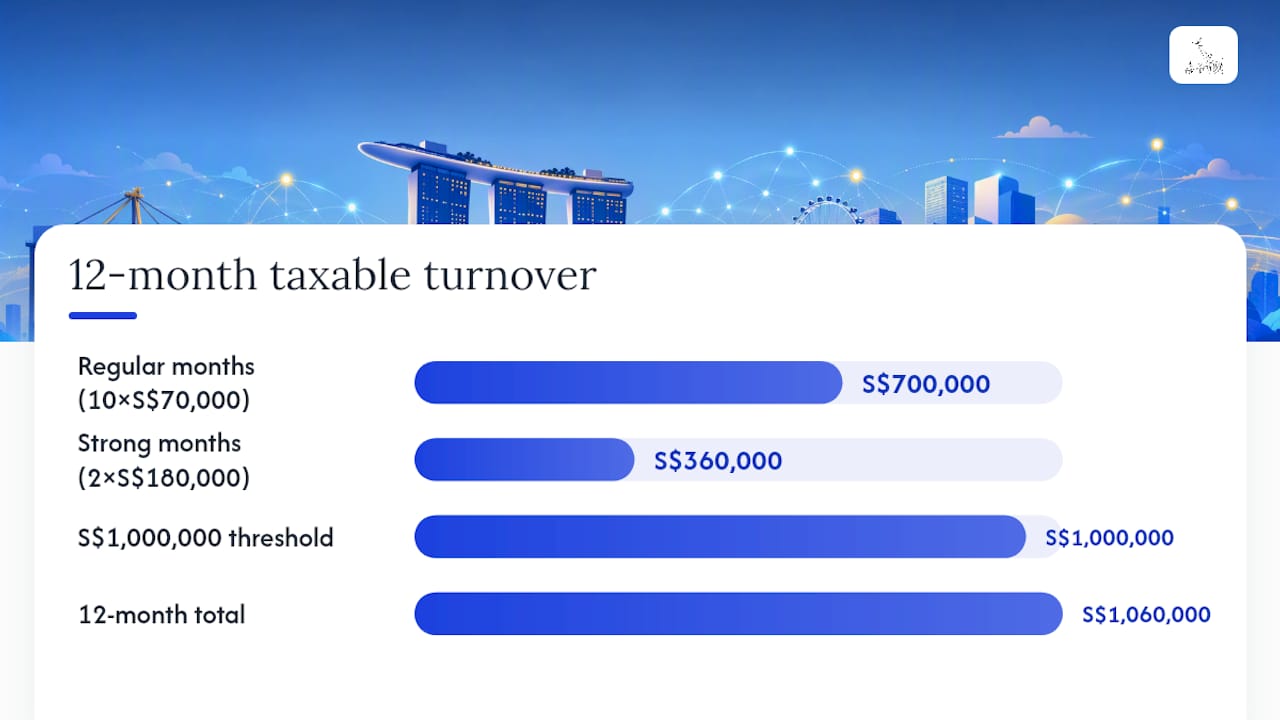
Here’s a worked example. Say your business recorded these monthly taxable sales over the past 12 months: an average of S$70,000 a month for ten months, plus two unusually strong months of S$180,000 each from a one‑off export contract. That’s (S$70,000 × 10) + (S$180,000 × 2) = S$700,000 + S$360,000 = S$1,060,000. You’ve crossed the retrospective threshold and must apply within 30 days of your financial year end.
Watch for these common pitfalls when running your own numbers:
Group structures. If you operate multiple related entities, each entity is generally assessed on its own taxable turnover, but structuring transactions between related parties to artificially split revenue can invite scrutiny.
Acquired businesses. If you bought an existing business as a going concern, its prior taxable turnover may need to be factored into your own calculation.
One‑off large contracts. A single big zero‑rated export deal can tip you over the threshold even if your regular monthly trading looks modest, so don’t assume steady‑state revenue tells the whole story.
Pro Tip: When forecasting for the prospective test, IRAS expects documentary proof, not optimism. Signed contracts, accepted purchase orders, and recurring invoice patterns carry weight; a sales target on a spreadsheet does not.
Step-by-step: how to register for gst in Singapore on myTax Portal
Once you’ve confirmed you meet a registration test, or decided voluntary registration makes sense, the mechanics run through myTax Portal, IRAS’s digital services hub.
Determine your registration type. Confirm whether you’re applying under the compulsory retrospective test, the compulsory prospective test, or voluntarily, since this affects the documents you’ll need and your effective date.
Secure Corppass authorisation. The person submitting the application needs the correct Corppass role linked to your UEN. Without it, you cannot access the GST digital services at all.
Complete the e‑Learning course if you’re applying voluntarily. IRAS requires most voluntary applicants to complete this course and retain the acknowledgement, which you’ll attach to your application.
Log in and open the GST F1 application, formally the “Register for GST” digital form, via myTax Portal.
Work through the form sections: a declaration, the main business profile section, details of your taxable supplies and imported services, a qualifying questionnaire, and the upload point for supporting documents.
Submit and monitor. IRAS reviews the application and may follow up for clarification. An incomplete submission, per IRAS’s own guidance, is treated as withdrawn rather than left pending.
Before you start, have these ready:
Your ACRA business profile and UEN.
Twelve months of revenue records, broken down by month.
Signed contracts or purchase orders if you’re applying on the prospective basis.
Bank details for GIRO or eGIRO setup.
Registration type | Typical trigger | Application window |
Compulsory (retrospective) | Taxable turnover exceeded S$1,000,000 in the calendar year | Within 30 days of year end |
Compulsory (prospective) | Reasonable expectation of exceeding S$1,000,000 in next 12 months | Within 30 days of forming that expectation |
Voluntary | Meets IRAS qualifying conditions; no threshold requirement | No fixed trigger, but 2‑year minimum commitment applies once approved |
Documents and evidence you need before you apply
Applications stall or get rejected most often because the supporting evidence doesn’t match what IRAS expects to see, not because the business itself is ineligible.
For a standard application, prepare:
ACRA Business Profile showing your UEN, registered address, and business activity.
Financial records covering the past 12 months, or supporting projections if you’re on the prospective test.
Signed contracts, accepted purchase orders, or recurring invoices that substantiate a forecast for prospective registration claims. IRAS is unlikely to accept a bare revenue target without this kind of paper trail.
Import and export documentation if any part of your taxable turnover relies on zero‑rated supplies.
Overseas entities and businesses dealing with imported goods face extra requirements. If you’re appointing someone to act on your behalf under the Section 33 provisions (covered in more detail below), you’ll need the formal appointment letter as part of your application pack.
A few practical notes worth knowing before you sit down to apply: myTax Portal drafts expire after 14 days if left unsubmitted, so don’t start the form until your documents are genuinely ready. Upload files in the formats IRAS specifies, usually PDF, and keep file sizes manageable. An application missing even one required document is treated as withdrawn rather than paused, which means starting the whole process again from scratch.
Pro Tip: Scan and organise your supporting documents into folders by category (business profile, contracts, financials) before you open the online form. Rushing to find a document mid‑application is the most common reason drafts time out.
Should you register voluntarily? Weighing the costs and setting up your systems
Voluntary registration is a genuine strategic decision, not a formality, and it deserves the same rigour you’d apply to any two‑year commitment.
IRAS itself recommends weighing the benefits against the costs over at least a two‑year horizon before applying, because that’s the minimum period you’ll typically be locked into once approved. Build a simple framework:
Likely recoverable input tax. If you buy a lot of GST‑bearing goods or services (office space, equipment, professional fees), registration lets you claim that GST back.
Your customer profile. If most of your clients are GST‑registered businesses, they’ll usually be indifferent to or even prefer paying GST, since they can claim it back themselves. If most of your customers are individual consumers, adding GST to your prices could affect competitiveness.
Administrative cost. Quarterly filing, recordkeeping, and correctly configured invoicing all take time and, often, professional support.
Before you commit, check your systems are ready. InvoiceNow, Singapore’s nationwide e‑invoicing network built on the Peppol standard, is becoming an operational expectation for newly registered GST businesses, with phased adoption dates rolling out for different taxpayer segments. Confirm your accounting software can generate a valid Peppol ID and issue InvoiceNow‑compliant invoices before you register, because retrofitting this after the fact usually costs more time than setting it up correctly from day one.
Businesses that register for GST voluntarily without first checking their invoicing software often find themselves manually reissuing invoices in InvoiceNow format months later, a cost that a short compatibility check at the outset would have avoided entirely.
Your operational checklist should also cover:
Accounting software compatibility with GST reporting fields and, ideally, native InvoiceNow support.
eGIRO enrolment, which speeds up payment processing considerably compared to manual GIRO setup and reduces the risk of processing delays.
Corppass user assignments, so the right people in your business hold the correct roles to file returns and manage GST digital services without bottlenecking through one person.
Clear internal ownership of who prepares, reviews, and submits each quarterly return.
A corporate compliance adviser can help pull all of this together: building the turnover forecast with proper documentary backing, completing the e‑Learning requirement on your behalf, and setting up GIRO and InvoiceNow correctly the first time.
Processing times, effective dates and what late registration actually costs you
How long does GST registration take? IRAS’s stated timelines vary by application type and completeness. Compulsory registrations with complete documentation generally process faster than voluntary applications, which often require closer scrutiny of the qualifying conditions and supporting forecasts. Applications missing documents, as noted earlier, are treated as withdrawn rather than delayed, which resets your clock entirely.
Your effective registration date depends on which test applies:
Basis | How the effective date is set |
Retrospective (compulsory) | Typically 1 March of the year following the year the threshold was exceeded |
Prospective (compulsory) | The date the 12‑month forecast became reasonably certain |
Voluntary | Usually the date IRAS approves the application, or an agreed later date |
The financial stakes of getting this wrong are real. If IRAS determines you should have registered earlier than you did, it can backdate your effective date, which means you owe GST output tax on sales made during the backdated period, even if you never collected GST from your customers at the time. On top of that shortfall, late notification penalties apply.
Consider this illustrative scenario: a business crosses the S$1,000,000 retrospective threshold in a given calendar year but doesn’t notice, or doesn’t act, for eight months after the deadline. IRAS backdates the registration to the correct effective date. The business now owes GST on every taxable sale made during those eight months, out of its own pocket, since it never charged customers GST at the time. That’s a direct hit to margin, on top of whatever late notification penalty applies. This is precisely why running the IRAS GST registration calculator regularly, not just once a year, matters so much for growing businesses.
If you discover you were late:
Don’t stay silent. Voluntarily disclosing a late registration to IRAS, rather than waiting to be caught, generally puts you in a better position when penalties are assessed.
Gather your evidence immediately. Pull together the revenue records that show exactly when you crossed the threshold, so the backdated period is calculated accurately rather than conservatively against you.
Get professional input before you respond to IRAS. A misjudged disclosure can create more exposure than a well‑documented one.
Filing GST returns and staying compliant after you register
Registration is the beginning of your compliance obligations, not the end of them. Most GST‑registered businesses file quarterly, though some are approved for monthly filing.
File on time. Your GST F5 return and payment are due one month after the end of each accounting period. Missing this deadline triggers late filing and late payment penalties under IRAS’s published framework.
File even when you have nothing to report. A nil return is still a return. Skipping it because there was no trading activity in the period is treated as a filing failure.
Understand your key boxes. Box 1 captures total value of standard‑rated supplies, Box 6 is output tax due, Box 7 is input tax and refunds claimed, and Box 8 is the net GST payable or claimable. Getting the relationship between these boxes right is where most first‑time filing errors happen.
Corppass governs who can file on your behalf. The approver role within your organisation assigns filing rights, and if you use a third‑party tax agent or a corporate secretarial provider, they’ll need their own Corppass linkage authorised by you before they can submit returns on your behalf.
Pro Tip: Reconcile your GST account monthly, even if you file quarterly. Catching a coding error in month one is a five‑minute fix; catching it in month three, after two more periods have compounded the mistake, is a much bigger job.
Overseas vendor registration and rules for cross-border suppliers
If you’re an overseas business selling into Singapore, a different set of rules may apply to you even without a local office or staff.
The Overseas Vendor Registration (OVR) regime captures overseas suppliers of low‑value goods and digital or other remote services to Singapore consumers, once their global turnover and Singapore sales cross the relevant thresholds. This is distinct from the standard compulsory registration test, though the underlying S$1,000,000 threshold principle carries similar weight.
For overseas suppliers importing physical goods into Singapore, two agency arrangements typically apply:
Section 33(1) agent, where a local agent handles GST obligations as though they were the principal, generally used when the agent is closely tied to the overseas business’s operations here.
Section 33(2) agent, a more limited arrangement where the local agent acts specifically for import and supply purposes without taking on the full range of principal obligations.
Choosing between the two affects who is legally on the hook for GST reporting and payment, so overseas businesses should take this decision seriously rather than defaulting to whichever local contact is easiest to reach.
If you’re preparing an OVR application or appointing a local agent, get these in order first:
A formal appointment letter naming your Section 33(1) or Section 33(2) agent, with clearly defined responsibilities.
Evidence of your low‑value goods (LVG) sales volumes into Singapore, or your remote services revenue, to confirm which OVR category applies.
Any guarantees or security IRAS may require as part of the agency arrangement, particularly for import‑related GST obligations.
Cancelling or deregistering: when and how
Deregistration isn’t automatic just because your circumstances change, and getting the timing wrong can leave you filing returns you no longer need to, or worse, missing a final return you still owed.
You can typically cancel your GST registration when:
Your business has ceased trading entirely or been sold as a going concern.
Your taxable turnover has genuinely fallen below the threshold and you can demonstrate it’s likely to stay there, for compulsory registrants who no longer meet the original test.
The nature of your supplies has changed such that you no longer make taxable supplies in Singapore.
Voluntary registrants face an added constraint: you generally cannot deregister before completing the minimum two‑year registration period you committed to at the outset, barring exceptional circumstances IRAS may consider on a case‑by‑case basis.
The cancellation process itself runs through myTax Portal:
Log in with the appropriate Corppass or Singpass authorisation tied to your GST registration number and UEN.
Submit the cancellation application with the reason for deregistration and the effective date you’re requesting.
File a final GST return covering the period up to your deregistration date, and account for GST on any business assets you retain that had input tax previously claimed.
Even after deregistration, your recordkeeping obligations don’t disappear. You must retain GST records for the statutory retention period, and IRAS can still query returns filed while you were registered.
Your 7-day and 30-day action plan for gst registration
If you suspect you might need to register, don’t let uncertainty turn into delay. Here’s a timeboxed way to move from “not sure” to compliant.
Within 7 days:
Run your last 12 months of revenue through the IRAS GST registration calculator to get a clear read on where you stand.
Pull your UEN and ACRA business profile, and lay out your monthly revenue figures for the past year.
Check whether your Corppass access is set up correctly, since this will hold up everything downstream if it isn’t.
Within 30 days:
Assemble your full supporting document pack: contracts, purchase orders, financial statements, and any forecast evidence if you’re applying prospectively.
Complete the mandatory e‑Learning course if you’re registering voluntarily, and save the completion acknowledgement.
Set up GIRO or, preferably, eGIRO for payment, and confirm your accounting software’s InvoiceNow readiness.
For anything unclear, particularly if you’re an overseas entity weighing a Section 33 agent arrangement, or you suspect you’ve already missed a compulsory deadline, this is the point to bring in a tax adviser or corporate compliance specialist rather than guessing. If you’ve genuinely missed a deadline, be upfront with IRAS about the timeline and the evidence behind your turnover calculation; a documented, voluntary disclosure tends to land better than a defensive one prompted by an audit query.
What experienced advisers see go wrong, again and again
The mistakes that trip up GST registration in Singapore are rarely about the law itself. Most business owners can grasp the S$1,000,000 threshold and the difference between compulsory and voluntary registration without much difficulty. The failures happen in execution, in the gap between understanding the rule and actually applying it to messy, real‑world revenue data.
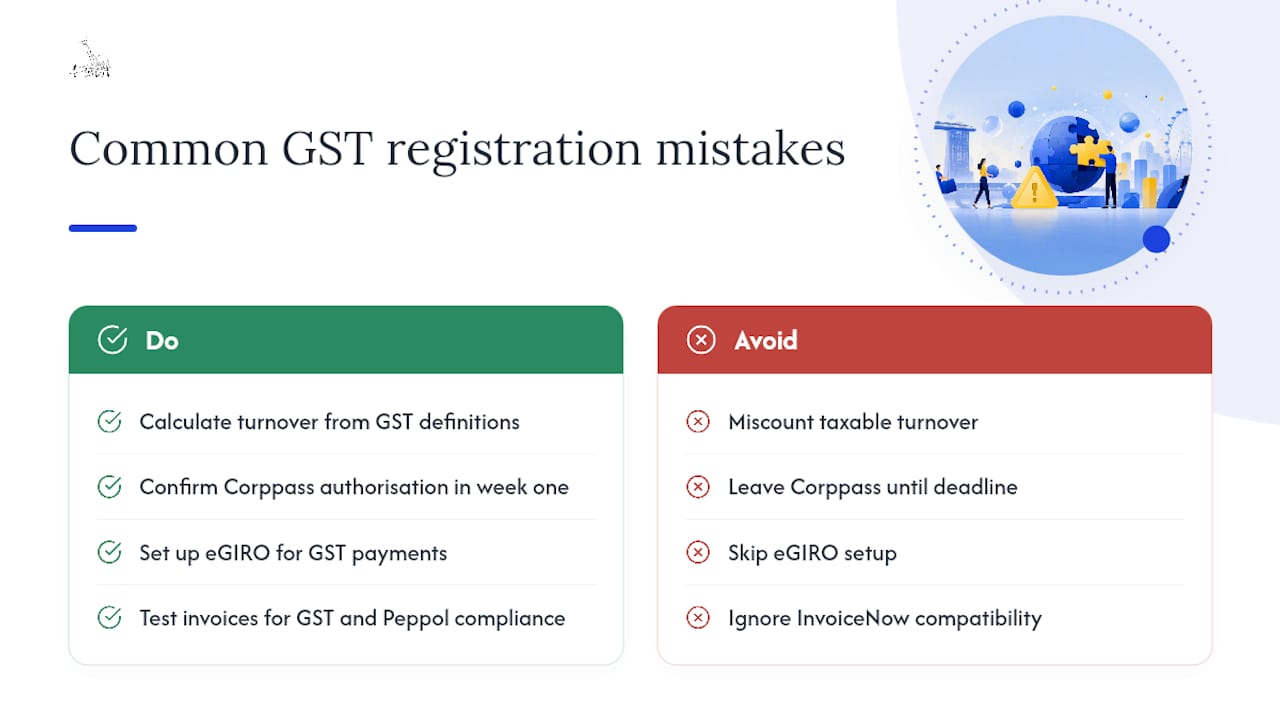
Miscounting taxable turnover is the most frequent error, and it usually comes from including or excluding the wrong line items. A business owner will forget that a large zero‑rated export contract still counts towards the S$1,000,000 threshold, because it “feels” like a one‑off rather than regular trading income. Or they’ll wrongly net off exempt income against taxable income, understating their true position. Either way, the fix is the same: build your calculation from the definitions, not from intuition about what “should” count.
The second recurring failure is treating Corppass as an afterthought. Business owners assemble a beautiful application, gather every document IRAS could possibly want, and then discover on submission day that nobody in the business actually holds the Corppass authorisation needed to file. This is a five‑minute problem if you check it in week one. It’s a week‑long problem if you discover it the day your deadline arrives.
The third is skipping eGIRO in favour of manual bank transfers, then wondering why payment processing lags and creates confusion in the GST account reconciliation. It’s a small setup step that pays for itself within the first filing cycle.
And the fourth, quieter failure is poor invoice configuration, particularly around InvoiceNow readiness. Businesses register, start trading as a GST entity, and only then discover their invoicing template doesn’t correctly separate GST amounts or doesn’t generate a valid Peppol‑compliant document. Fixing invoicing after the fact, across a customer base that’s already receiving your invoices, is disproportionately more disruptive than confirming compatibility before you ever submit the GST F1 form.
If there’s one piece of advice that cuts across all of these, it’s this: treat your forecast and your systems as part of the same decision, not two separate steps. A business that nails the turnover calculation but has no functioning Corppass access or InvoiceNow‑ready software hasn’t actually solved its GST registration problem. It’s solved half of it.
How Headington can support your GST registration and ongoing compliance
Getting GST registration right the first time saves you from the two costliest outcomes: a backdated effective date that lands you with an unexpected GST bill, or a rejected application that sends you back to square one after weeks of preparation. Headington works alongside Singapore business owners to build accurate turnover forecasts with proper documentary backing, complete the myTax Portal application correctly, and set up the Corppass, GIRO or eGIRO, and InvoiceNow foundations your business needs from day one.
Whether you’re weighing voluntary registration against the administrative cost, structuring a Section 33 agent arrangement as an overseas supplier, or simply want a second pair of eyes on your prospective turnover evidence before you submit, having a specialist involved reduces the risk of an incomplete application being treated as withdrawn or a missed deadline triggering penalties. As part of Headington’s corporate compliance services, you can get a straightforward GST compliance health check that covers your registration position, your filing systems, and your InvoiceNow readiness in one sitting. If you’re unsure where you stand, get in touch with Headington to book that health check before your next filing deadline arrives.
IRAS links and checklists worth bookmarking
Keep these official IRAS pages close at hand as you work through registration and beyond:
GST F5 filing help on myTax Portal, for your quarterly return once registered.
GST digital services, the portal hub for Corppass access and all GST‑related online transactions.
For businesses handling cross‑border payments alongside their GST obligations, Demivolt’s international payment compliance checklist offers a useful complementary framework for keeping cash‑flow controls tight once you’re GST‑registered.
This article is general information, not a substitute for advice from a qualified financial advisor. Consult a qualified financial professional about your own circumstances before acting on anything here.
Sources
FAQ
Who is required to register for GST in Singapore?
Any business whose taxable turnover exceeded S$1,000,000 in a calendar year, or reasonably expects to exceed that figure in the next 12 months, must register compulsorily under IRAS rules.
Do I need to charge GST if I earn under S$1,000,000?
No, if you haven’t crossed the compulsory threshold and haven’t registered voluntarily, you don’t charge or collect GST on your sales. Some businesses below the threshold choose voluntary registration anyway to recover input tax, but that’s an optional decision, not a requirement.
How do I get a GST registration number in Singapore?
You apply through myTax Portal using Corppass authorisation, completing the GST F1 “Register for GST” digital form with your business profile, turnover details, and supporting documents; IRAS issues your GST registration number once the application is approved.
What happens if I register for GST late?
IRAS can backdate your effective registration date to when you should have registered, which means you owe GST on sales made during that backdated period out of your own margin, plus late notification penalties.
Can I cancel my GST registration once I’m signed up?
Yes, if your business ceases trading, your taxable turnover falls durably below the threshold, or the nature of your supplies changes, though voluntary registrants generally must complete a minimum two‑year period first.
Where can Headington help with my GST registration?
Headington assists with building an accurate turnover forecast, completing the myTax Portal application correctly, and setting up Corppass, GIRO or eGIRO and InvoiceNow readiness so your registration goes through cleanly the first time.
Comments