Singapore Micro SMEs: Pick the Right Form C, C-S or C-S (Lite) by Nov 30


File Form C-S (Lite) if your company is Singapore-incorporated, earns S$200,000 or less in annual revenue, and has straightforward tax affairs with no disallowed claims. Move up to Form C-S if revenue sits at S$5 million or below and you meet the same eligibility conditions. Every other company, and anyone claiming reliefs like group relief or foreign tax credits, must file Form C. All three are due on 30 November via the myTax Portal, authorised through Corppass.
TL;DR:
Companies with revenue over S$200,000 but up to S$5 million can file Form C-S, while those above S$5 million must use Form C due to complexity.
Filling out Form C-S (Lite) requires only six fields and no financial statements or tax computations at submission, but figures still need to match actual accounts.
Claiming disallowed reliefs or revenue exceeding thresholds automatically mandates filing Form C, with full financial statements and detailed schedules required.
Correct Corppass authorization and reconciling revenue figures before filing are crucial to avoid delays or incorrect submissions.
For companies with very simple, low-revenue profiles, Form C-S (Lite) offers the quickest, easiest filing process, while larger or more complex firms should consider professional advice.
Table of Contents
Form C vs C-S in Singapore: revenue, complexity and documents at a glance
The three forms sit on a sliding scale of complexity that tracks almost exactly with company size. Get the revenue threshold wrong and you risk filing the wrong return, which can trigger unwanted scrutiny from the Inland Revenue Authority of Singapore (IRAS)-form-c-filing/overview-of-form-c-s-form-c-s-(lite)-form-c).
Here is how the three forms actually compare once you strip away the jargon:
Revenue threshold: Form C-S (Lite) applies at S$200,000 or below; Form C-S applies up to S$5 million; Form C applies above S$5 million or whenever disallowed claims are involved.
Form complexity: Lite asks for six essential fields; standard C-S runs to around 18 fields; Form C has no field cap and requires a full tax computation submitted alongside it.
Supporting documents at filing: neither C-S (Lite) nor standard C-S requires financial statements or tax computations to be attached at the point of filing. Form C requires both, every time.
Disqualifying claims: group relief, foreign tax credit, investment allowance claims, and loss carry-back claims all rule out both C-S variants, regardless of revenue.
Optional upgrade: a company eligible for C-S (Lite) or C-S can still choose to file the fuller version, or Form C, if its tax position is complex enough to warrant it.
That last point catches people out more often than you’d expect. Eligibility for a simplified form is a ceiling, not a floor. If your finance team already has audited accounts ready and a slightly unusual tax position, filing the fuller Form C sometimes causes fewer headaches than trying to squeeze irregular figures into six or eighteen boxes.
Form C-S (Lite): eligibility, fields and filing practicalities
Form C-S (Lite) was built for the smallest end of the corporate tax base, and it shows. The IRAS overview confirms the Lite form requires only six essential fields when annual revenue is S$200,000 or below.
Before you open the myTax Portal, run through this eligibility checklist:
Your company is incorporated in Singapore.
Annual revenue for the Year of Assessment does not exceed S$200,000.
All income is taxed at the prevailing corporate rate, with no preferential treatment.
You are not claiming group relief, foreign tax credit, investment allowance, or carry-back reliefs.
Your tax affairs are otherwise straightforward, meaning no complex related-party transactions or unusual income streams.
The six fields on Lite cover essentials: revenue, taxable income, and a handful of declarations about your tax position. Where owners go wrong is assuming “six fields” means “six minutes of guessing.” The figures you enter still need to reconcile with your actual accounts. IRAS does not ask to see your financial statements at filing, but it can ask for them afterwards, and the numbers on Lite need to match what is sitting in your ledgers.
To file, log into the myTax Portal, select the correct Year of Assessment, and choose the C-S (Lite) option when prompted. This only appears if your declared revenue falls within the threshold, so an incorrect revenue figure entered earlier in the process can knock the Lite option off the menu entirely.
Pro Tip: Prepare your financial statements and a basic tax computation before you log in, even though Lite doesn’t ask for them. It takes the guesswork out of the six fields and gives you something to point to if IRAS ever follows up.
Form C-S: the fuller simplified return and when to choose it
Form C-S sits between Lite and the full Form C, built for companies with annual revenue of S$5 million or below that still meet the core eligibility conditions: Singapore incorporation, income taxed at the prevailing rate, and no disallowed claims such as group relief or foreign tax credit.
The standard C-S form runs to roughly 18 fields, a meaningful step up from Lite’s six but still far shorter than the open-ended structure of Form C. Those fields capture more granular detail: adjustments to accounting profit, capital allowances, and a breakdown of non-taxable or exempt income. Financial statements and tax computations still don’t need to be submitted with the form itself, matching the same rule that applies to Lite.
Reasons to choose C-S over Lite or Form C tend to fall into a few camps:
Your revenue exceeds S$200,000 but sits comfortably under S$5 million, so Lite isn’t available but a full Form C would be overkill.
You want the administrative saving of not attaching financial statements at filing, while still capturing enough detail to reflect a slightly more complex tax position.
Your company has straightforward income sources with no reliefs to claim, so the extra fields on C-S are quick to complete accurately.
There are also good reasons to skip C-S even when you qualify. If your accountant has already prepared a full tax computation and audited financial statements, filing Form C sometimes takes less overall effort than reworking those figures into the C-S format, particularly for companies with unusual capital allowance schedules or multiple income streams that don’t map neatly onto 18 standard fields.
Form C: mandatory situations and required attachments
Form C stops being optional the moment any of the following applies:
Annual revenue exceeds S$5 million for the Year of Assessment.
You are claiming group relief for losses transferred between related Singapore companies.
You are claiming a foreign tax credit for tax paid overseas on foreign-sourced income.
You are claiming an investment allowance under an approved scheme.
You want to carry back current-year losses or capital allowances against prior-year income.
Any one of these conditions forces Form C, regardless of how small your revenue figure is otherwise. A company with S$300,000 in revenue claiming a foreign tax credit must file Form C, not C-S.
Form C also demands a heavier paper trail. At filing, you need audited or unaudited financial statements, a full tax computation showing how accounting profit reconciles to chargeable income, and supporting schedules such as capital allowance workings. Larger or more complex filers may also need to submit the IRIN 301 or similar supplementary schedules depending on the reliefs claimed.
Budget more preparation time than you would for either simplified form. IRAS estimates at least 30 minutes to complete Form C itself, and that figure assumes your financial statements and tax computation are already finished. In practice, gathering and finalising those documents is where most of the real time goes, often days rather than minutes once your accountant is reconciling figures and checking capital allowance schedules against fixed asset registers.
How to file: myTax flow, Corppass roles and timelines
Filing any of the three forms runs through the same digital gateway, but the authorisation step trips up more companies than the form itself.
Confirm your company has a valid UEN and that a director or authorised officer has set up Corppass with an Approver role for “Corporate Tax (Filing and Applications)”.
Log into mytax.iras.gov.sg using Singpass, linked to your Corppass authorisation.
Select the correct Year of Assessment and let the portal indicate whether C-S (Lite), C-S, or Form C applies based on your declared revenue.
Complete the relevant fields, attaching financial statements and tax computation only if filing Form C.
Review and submit before 30 November.
The 30 November deadline applies to every one of the three forms, giving companies with a standard 31 December financial year end roughly 11 months from account closing to file. First-time filers need to work out their initial Year of Assessment based on their first set of accounts, and IRAS provides worked examples for companies with a financial year end that doesn’t align neatly to 12 months.
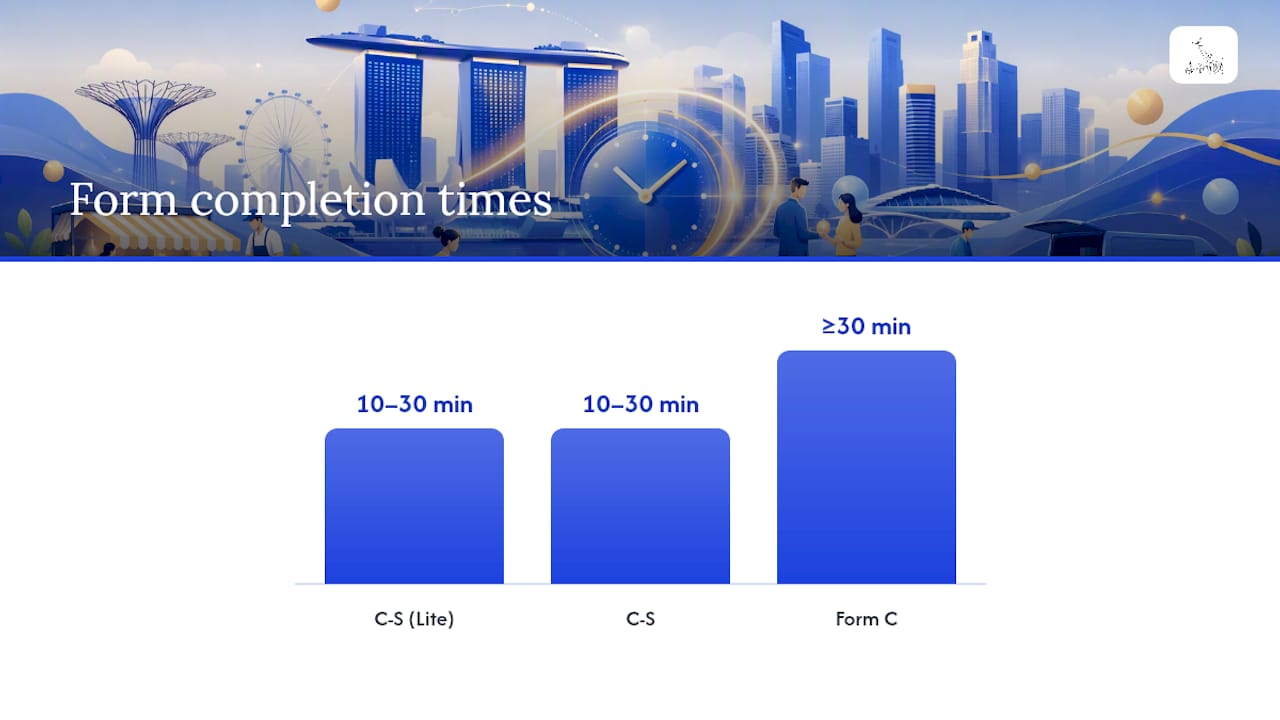
IRAS estimates 10 to 30 minutes to complete Form C-S or C-S (Lite), against 30 minutes or more for Form C, assuming your Corppass Approver access is already sorted and your figures are ready to enter. That estimate is for the form itself, not the accounting work behind it, so treat it as the last step in a longer process rather than the whole job.
Corppass authorisation is the single most common cause of last-minute delays. If your appointed Approver has left the company, changed roles, or never had access granted in the first place, you will lose time in late November precisely when you can least afford it.
Eligibility pitfalls and checks before you file
The most expensive mistake in this whole process is not a wrong number. It is filing a simplified form when your company doesn’t actually qualify.
Run through these checks before you commit to C-S or Lite:
Does your company hold shares in, or receive losses from, a related Singapore company under group relief? If yes, Form C is mandatory.
Did you pay tax overseas on any foreign-sourced income and want to claim a credit against Singapore tax? If yes, Form C applies.
Have you claimed or plan to claim an investment allowance under an approved scheme?
Do you want to carry back current losses or capital allowances against a prior year’s taxable income?
Does your revenue figure, once reconciled against your accounts, genuinely sit at or below the S$200,000 or S$5 million threshold?
Preparing a proper tax computation before you file matters even when the form itself doesn’t ask for one. IRAS can request supporting documents after filing, and simplified forms are a simplification of what you submit, not of the accuracy expected behind the numbers.
Pro Tip: If you’re unsure whether a transaction counts as a disallowed claim, check it against your tax computation before selecting a form. Guessing wrong after submission means an amended filing, and possibly a closer look at your other figures too.
Recordkeeping, audits and how to revise an incorrect return
Whichever form you file, prepare and keep these documents on hand:
Full financial statements for the relevant financial year.
A tax computation reconciling accounting profit to chargeable income.
Supporting schedules for capital allowances, provisions, or related-party transactions.
IRAS can request any of these after you file a simplified return, and audit exemption under the Companies Act’s small company concept does not remove this obligation. Not needing an audit is not the same as not needing accounts.
If you spot an error after submitting, you can request a revision through myTax or by writing to IRAS directly, and the sooner you do it, the better. Late filing or incorrect returns left uncorrected can lead to estimated assessments, penalties, or enforcement action, none of which are worth risking to save an afternoon of reconciliation work.
Headington Management checklist: pre-filing actions for micro SMEs
Micro SMEs, companies with under S$1 million in annual revenue and typically fewer than 10 staff, form a large majority of enterprises in Singapore and employ a significant portion of the workforce, yet contribute a smaller share of nominal value added. That mismatch usually comes down to thin admin capacity rather than weak business fundamentals, and tax filing is often where it shows first.
Before filing season, work through this:
Corppass Approver confirmed and active, not left with someone who has since departed.
Revenue figure reconciled between your accounting system and what you intend to declare.
Tax computation drafted, even if the form doesn’t require it at submission.
A clear check that you are not claiming group relief, foreign tax credit, or investment allowance.
Pro Tip: Set aside a fixed 30-minute slot in early November rather than squeezing it in on deadline day. Micro SMEs with one director wearing every hat benefit most from a dedicated, distraction-free window.
If your tax position involves foreign income, related-party transactions, or you genuinely aren’t sure which form applies, that’s the point to bring in a tax adviser rather than guess.
Which form should you actually pick?
For most micro SMEs turning over S$200,000 or less with clean, simple accounts, Form C-S (Lite) is the sensible default. It asks for the least, and there is no upside to over-filing when your affairs are genuinely simple. Small companies above that threshold but under S$5 million should default to standard Form C-S, provided no disqualifying claims apply.
The one habit worth building regardless of company size: check disqualifying claims and confirm Corppass access weeks before November, not days. Where foreign income, group structures, or unusual reliefs enter the picture, that’s the moment to bring in paid advice rather than push a simplified form where it doesn’t belong.
— Colin
How Headington can support your filing and compliance
Sorting Corppass access, reconciling a revenue figure, or drafting a tax computation before filing takes real time, particularly for a micro SME running lean with no dedicated finance hire. We work alongside company owners on exactly this groundwork, from setting up Corppass authorisation correctly the first time to reviewing a tax computation before it goes anywhere near myTax.
As part of broader corporate secretarial and compliance retainers, we help Singapore-based companies keep the underlying records in order year-round, so filing season is a formality rather than a scramble. This sits alongside wider support for entity structuring and cross-border compliance for businesses growing beyond Singapore. It is one route among several open to you, but if you would rather hand off the reconciliation and authorisation work than do it solo in November, get in touch through the Headington team for an initial consultation on what your filing actually needs.
This article is general information, not a substitute for advice from a qualified financial advisor. Consult a qualified financial professional about your own circumstances before acting on anything here.
Sources
FAQ
What is the difference between Form C and Form C-S?
Form C-S is a shorter return for eligible companies with revenue of S$5 million or below and no disallowed claims, while Form C is the full return required for larger companies or anyone claiming reliefs like group relief or foreign tax credit.
What are the requirements for filing Form C with IRAS?
Form C requires attaching full financial statements and a tax computation, and it becomes mandatory once revenue exceeds S$5 million or you claim group relief, foreign tax credit, investment allowance, or loss carry-back.
What is the deadline to file Form C with IRAS?
Form C, along with Form C-S and C-S (Lite), must be filed by 30 November of the relevant Year of Assessment.
How do I file Form C?
Log into the myTax Portal with Singpass and a Corppass Approver authorisation, select the applicable Year of Assessment, choose Form C, then complete the return and attach your financial statements and tax computation before submitting.
What is Form C-S (Lite) and who can use it?
Form C-S (Lite) is a six-field simplified return for Singapore-incorporated companies with annual revenue of S$200,000 or below and straightforward tax affairs, with no disallowed claims such as group relief or foreign tax credit.
Comments