Singapore's COMPASS framework: the employer's EP guide


COMPASS is the mandatory stage-2 assessment for most Employment Pass (EP) applications in Singapore. An application must first clear the EP qualifying salary threshold, then score at least 40 points under COMPASS before MOM will approve it. If your candidate clears the salary bar but your firm’s workforce profile is weak on diversity or local PMET support, the application can still fail.
Immediate HR checklist before any EP submission:
Confirm the candidate’s fixed monthly salary meets the current EP qualifying salary for their sector and age band (stage 1 must pass before COMPASS is even considered)
Log in to Workforce Insights (WFI) via the myMOM Portal to check your firm’s C3 (nationality diversity) and C4 (local PMET support) profile
Run the enhanced Self-Assessment Tool (SAT) on the myMOM Portal to estimate the candidate’s likely COMPASS score before submission
Order qualification verification early — this is the step most HR teams leave too late
Check whether the role appears on the Shortage Occupation List (SOL) for a potential C5 bonus
Assess whether your firm participates in a qualifying programme for the C6 Strategic Economic Priorities Bonus
One exemption to note: candidates earning a fixed monthly salary of S$22,500 or above are exempt from COMPASS and pass on salary alone. A narrow set of other exemptions also apply, including certain intra-company transferees under specific conditions — check MOM’s eligibility page to confirm whether your candidate qualifies before running the full COMPASS assessment.
Key takeaways
Singapore’s COMPASS framework requires employers to clear both the EP qualifying salary and a minimum of 40 points across up to six criteria before MOM will approve an Employment Pass application.
Point | Details |
Two stages, both mandatory | An application must clear the EP qualifying salary (stage 1) before COMPASS (stage 2) is assessed. |
40 points to pass | Points come from C1 (salary benchmarks), C2 (qualifications), C3 (diversity), and C4 (local employment), with optional C5/C6 bonus criteria. |
Small firms get a buffer | Firms with fewer than 25 PMETs automatically receive 10 default points each for C3 and C4. |
Verification takes time | Qualification verification typically takes four to six weeks; submit the EP application only once it is complete. |
Headington for EP support | Headington provides COMPASS eligibility assessments, documentation verification, and sector agency liaison for Singapore employers. |
This article is general information, not a substitute for advice from a qualified lawyer. Consult a qualified legal professional about your own circumstances before acting on anything here.
Table of Contents
How does the COMPASS framework work in Singapore’s EP system?
Breaking down COMPASS criteria C1 to C4: what HR needs to score
What are the C5 and C6 bonus criteria, and when do they apply?
What verification documents does HR need, and how long does it take?
Worked example: does this candidate reach 40 COMPASS points?
How does the COMPASS framework work in Singapore’s EP system?
Singapore’s EP eligibility process runs in two distinct stages, and both must be cleared for an application to succeed.
Stage 1: EP qualifying salary. MOM sets a minimum fixed monthly salary that varies by the candidate’s age and sector. Financial services roles carry a higher floor than most other sectors. Failing stage 1 ends the application immediately — COMPASS points are irrelevant at that point.
Stage 2: COMPASS. Once stage 1 is cleared, MOM applies the Complementarity Assessment Framework (COMPASS), the points-based system that evaluates whether the candidate and the hiring firm together meet Singapore’s broader workforce goals. A candidate must accumulate at least 40 COMPASS points across up to six criteria to pass.
The roll-out followed a phased timeline. COMPASS applied to new EP applications from 1 September 2023, and to EP renewals from 1 September 2024. If your firm has been renewing EPs without running COMPASS checks, that window has now closed.
Stage | What it assesses | Immediate HR check |
Stage 1: EP qualifying salary | Fixed monthly salary vs MOM’s sector and age-band floor | Confirm salary against MOM’s current schedule before preparing documents |
Stage 2: COMPASS | Points across C1–C4 core criteria plus optional C5/C6 bonus criteria | Run WFI and SAT; review firm workforce profile; gather verification proof |
The COMPASS booklet published by MOM is the definitive reference for criterion details, verification requirements, and the WFI/SAT planning tools. Keep it accessible throughout the application process.
Breaking down COMPASS criteria C1 to C4: what HR needs to score
Each of the four core criteria awards 0, 10, or 20 points. The maximum from C1–C4 alone is 80 points, though most applications will not reach that ceiling without deliberate planning.
C1: salary relative to local PMET benchmarks
C1 is the criterion HR teams most frequently misread. Clearing the EP qualifying salary does not guarantee C1 points. MOM compares the candidate’s fixed monthly salary against sector-and-age-band benchmarks for local PMETs, not against the EP qualifying salary floor.
20 points: salary at or above the 90th percentile for local PMETs in the same sector and age band
10 points: salary at or above the 65th percentile but below the 90th percentile
0 points: salary below the 65th percentile
A candidate earning S$6,000 per month may clear stage 1 comfortably but still score 0 on C1 if local PMETs in that sector and age group typically earn more. Model C1 specifically using MOM’s published benchmarks before finalising the offer.
C2: qualifications
C2 rewards candidates with strong academic credentials, particularly those from institutions that MOM recognises as top-tier.
20 points: degree from a top-tier institution (as defined by MOM’s list) or a qualification verified as equivalent
10 points: any other degree-level qualification
0 points: no degree-level qualification
The critical condition: if you are relying on C2 points, the qualification must be verified. Unverified qualifications cannot be counted. MOM accepts verification from recognised bodies, and the process takes time — order it early.
C3: nationality diversity
C3 measures whether the candidate’s nationality is already over-represented among your firm’s PMET workforce. If a single nationality makes up too large a share of your PMETs, new hires of that nationality score 0 on C3.
20 points: the candidate’s nationality represents less than 5% of the firm’s PMET workforce
10 points: the candidate’s nationality represents 5%–25% of the firm’s PMET workforce
0 points: the candidate’s nationality represents more than 25% of the firm’s PMET workforce
Small-firm rule: firms with fewer than 25 PMETs automatically receive 10 default points for C3. This is a meaningful planning buffer for smaller employers, and HR should factor it into hiring sequencing decisions.
C4: support for local employment
C4 compares your firm’s share of local PMETs against sector peers. Firms that employ a higher proportion of locals relative to their industry score better.
20 points: firm’s local PMET share is stronger than many peers in the sector
10 points: firm’s local PMET share is about average for the sector
0 points: firm’s local PMET share is weaker than many peers in the sector
The same small-firm default applies: fewer than 25 PMETs earns 10 automatic points for C4 as well.
C3 and C4 scores are drawn from a three-month rolling average of your firm’s workforce profile in WFI. A single new hire or departure will not shift these scores overnight. Meaningful movement requires sustained workforce planning over several months.
COMPASS scoring summary: C1–C4
Criterion | What it measures | 20 points | 10 points | 0 points |
C1: Salary | Salary vs local PMET benchmarks by sector and age | At or above 90th percentile | 65th–90th percentile | Below 65th percentile |
C2: Qualifications | Academic credentials and verification | Top-tier institution (verified) | Other degree (verified) | No degree |
C3: Diversity | Candidate’s nationality share among firm PMETs | Below 5% | 5%–25% | Above 25% |
C4: Local employment | Firm’s local PMET share vs sector peers | Above sector median | At sector median | Below sector median |
Verification checklist for C1–C4
Download MOM’s C1 salary benchmarks and map the candidate’s salary against the correct sector and age band before making an offer.
Confirm the candidate’s institution appears on MOM’s recognised list; if uncertain, initiate third-party verification immediately.
Pull your firm’s current WFI profile to check C3 nationality share and C4 local PMET ratio before selecting the candidate.
If C2 verification is required, allow a minimum of four to six weeks for the process — do not submit the EP application until verification is complete.
Document all verification outcomes and keep copies for MOM submission.
What are the C5 and C6 bonus criteria, and when do they apply?
Beyond the four core criteria, two bonus criteria can add up to 20 extra points each, giving a theoretical maximum of 120 points. In practice, bonus points are most valuable when a candidate’s C1–C4 total sits in the 20–35 point range and needs a lift to clear 40.
C5: Skills Bonus and the Shortage Occupation List
The C5 Skills Bonus awards up to 20 points when the candidate’s role appears on MOM’s Shortage Occupation List (SOL). The SOL identifies occupations where Singapore faces genuine skills shortages, and it is reviewed periodically.
Key conditions under MOM’s bonus criteria guidance:
The candidate’s actual job duties must match the SOL occupation — a job title alone is insufficient
An additional safeguard applies: if the candidate’s nationality already makes up more than 5% of the firm’s PMET workforce in that SOL occupation, the bonus points are reduced
Employers must be prepared to demonstrate the role genuinely falls within the SOL occupation’s scope
C6: Strategic Economic Priorities Bonus
C6 awards up to 20 points when the hiring firm participates in a qualifying programme tied to Singapore’s strategic economic priorities. This typically means the firm has received endorsement or support from a sector agency such as the Economic Development Board (EDB), the Infocomm Media Development Authority (IMDA), or the Monetary Authority of Singapore (MAS).
Qualifying conditions include:
Active participation in a recognised programme at the time of application
Endorsement from the relevant sector agency confirming the firm’s participation
The employer must hold documentation of the endorsement and submit it with the EP application
Planning for bonus points:
Check the current SOL on MOM’s website before writing the job description — aligning duties to a listed occupation at the design stage is far easier than retrofitting a role description later
Contact the relevant sector agency early if your firm may qualify for C6; endorsement processes take time and cannot be rushed at submission
Never claim bonus points without the required verification or endorsement in hand — MOM treats unsupported bonus claims as grounds for rejection
How do you use WFI and SAT to estimate a COMPASS score?
The two MOM tools that matter most for pre-submission planning are Workforce Insights (WFI) and the enhanced Self-Assessment Tool (SAT), both accessible via the myMOM Portal.
Step-by-step: using WFI and SAT
Log in to the myMOM Portal using your firm’s Corppass credentials. Both WFI and SAT are available from the portal dashboard.
Open Workforce Insights (WFI). WFI shows your firm’s current PMET composition: nationality breakdown (relevant to C3) and local PMET share relative to sector peers (relevant to C4). Review these figures before selecting a candidate — if your C3 or C4 profile is already weak, a new hire of a dominant nationality will score 0 on C3 regardless of their other credentials.
Note the sector mapping. WFI assigns your firm to a sector based on its primary business activity. The COMPASS FAQ explains how sector mappings work and what to do if you believe your firm has been mapped incorrectly — this is worth checking, because the sector affects C1 benchmarks, C3/C4 peer comparisons, and SOL eligibility.
Run the SAT for the specific candidate. The enhanced SAT incorporates COMPASS scoring. Enter the candidate’s salary, qualifications, nationality, and role details. The SAT will return an estimated score and flag which criteria are likely to score low.
Interpret the result. A SAT score comfortably above 40 gives reasonable confidence, but it is an estimate. The SAT cannot account for verification outcomes or sector agency endorsements that have not yet been confirmed.
Mini calculation example
That gives a C1–C4 total of 50 points, which clears 40 without needing bonus criteria. If C1 dropped to 0 (salary below the 65th percentile), the total falls to 40 — still passing, but with no margin. A further drop in C3 or C4 would fail the application.
Pro Tip: WFI updates on a rolling three-month average, so the profile you see today reflects hires and departures from the past quarter. If your firm recently made significant changes to its workforce composition, allow time for those changes to flow through before submitting an EP application that depends on improved C3 or C4 scores.
What verification documents does HR need, and how long does it take?
Verification is where well-prepared applications fall apart. MOM requires proof, not declarations, and missing or late verification is one of the most common causes of rejection.
What must be verified
C2 qualifications: the candidate’s degree or equivalent must be verified by a recognised body if you are claiming C2 points. A certificate alone is not sufficient.
C5 SOL roles: the candidate’s job duties must demonstrably match the SOL occupation. Employers should prepare a detailed job description and, where required, supporting documentation from the relevant sector agency.
C6 programme participation: the firm must hold a current endorsement letter or equivalent documentation from the sector agency confirming active participation in the qualifying programme.
Practical lead times and order of operations
Weeks 1–2: Run WFI and SAT to identify which criteria are at risk. Confirm the candidate’s salary against C1 benchmarks.
Weeks 2–6: Initiate qualification verification. This is the longest lead-time item — four to six weeks is typical, and some institutions take longer.
Weeks 3–4: If claiming C5, confirm the role maps to an SOL occupation and prepare the job description. Contact the sector agency if C6 endorsement is needed.
Week 6 onwards: Compile the full application pack once verification is complete. Do not submit before all verification documents are in hand.
Common rejection reasons and how to avoid them
Salary below EP qualifying salary: check the current MOM schedule before making an offer, not after
Missing qualification verification: order it at the point of offer, not at the point of submission
Inaccurate WFI profile: if your firm’s sector mapping or workforce data appears wrong in WFI, raise it with MOM before submitting — an application built on incorrect firm data is vulnerable
C3/C4 profile below threshold: if your firm scores 0 on both C3 and C4, even strong C1 and C2 scores may not be enough; address the workforce profile over time rather than relying on bonus points to compensate
Unsupported bonus claims: claiming C5 or C6 without the required verification or endorsement documentation is a straightforward rejection trigger
How should HR build a strategy to improve COMPASS outcomes?
COMPASS rewards deliberate workforce planning, not last-minute fixes. The firms that consistently clear 40 points treat the framework as an ongoing HR discipline rather than a pre-submission checklist.
Prioritised action plan
Immediate pre-submission (weeks 1–6): benchmark the candidate’s salary against MOM’s C1 tables; run WFI and SAT; order qualification verification; confirm SOL and sector agency status if bonus points are in scope.
Medium-term workforce actions (rolling): monitor your firm’s C3 nationality distribution and C4 local PMET ratio in WFI quarterly. If either is drifting toward the 0-point band, adjust hiring priorities before the next EP application — not during it.
Job design: when writing job descriptions for roles you expect to fill with EP holders, check the SOL at the drafting stage. Aligning duties to a listed occupation from the outset is cleaner than amending a description after a candidate is selected.
Workforce planning and HR policy alignment
Long-term C4 improvement comes from investing in local PMET development — structured career pathways, mentoring, and succession planning for Singaporean and PR staff. These are not just COMPASS compliance measures; they are the kind of workforce practices that also reduce turnover and strengthen institutional knowledge.

For job offers and role descriptions, include explicit language about the duties and responsibilities that map to the relevant COMPASS criteria. If a role is SOL-eligible, the job description should reflect the actual duties of that occupation, not a generic title.
Questions to raise with sector agencies
When a role’s SOL eligibility or a firm’s C6 qualification is unclear, contact the relevant agency directly:
IMDA for technology, media, and infocomm roles
MAS for financial services roles
EDB for manufacturing, engineering, and strategic investment roles
Ask specifically: does this role’s description match the SOL occupation as the agency interprets it? Does our firm’s programme participation qualify for C6 endorsement, and what documentation is required? EDB’s guidance on COMPASS is a useful starting point for firms in its remit.
Worked example: does this candidate reach 40 COMPASS points?
Candidate profile: a 35-year-old software engineer applying to a mid-sized technology firm in Singapore. Fixed monthly salary: S$7,500. Degree from a recognised but non-top-tier university. The firm’s local PMET share sits slightly below the sector median. The role does not appear on the SOL, and the firm does not participate in a qualifying C6 programme.
Result: fail. The candidate scores 30 points — 10 short of the 40-point threshold.
What would change the outcome?
Raising the salary to the 90th percentile or above would add 10 points on C1, bringing the total to 40 — a pass, but with no margin.
If the firm’s local PMET share were at or above the sector median, C4 would contribute 10 points, also reaching 40.
If the role were on the SOL and the candidate’s nationality is below 5% of the firm’s SOL-occupation PMETs, C5 could add up to 20 points — pushing the total to 50 even without changing salary or C4.
The lesson here is practical: a single criterion at 0 points is recoverable if the others are strong. Two criteria at 0 points usually requires either a salary increase or a bonus criterion to compensate. Three at 0 points is very difficult to overcome without structural workforce changes.
What HR teams consistently get wrong about COMPASS
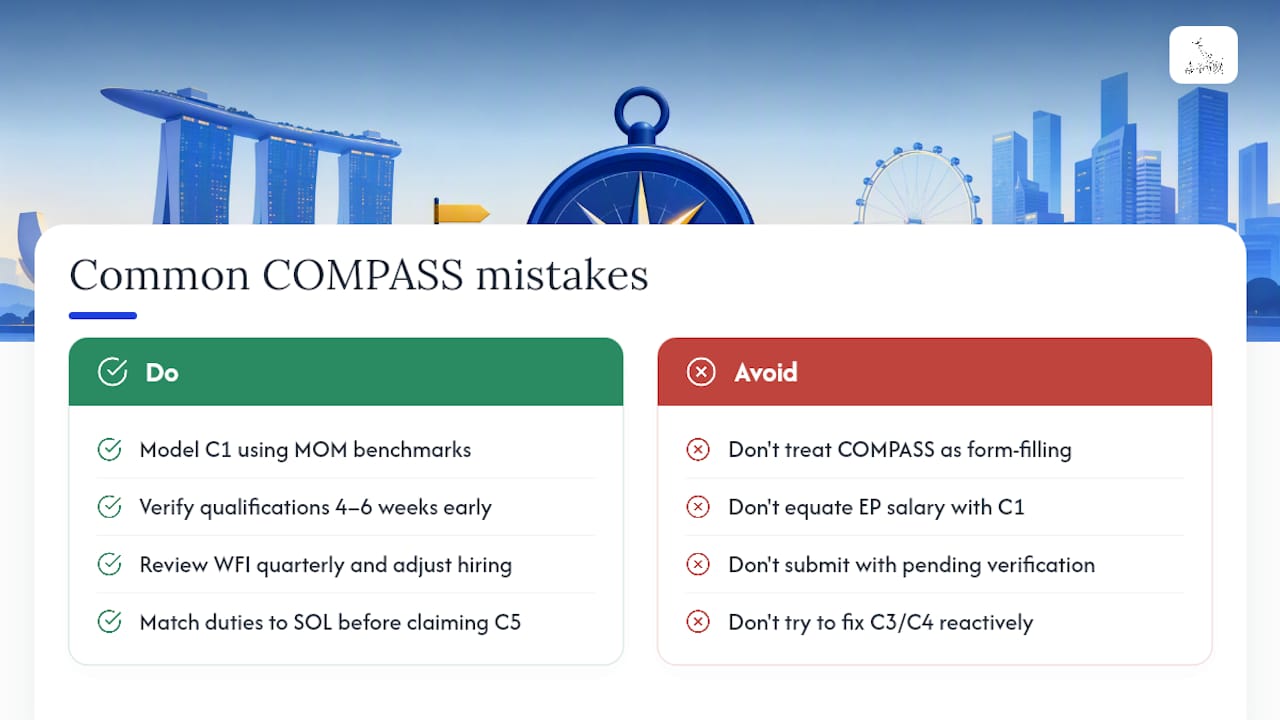
Most EP rejections under COMPASS are not caused by genuinely unqualified candidates. They are caused by firms that treat the framework as a form-filling exercise rather than a workforce signal.
The most common error is conflating the EP qualifying salary with C1 performance. A candidate who clears stage 1 by a comfortable margin can still score 0 on C1 if local PMETs in that sector and age group typically earn significantly more. HR teams that do not model C1 specifically — using MOM’s published benchmarks — regularly submit applications they believe are strong and receive rejections they find baffling.
The second pattern is leaving qualification verification until the week before submission. Verification takes four to six weeks at minimum. An application submitted without it, or with a note that verification is “pending,” is not a complete application.
C3 and C4 deserve more strategic attention than most firms give them. Because these scores reflect a three-month rolling average, they cannot be improved reactively. A firm that has been hiring predominantly from one nationality for two years will not shift its C3 score in time for the next application cycle. The firms that manage COMPASS well are the ones that review their WFI profile quarterly and adjust hiring priorities before the problem becomes acute.
Bonus criteria are genuinely useful, but they carry compliance expectations that some employers underestimate. Claiming C5 requires that the candidate’s actual duties match the SOL occupation — not just the job title. MOM can and does scrutinise this. Treat bonus points as a legitimate planning tool, not a shortcut.
How Headington can support your COMPASS and EP filings
Clearing COMPASS consistently requires more than reading MOM’s guidance once. It requires integrating the framework into how your firm hires, designs roles, and manages its workforce profile over time. That is where the process gets complicated for most HR teams.
Headington brings over 25 years of corporate advisory experience across 90 countries, with in-house specialists who handle EP eligibility assessments, documentation verification, and sector agency liaison for Singapore employers. Rather than working through MOM’s tools in isolation, you get a structured pre-submission review: WFI and SAT analysis, C1 salary benchmarking against current MOM tables, qualification verification coordination, and a clear picture of where your application stands before it is filed.
For firms managing multiple EP applications or navigating a weak C3/C4 profile, Headington also supports medium-term workforce planning aligned to COMPASS requirements. If your situation involves sector agency endorsement for C5 or C6, the team handles those conversations directly.
Get in touch with Headington to arrange a COMPASS eligibility review or discuss an ongoing EP compliance retainer.
Sources
Eligibility for Employment Pass - Singapore
FAQ
What does COMPASS stand for in Singapore’s EP system?
COMPASS stands for Complementarity Assessment Framework. It is the points-based stage-2 assessment MOM uses to evaluate Employment Pass applications after the EP qualifying salary threshold has been cleared.
What is the minimum COMPASS score needed to pass?
An EP applicant must score at least 40 points across the COMPASS criteria to pass stage 2. Candidates earning S$22,500 or above per month are exempt from COMPASS entirely.
What is the minimum salary for a COMPASS EP application?
There are two salary thresholds to understand. The EP qualifying salary (stage 1) sets the minimum fixed monthly salary for the application to proceed — this varies by sector and age. Separately, C1 awards points based on how the candidate’s salary compares to local PMET benchmarks in the same sector and age band; clearing stage 1 does not guarantee C1 points.
What is the COMPASS rule for small firms in Singapore?
Firms with fewer than 25 PMETs automatically receive 10 default points for both C3 (nationality diversity) and C4 (support for local employment), rather than being assessed against sector benchmarks. This default applies to both criteria simultaneously and is a useful planning buffer for smaller employers.
How do you check a firm’s COMPASS profile before submitting an EP application?
Log in to the myMOM Portal using Corppass credentials and access Workforce Insights (WFI). WFI shows your firm’s current C3 nationality distribution and C4 local PMET share relative to sector peers. Run the enhanced Self-Assessment Tool (SAT) on the same portal to estimate the candidate’s likely COMPASS score before submission.
Comments