Avoid 3 KYC Pitfalls When Opening a Business Bank Account in Singapore


Yes, you can open a business bank account in Singapore as soon as your company is incorporated with ACRA, provided you have the right paperwork ready. The applications that stall or get rejected almost always fail on three fronts: an outdated ACRA BizFile+ printout, a missing or improperly worded board resolution, or incomplete certified identification and address proof for directors, signatories and beneficial owners. Get those three right, and a UEN plus Corppass access, and you are genuinely ready to apply.
TL;DR:
Ensuring the ACRA BizFile+ printout is recent, matching company details, is critical to avoid delays or rejections in the application process.
Most banks require in-person attendance for directors or signatories, but notarized or overseas certified copies can often substitute if pre-arranged.
Account fees depend on the chosen bank and account type, with low-deposit digital options often waiving minimum initial deposits and fees for the first year.
For high-risk industries or structures involving foreign ownership, expect extra documentation and scrutiny, especially regarding beneficial ownership and compliance.
Preparing a complete, certified documentation package before applying can cut onboarding time from weeks to well under a month.
Table of Contents
What documents do banks need for a business bank account in Singapore?
Who needs to be present, and when will banks accept certified copies?
Licensed bank account or digital business account: which do you need?
How do banks scrutinise beneficial ownership and nominee directors?
What is the step‑by‑step process for opening a business account?
Does your business structure change the eligibility criteria?
What extra rules apply if you operate in a high-risk industry?
How Headington Management prepares your bank-facing paperwork
What documents do banks need for a business bank account in Singapore?
Every bank in Singapore builds its checklist around the same core set, even though the exact wording and formatting vary by institution. Get these five categories sorted before you book an appointment or start an online application, and you avoid the single biggest cause of delay: banks asking for the same document twice because the first version was outdated or uncertified.
A recent ACRA BizFile+ company profile. Most banks want this dated within one to three months of your application, and it must match your current directors, shareholders and registered address exactly.
Certificate of incorporation and company constitution. Banks typically request a certified true copy of the company constitution, not just the incorporation certificate.
Board resolution authorising the account opening. This document names the bank, states which directors or officers may operate the account, and defines signing authority (sole, joint, or a mandate above a certain value).
Certified identification and proof of residential address. Every director, authorised signatory and ultimate beneficial owner needs a certified passport or NRIC copy plus a utility bill or bank statement no older than three months.
Register of Registrable Controllers (RORC) and beneficial ownership declarations. Banks cross check this against your shareholding structure, particularly where shares sit inside holding companies or trusts.
Startup account guidance from OCBC shows how these categories translate into a real checklist, and it is worth printing that list before your appointment rather than relying on memory.
Who needs to be present, and when will banks accept certified copies?
Most banks expect the majority of directors and at least one authorised signatory to appear in person for a private limited company, according to GoBusiness. Sole proprietors and partners in a partnership usually face the same rule, scaled down to however many principals the business has.
Banks do make exceptions. A notary public certification, an attestation from a lawyer or accountant, or a signature witnessed at an overseas branch of the same bank can substitute for physical presence in many cases.
Foreign‑incorporated entities opening a Singapore subsidiary often need a letter of recommendation from their existing banker.
Certified copies of the parent company’s incorporation documents, translated where necessary, are a common additional request.
A frequent pitfall: submitting a certified copy that is older than the bank’s own cutoff, usually three to six months, which triggers a fresh certification request.
Pro Tip: Call the bank’s business banking desk before your appointment and ask exactly who they will accept as a certifier. Banks like DBS list acceptable certifiers on their account opening checklist, and it differs from what a notary in a different jurisdiction might assume is standard.
How much does a business bank account cost in Singapore?
Initial deposits for standard business accounts in Singapore vary by bank, with some requiring a minimum deposit and several offering digital-first startup accounts with no minimum initial deposit. Minimum average monthly balance requirements vary just as widely, and falling below that threshold triggers a fall‑below fee rather than an outright penalty.
Monthly service charges typically apply unless you meet a waiver condition tied to transaction volume, average balance, or bundling with other products such as a corporate card.
Fall‑below fees are usually charged monthly and are separate from any transaction fees on GIRO, cheques or wire transfers.
Some accounts waive fees entirely for the first six to twelve months as an onboarding incentive.
A pre‑revenue startup with modest capital often does better on a low‑deposit digital account, while an SME running multi‑currency trade or needing letters of credit will find the fee structure at a full‑service bank easier to justify given the services bundled in. OCBC’s guidance on startup accounts is a useful benchmark for comparing entry costs before you commit.
Licensed bank account or digital business account: which do you need?
Some transactions in Singapore simply require a licensed bank account. GIRO arrangements, CPF contributions, and participation in most government schemes all run through banks regulated directly by MAS, not through payment service providers or e‑money issuers.
Digital business accounts from providers such as ANEXT Bank close that gap for everything else. Onboarding is often faster, multi‑currency handling is usually smoother, and many products carry no minimum balance requirement at all.
ANEXT and similar digital providers offer fast onboarding and multi‑currency accounts, but coverage under the Singapore Deposit Insurance Corporation (SDIC) scheme and eligibility for certain government schemes can differ from a traditional bank.
A licensed bank remains the safer default for payroll and statutory contributions; a specialist payroll processing service can also help you keep GIRO deductions and CPF filings compliant once the account is live.
Many SMEs run both: one licensed bank for payroll and GIRO, one digital account for foreign currency operations and faster transfers.
Deposit insurance coverage is an important differentiator. Under the SDIC scheme, eligible deposits at full banks and finance companies are insured up to a prescribed amount per depositor per institution, a protection some digital account structures do not replicate identically.
How do banks scrutinise beneficial ownership and nominee directors?
MAS requires banks to apply enhanced due diligence on corporate customers, which is why every account opening now functions as a compliance review as much as a paperwork exercise. Banks are verifying that the people named on your RORC actually control the company, not just that the documents exist.
Nominee director arrangements face particularly close scrutiny following recent changes to corporate law. Expect banks to ask for the corporate service provider’s registration details, a formal nominee deed, and a declaration of who the nominee actually acts for.
Prepare your RORC and beneficial ownership declarations before the first meeting, not after a bank officer asks for them.
If a nominee director is involved, have the CSP registration and nominee deed ready as a matched pair.
Document your source of funds, expected transaction volumes, and the countries you will be dealing with. Vague answers here generate more follow‑up queries than almost anything else.
Pro Tip: Write a one‑page business narrative covering what you sell, who buys it, and where the money moves. Handing this to the bank proactively often shortens the KYC conversation by days.
What is the step‑by‑step process for opening a business account?
Get your UEN and register for Corppass. ACRA issues your UEN automatically at incorporation, and Corppass registration should happen within days, since most banks now authenticate business representatives through it rather than paper forms.
Assemble and certify your documents. Pull a fresh BizFile+ printout, draft the board resolution, and get IDs and address proof certified for every director, signatory and UBO.
Choose online or branch application. Some banks, per OCBC’s startup account process, let wholly locally owned companies apply entirely online through Singpass. Others still require a branch visit for signatures and verification.
Attend the branch appointment if required. Bring original documents alongside certified copies, since banks routinely check both against each other.
Wait out the verification window. Online applications for straightforward, fully local companies can activate within a few working days; branch applications involving foreign shareholders or nominee structures typically take longer and benefit from a follow‑up call after a week if you have heard nothing.
Why do bank account applications get delayed or rejected?
Three issues account for most rejections, and each has a straightforward fix.
ACRA records do not match submitted documents. Update your BizFile+ profile first, whether that means correcting a registered address or reflecting a recent director change, then reapply for the account.
Beneficial ownership documentation is incomplete or the nominee arrangement is unclear. Supply the RORC, nominee deed, and CSP registration together rather than piecemeal.
Large or unexplained incoming transfers appear early in the account’s life. Have invoices, signed contracts, and a short payment narrative ready before the funds land, not after the bank flags them.
Most of these fixes take a day or two to prepare properly, far less time than the weeks lost when a bank has to chase you for a second or third round of paperwork.
Does your business structure change the eligibility criteria?
Private limited companies, sole proprietorships and partnerships all face different practical hurdles, even though the underlying regulatory logic is the same. A private limited company benefits from a clean legal separation between owner and business, which banks generally find easier to assess against ACRA’s records.
Sole proprietorships face a narrower but stricter test: the bank is really assessing the individual owner’s creditworthiness and identity documents, since there is no separate legal entity to fall back on. Expect the same certified ID and address proof requirements as a company director, plus your business registration certificate from ACRA.
Partnerships sit in between. Banks generally want the partnership agreement itself, alongside certified ID and address proof for every partner with signing authority, not just the managing partner. If your partnership has more than two or three partners, expect the bank to ask which ones actually need transaction access, since fewer signatories on the account tends to speed up approval.
Newly incorporated companies with no trading history yet sometimes face extra questions about expected turnover and business activity. This is not a barrier to opening an account, but banks will ask you to describe your business model in more detail than an established company with two years of financial statements behind it. A clear, specific answer here, rather than a vague description of “general trading” or “consulting,” genuinely speeds things along.
How does foreign ownership affect your account application?
Wholly Singapore‑owned and locally directed companies generally get the smoothest path, and some banks reserve their fastest online, Singpass‑based applications for exactly this profile. The moment foreign shareholders, foreign directors, or a foreign parent company enter the structure, expect additional verification steps rather than automatic rejection.
Foreign‑incorporated entities setting up a Singapore subsidiary typically need certified copies of the parent company’s incorporation documents, sometimes translated, plus a letter of recommendation from an existing banking relationship overseas. Banks use this to establish that the parent entity is a real, operating business rather than a shell.
Individual foreign directors or shareholders who cannot appear in Singapore in person will usually need notarised identification and address proof, or an attestation completed at an overseas branch of the same bank where one exists. This is exactly the scenario where the presence rules discussed earlier become most relevant, and where planning your certification route two or three weeks ahead of the application saves real time.
Higher foreign ownership percentages do not automatically mean higher fees or stricter minimum balances, but they do mean banks will ask more detailed questions about the ultimate beneficial owners and the source of the company’s capital. Structures involving offshore holding companies or trusts face the closest scrutiny of all, simply because tracing the real controller takes more steps.
What extra rules apply if you operate in a high-risk industry?
Certain sectors trigger enhanced due diligence regardless of how clean your paperwork otherwise is, because MAS classifies them as higher risk for money laundering or terrorism financing exposure. Payment services, virtual asset trading, money changing, precious metals and stones dealing, and certain import export trading businesses all fall into this category.
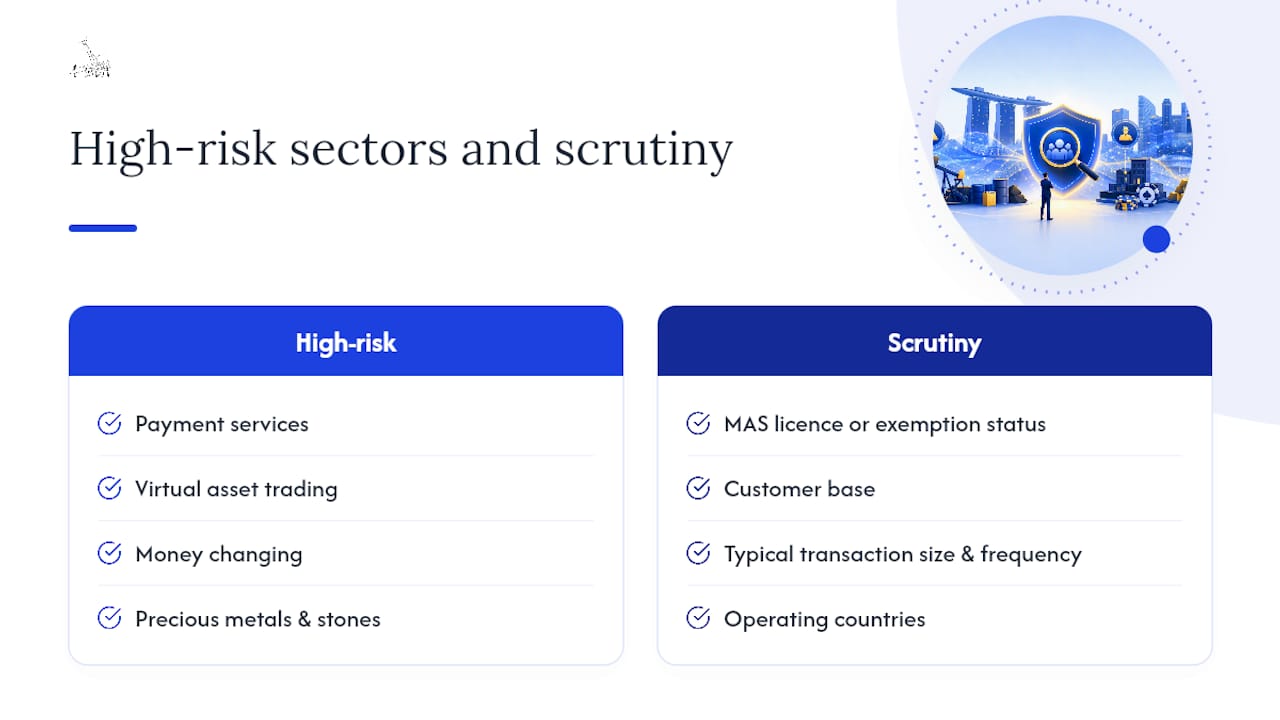
Expect banks to ask for your relevant licence or exemption status from MAS upfront, before they will progress your application any further. A payment services business without proof of its MAS licence application status, for instance, is likely to see its account application paused entirely rather than merely delayed.
Banks will also want a more detailed business narrative for high-risk sectors: your customer base, your typical transaction size and frequency, the countries you deal with, and your own internal anti-money laundering controls if you have any in place. This is not optional extra paperwork you can skip. Preparing it in advance, rather than reacting to a bank’s request mid-application, is the difference between a two-week onboarding and a two-month one.
Import export and trading companies dealing with sanctioned or high-risk jurisdictions face similar scrutiny even outside the classic high-risk sector list, so it pays to check your intended trading partners against current sanctions lists before you apply.
How do you pick the right bank and account type?
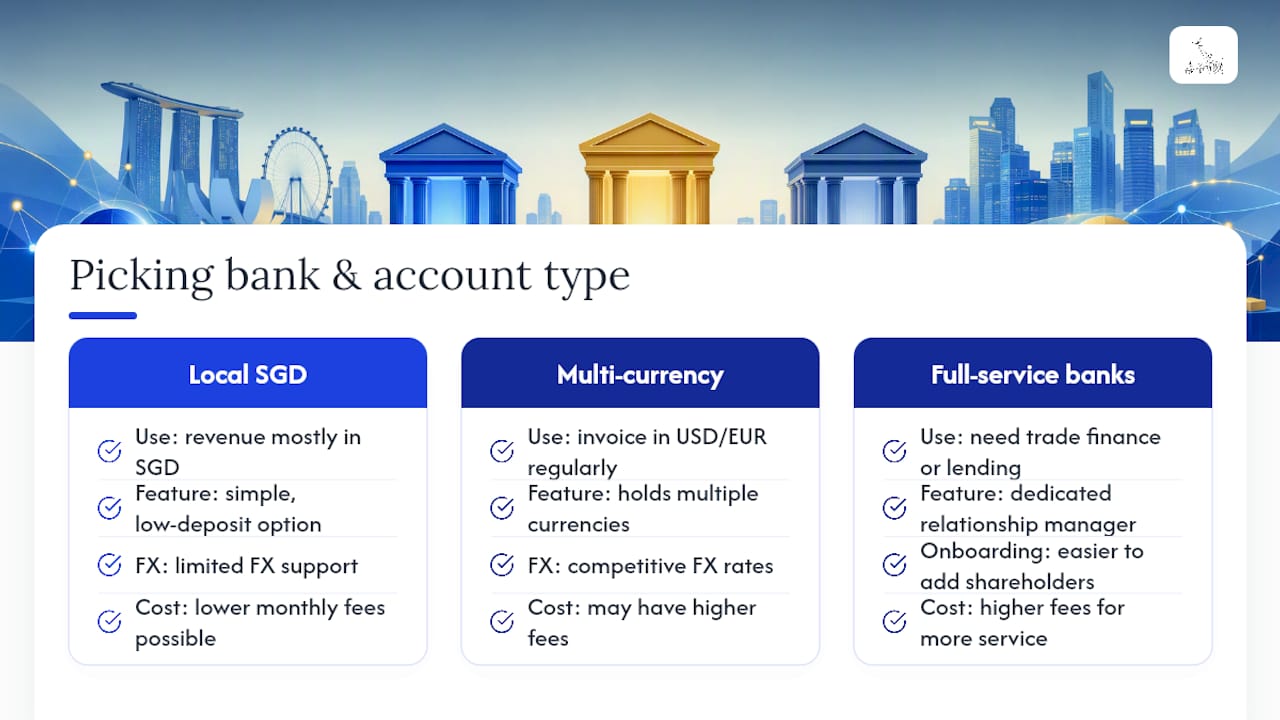
Match the account to what your business actually does in its first year, not to where you happen to already bank personally. A services business with no import-export activity and modest transaction volumes rarely needs the same account as a trading company juggling letters of credit and multiple currencies.
Consider transaction volume and currency needs first. If most of your revenue and payments happen in Singapore dollars, a straightforward local account, potentially a low-deposit digital option, covers you well. If you are invoicing clients in US dollars, euros or other currencies regularly, prioritise multi-currency handling and competitive FX rates over a slightly lower monthly fee.
Consider your growth trajectory too. A startup expecting to raise venture funding within eighteen months should think about which banks make it easiest to add new shareholders and directors to an existing account, since that process varies more between institutions than most founders expect. Established SMEs with steady revenue should weigh fee waiver conditions against their typical average balance, since a bank offering a slightly higher minimum balance requirement but a lower monthly fee can still work out cheaper overall.
Finally, weigh service model against cost. Full-service banks such as DBS, OCBC and UOB offer dedicated relationship managers for larger accounts, useful if you anticipate needing trade financing or lending down the line. Digital-first providers trade that relationship depth for speed and lower fees, which suits straightforward operating accounts well.
Preparation is what actually shortens onboarding
The single biggest lever any business owner has over how fast their account opens is not which bank they choose. It is how complete their ACRA records and Register of Registrable Controllers are before they walk in the door. Banks are not trying to make this difficult. They are working through a compliance checklist that gets faster the moment your paperwork matches what ACRA already has on file.
[Colin’s professional credentials and experience details to be inserted here.]
[Client case studies or testimonials related to Colin’s advisory services to be inserted here.]
— Colin
How Headington Management prepares your bank-facing paperwork
Getting every certified copy, board resolution and RORC declaration right the first time is the difference between a same-week account activation and a month of back-and-forth with a bank’s compliance desk. Certain corporate secretarial groundwork involves drafting board resolutions with signing mandates, arranging certified true copies for directors and beneficial owners, and managing nominee director or CSP due diligence where the structure requires it.
The realistic outcome is a document pack that is genuinely ready to submit, not one that generates a second round of bank queries a week later. For businesses with foreign shareholders, nominee arrangements, or high-risk sector exposure, that preparation work often shaves days or weeks off the timeline discussed earlier. If you would rather hand the document preparation and bank liaison to specialists than chase certifications yourself, get in touch with Headington Management to book a consultation or request a preparation checklist tailored to your entity type.
Where to check the official rules before you apply
Keep a few official pages open while you prepare. ACRA’s post‑registration guide covers BizFile+ and the documents you’ll need immediately after incorporation. GoBusiness’s corporate bank account step walks through the presence and certification rules banks apply. For fee structures and startup-specific guidance, OCBC’s account guide and DBS’s downloadable checklist are worth printing, and MAS’s regulatory framework explains the compliance logic behind the questions banks ask.
This article is general information, not a substitute for advice from a qualified financial advisor. Consult a qualified financial professional about your own circumstances before acting on anything here.
Sources
FAQ
Can I open a business bank account without a registered business?
No. Every bank in Singapore requires a valid UEN from ACRA before it will open a corporate account, so incorporation or business registration must come first.
What do I need to qualify for a business bank account in Singapore?
You need a recent ACRA BizFile+ profile, a board resolution authorising the account, certified identification and address proof for directors, signatories and beneficial owners, and your company’s UEN with Corppass access ready.
Which bank is best for a small business account in Singapore?
It depends on your transaction volume and currency needs. Startups with low capital and mostly local transactions often do well with lower-deposit digital-first accounts, while SMEs handling multi-currency trade or seeking future financing tend to benefit more from full-service banks like DBS, OCBC or UOB.
What is the minimum amount to open a business bank account in Singapore?
Minimum initial deposits vary widely by bank and account type, ranging from no minimum on some startup and digital accounts to a few thousand dollars on standard business accounts, so check the specific product’s terms before applying.
Do digital business accounts qualify for the same protections as traditional banks?
Not always. Deposits at licensed banks are typically covered under the Singapore Deposit Insurance Corporation scheme up to the applicable limit, while some digital account providers may not offer identical coverage, so check the provider’s terms directly.
Comments