Directors: Singapore Audit Requirements and the S$10M Test for 2026


Most private companies in Singapore need audited accounts unless they qualify for an exemption. The three main routes out of an audit are the small company exemption, the small group exemption, and the dormant company exemption, each governed by a two-of-three financial test with a two-year lookback. Get any of those checks wrong and you could find yourself scrambling for an auditor weeks before your AGM.
TL;DR:
Companies that just exceed two of the three small company thresholds for two consecutive years automatically lose their exemption and must appoint an auditor before their next AGM.
For group companies, both individual and consolidated figures are assessed, including foreign subsidiaries, which can cause exemption loss even if standalone subsidiaries qualify.
Dormant companies are exempt from audit if they have no transactions other than permitted statutory items during the financial year, but they still need to file annual returns and may need tax filings.
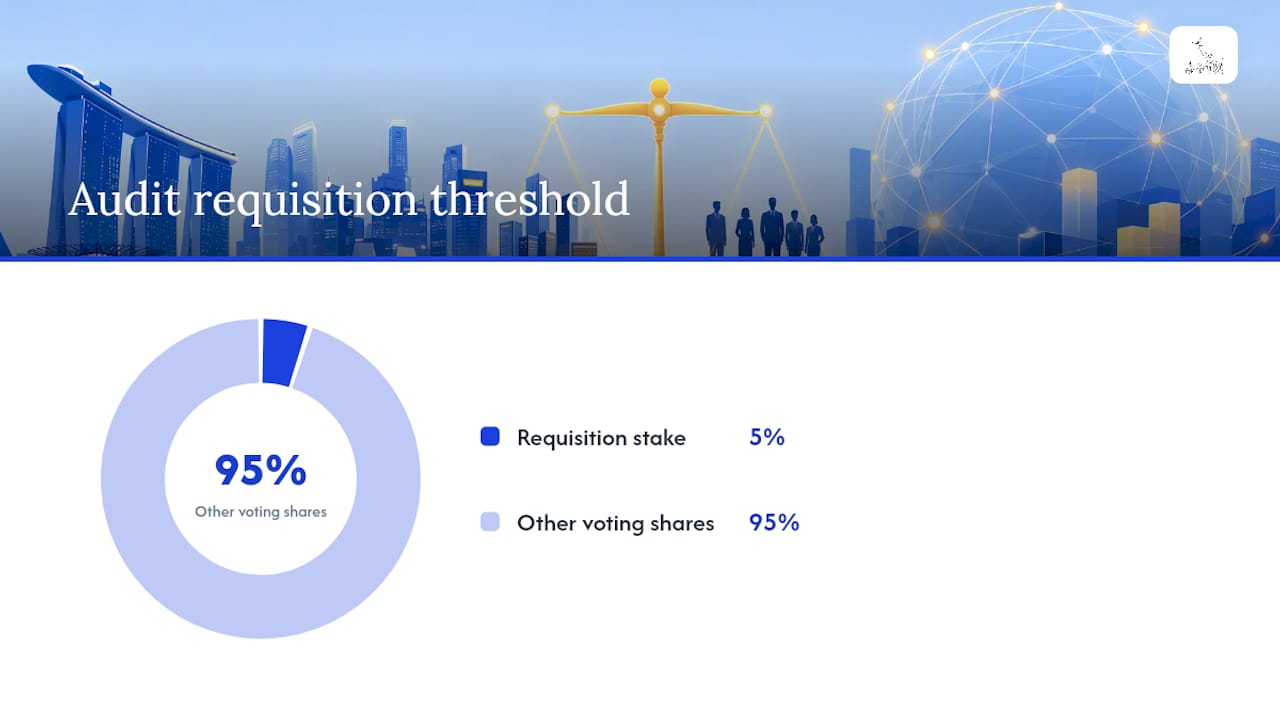
Shareholder owners holding at least 5 percent of voting shares can force an audit request, regardless of exemption status, especially if record-keeping or filing deadlines are missed.
Regular quarterly monitoring of financial thresholds and early engagement with auditors are crucial to maintain compliance and avoid last-minute scramble before AGMs.
Table of Contents
Small company audit exemption: the two-of-three thresholds and lookback
Small group exemption and consolidation: when group numbers matter
When exemption is overridden: Registrar powers and shareholder rights
Practical checklist for directors: records, filings, and deadlines
Practitioner perspective: recurring director mistakes and governance fixes
Who needs an audit, and when to appoint an auditor
The Companies Act starts from a simple baseline: every private company must have its accounts audited unless it qualifies for an exemption. That baseline exists whether you are a five-person consultancy or a mid-sized manufacturer, and it does not disappear just because a director assumes the business is “too small to bother.”
Timing matters as much as the rule itself. A newly incorporated company must appoint an auditor within three months of incorporation, unless it is exempt from the outset. Once appointed, that auditor typically holds office until the conclusion of the next annual general meeting, giving both the company and the auditor a predictable annual cycle.
Not every entity gets a shot at exemption, however:
Public companies do not qualify for the small company exemption, regardless of size.
Companies regulated by the Monetary Authority of Singapore generally fall outside the exemption regime.
Subsidiaries of larger groups may lose access to exemption depending on the group’s consolidated position, covered further below.
Small company audit exemption: the two-of-three thresholds and lookback
A private company qualifies as a “small company” if it meets at least two of three conditions for the immediate past two consecutive financial years:
Total annual revenue does not exceed S$10 million.
Total assets do not exceed S$10 million.
The company has 50 or fewer full-time employees.
Revenue is measured on the company’s own financial statements, assets are taken from the balance sheet total, and employee headcount counts full-time staff at financial year end rather than an average across the year. A newly incorporated company is generally assessed against these thresholds from its first financial year, since the two-year lookback has nothing earlier to draw on yet.
The trap most directors fall into is treating exemption as a one-off badge rather than an annual test. A company that qualified last year can lose exemption the moment it crosses two of the three thresholds for two consecutive years, and there is no grace period once that happens. If exemption lapses, you need an auditor appointed in good time before your next annual general meeting, not after your accountant has already closed the books.
Pro Tip: Reassess your small company status at every financial year end, not just when preparing the annual return. A single strong sales year can push revenue past S$10 million and put next year’s exemption at risk before you have even noticed.
Small group exemption and consolidation: when group numbers matter
If your company sits within a group structure, the small company test alone is not enough. For a company that is a parent or subsidiary within a group, both the individual entity and the entire group must meet at least two of the three thresholds on a consolidated basis for the immediate past two consecutive financial years.
That consolidation catches more than most directors expect:
Foreign subsidiaries are included in the group calculation, even where they are audited separately under another jurisdiction’s rules.
All subsidiaries consolidated under the applicable accounting standard count toward group revenue, assets, and headcount.
A holding company with several small operating subsidiaries may still lose exemption if the consolidated totals breach two of the three thresholds.
The practical consequence: any group with more than one entity needs to run the consolidated numbers before assuming a subsidiary is exempt, not just check that subsidiary’s standalone figures.
Dormant company exemption: what counts as dormancy
A company is treated as dormant, and therefore exempt from audit, when it has no accounting transactions during the financial year beyond a short list of permitted statutory items under Section 205B of the Companies Act.
Permitted without breaking dormancy: appointing a company secretary, appointing an auditor, and paying statutory fees such as ACRA charges.
Breaks dormancy: receiving sales income, paying supplier invoices, drawing down a bank loan, or any transaction that runs through the company’s books.
Dormant companies must still file their annual return with ACRA every year.
IRAS may still expect a tax filing unless the company has an express waiver, so dormancy for audit purposes does not automatically mean dormancy for tax purposes.
When exemption is overridden: Registrar powers and shareholder rights
Exemption is not absolute. The Registrar of Companies can direct a company to prepare audited financial statements where there are breaches of record-keeping obligations or failures to hold AGMs or file returns on time, regardless of whether the company otherwise qualifies as small or dormant.
Minority shareholders have a separate lever entirely.
The 5% threshold applies to voting shares, not the number of shareholders.
Notice must generally be given before the financial year in question closes, so late requests can be refused.
Failing to comply with audit or filing obligations exposes the company and its officers to penalties, and persistent breaches can lead to director disqualification.
One in twenty voting shares is all it takes to force an audit your small company exemption would otherwise avoid. It is a low bar, and it is worth documenting how your shareholder base could exercise it before a dispute makes the question urgent.
Directors also carry an obligation that survives every exemption: financial statements must still comply with Singapore Financial Reporting Standards whether or not the company is audited. Exemption removes the independent assurance requirement, not the accounting one.
Practical checklist for directors: records, filings, and deadlines
Getting audit status right is a yearly exercise, not a one-time decision. Work through it in this order:
Reassess exemption at every financial year end. Recalculate revenue, assets, and headcount against the two-of-three test, and check the group position if you sit inside a corporate structure.
Appoint an auditor promptly if thresholds are exceeded. Do not wait for the AGM to approach before contacting a public accountant.
Keep SFRS-compliant financial statements regardless of audit status, and retain supporting records for the statutory retention period.
File your annual return on time. For non-listed companies, the annual return filing due date is generally within seven months after financial year end, and the applicable XBRL format depends on your company’s size and filing profile.
Apply for an ACRA extension early if you anticipate missing a deadline, rather than after the due date has passed.
Pro Tip: If your projections show you crossing the small company thresholds this year, contact a public accountant before your financial year even closes. Auditors need lead time to plan fieldwork, and leaving it until after year end routinely pushes AGMs past their statutory deadline.
Some companies that qualify for exemption still choose a voluntary audit anyway, particularly where a bank covenant, an investor, or an upcoming financing round expects audited numbers. Exemption is a legal minimum, not always a commercial one.
Practitioner perspective: recurring director mistakes and governance fixes
The single most common error is not a calculation mistake. It is directors assuming exemption is permanent once granted. In practice, exemption is reassessed every year against the two-of-three test, and a good sales quarter can undo it without any warning bell going off.
The second recurring issue is a lack of quarterly monitoring. Waiting until financial year end to check thresholds leaves no time to engage an auditor if the numbers have tipped over. Directors of growing companies should run the numbers quarterly, and start conversations with a public accountant the moment projections suggest breaching two of three thresholds, not after the fact.
Building notice mechanics into a shareholders’ agreement, rather than leaving it to statute alone, avoids disputes surfacing mid-year. With ACRA’s 2026 review of the audit exemption framework potentially reshaping thresholds, this is not a rulebook to file away and forget.
— Colin
How Headington can help you get audit status right
Working out whether your company still qualifies for exemption, and what to do if it does not, is exactly the kind of compliance question that benefits from a second set of eyes before it becomes a deadline problem.
A compliance review typically covers your financial statement preparation, confirms whether your annual return and XBRL filings are on track for your financial year end, and, where an audit is needed, can help connect you with a suitable public accountant with enough lead time to protect your AGM date. If cash flow planning around statutory filings is also on your mind, this property tax guidance is a useful companion read. To find out exactly where your company stands, book a compliance review with Headington.
Sources
FAQ
What audit standards apply in Singapore?
Audited financial statements in Singapore are prepared under Singapore Financial Reporting Standards and audited in accordance with Singapore Standards on Auditing, which govern how auditors gather evidence and form their opinion.
Do all companies in Singapore need to be audited?
No. Private companies that qualify as a small company, part of a small group, or dormant under the relevant exemption criteria are exempt, though public companies and MAS-regulated entities are not.
How is the small company exemption calculated?
A company must meet at least two of three tests, revenue up to S$10 million, assets up to S$10 million, and 50 or fewer employees, for the immediate past two consecutive financial years.
Can Headington help if my company just lost its audit exemption?
Yes. A professional corporate advisory service can review your current financial position against the thresholds and assist in connecting you to a public accountant with enough lead time to meet your AGM deadline.
Comments