Annual general meeting Singapore: what directors need to know


Most Singapore companies must hold an annual general meeting (AGM). The deadline depends on your company type: listed companies have four months after their financial year end (FYE), and non-listed companies have six months. Miss that window without an approved extension and you are in breach of the Companies Act.
If your accounts are running late, you can apply to ACRA for an extension of time (EOT) of up to 60 days. The application goes through BizFile, costs SGD 200 (non-refundable), and must be submitted at least 14 working days before the original due date. ACRA will not accept BizFile EOT applications after the statutory deadline has passed.
At a glance:
Listed company: AGM within 4 months of FYE
Non-listed company: AGM within 6 months of FYE
EOT available: up to 60 days, SGD 200 fee via BizFile
Post-AGM: lodge return with the Registrar within 14 days
Private companies may qualify for an exemption or may pass a resolution to dispense with AGMs entirely, but safeguards apply and members retain the right to request a meeting.
Key takeaways
Singapore companies must hold their AGM within four or six months of FYE depending on company type, with a 60-day EOT available via BizFile for SGD 200 if accounts are delayed.
Point | Details |
AGM deadline by company type | Listed companies: 4 months after FYE; non-listed companies: 6 months after FYE. |
EOT process and cost | Apply via BizFile at least 14 working days before the deadline; fee is SGD 200 non-refundable. |
Post-AGM filing window | Lodge the return with the Registrar within 14 days of the AGM date. |
Dispensation safeguards | All members must agree; accounts must be sent within 5 months of FYE; members can still request a meeting. |
Headington support | Headington provides end-to-end AGM administration, BizFile filings, and EOT applications for Singapore companies. |
Table of Contents
Who must hold an annual general meeting in Singapore?
The obligation sits in the Companies Act 1967. Directors must lay the company’s financial statements before members at the AGM, together with the auditor’s report where an audit is required. The AGM is also where directors are re-elected, dividends are declared, and auditors are appointed or re-appointed.
ACRA’s guidance confirms that the AGM is a central governance mechanism: it is where financial performance is presented, directors are elected, and major corporate decisions are approved. Failing to hold one, or failing to keep proper documentation, can trigger enforcement action including director disqualification.
Who is exempt or may dispense with AGMs?
Private companies that qualify as small companies (meeting at least two of three size criteria under the Companies Act) may be exempt from audit requirements, which affects what must be tabled at the AGM.
Private companies may pass a members’ resolution to dispense with AGMs entirely, provided all members agree and accounts are sent to every member within five months of FYE.
Dormant companies meeting the relevant statutory criteria may also be exempt.
Even where a company has dispensed with AGMs, members and auditors retain statutory rights to request a meeting. Those rights cannot be waived by a prior resolution.
Pro Tip: When documenting a resolution to dispense with AGMs, retain signed copies of every member’s agreement, the date accounts were sent to members, and confirmation that no member has subsequently requested a meeting. A single missing signature can invalidate the dispensation.
What are the AGM deadlines and notice requirements in Singapore?
Precise timing is where most compliance failures begin. The statutory deadlines are fixed relative to FYE, not to when accounts are ready.
Company type | AGM due date after FYE |
Listed company | Within 4 months |
Non-listed company | Within 6 months |
Notice periods and quorum
Under the Companies Act, members must receive at least 14 days’ written notice of an AGM (21 days for listed companies or where a special resolution is proposed). The notice must state the date, time, venue, and agenda. Quorum is typically two members present in person or by proxy, unless the constitution specifies otherwise.
Proxy voting allows members who cannot attend to appoint a representative. Proxy forms must be lodged with the company at least 48 hours before the meeting unless the constitution provides a shorter period.
Audit timing is the critical path item. The Companies Act requires financial statements to be audited and accompanied by an auditor’s report before they are laid at the AGM. The practical standard is to have audited accounts finalised at least 14 days before the AGM date, giving time to circulate them with the notice. Members may agree to a shorter period, but relying on that agreement adds risk.
Checklist: the 90 days before your AGM
Confirm FYE and calculate the statutory AGM due date.
Engage auditors and agree a completion date at least 14 days before the planned AGM.
Set the AGM date and book the venue or virtual platform.
Prepare the directors’ report and draft financial statements.
Issue notice to all members (minimum 14 days, 21 days for listed companies).
Circulate proxy forms with the notice.
Confirm quorum arrangements and appoint a chairperson.
When can a company skip or dispense with its AGM?
The Companies Amendment Act 2017 introduced the right for private companies to dispense with AGMs, reducing administrative burden for smaller businesses. The reform was significant: before 2017, every company had to hold one regardless of size or shareholder structure.
Conditions for dispensing with an AGM
The company must be a private company.
All members must pass a resolution (unanimous agreement) to dispense with AGMs.
The company must send audited financial statements to every member within five months of FYE.
The dispensation remains in effect until a member or auditor requests a meeting.
How to dispense: step by step
Confirm all members are willing to agree (a single dissenting member blocks the resolution).
Pass a written resolution signed by all members.
File the resolution with ACRA via BizFile within the required period.
Send audited accounts to every member within five months of FYE each year.
Monitor for any member or auditor request to reinstate the AGM.
Member and auditor rights that override dispensation
Members may request an AGM up to 14 days before the end of the sixth month after FYE. If a valid request is received, the company must hold the meeting within six months of FYE. Auditors also retain the right to request a meeting. These rights cannot be contracted away.
How do you prepare for and run an AGM in Singapore?
Running an AGM is straightforward when the preparation is done properly. The meeting itself rarely takes more than an hour for a private company; the work is in the weeks before it.
Step-by-step: from planning to closing
Set the date. Work backwards from the statutory deadline. For a non-listed company with a 31 December FYE, the AGM must be held by 30 June.
Finalise audited accounts. Confirm the auditor’s completion date. Accounts must be ready at least 14 days before the AGM.
Prepare the agenda. Standard items: receive and adopt financial statements, declare dividends (if any), re-elect directors, re-appoint auditors, and any special business.
Issue notice. Send written notice to all members, attaching the audited financial statements, directors’ report, auditor’s report, and proxy form.
Receive proxy forms. Collect and record all proxies at least 48 hours before the meeting.
Open the meeting. The chairperson confirms quorum, opens proceedings, and works through the agenda.
Present accounts and resolutions. Directors present the financial statements; members vote on each resolution by show of hands or poll.
Close and minute the meeting. The company secretary records all resolutions passed, votes cast, and any material questions raised.
Lodge post-AGM returns. File the required return with the Registrar within 14 days.
Virtual and hybrid AGMs
Singapore law permits virtual and hybrid meetings. If your company’s constitution does not explicitly allow electronic participation, pass a resolution to amend it before the meeting date. Test the platform at least 48 hours in advance; a failed connection during voting is a procedural risk, not a technical inconvenience.

Pro Tip: Use Form for any administrative submissions ACRA directs you to complete outside BizFile. Keep a copy of every submission confirmation as evidence of timely filing.
How do you apply for an AGM extension of time with ACRA?
If your accounts will not be ready in time, an EOT is your only lawful option. ACRA allows an extension of up to 60 days, applied for through BizFile at a cost of SGD 200 (non-refundable). Submit at least 14 working days before the statutory due date; applications after the deadline are rejected.
What increases your chance of approval
A clear, specific reason (audit delay, key personnel unavailability, complex group consolidation).
Supporting documentation where available (auditor’s letter confirming delayed completion).
A proposed new AGM date within the 60-day extension window.
Further extensions beyond the initial 60 days are rarely granted. If you anticipate needing more time, contact ACRA directly via the Form.gov.sg enquiry form before the original deadline.
EOT application checklist via BizFile
Log in to BizFile using your CorpPass credentials.
Navigate to the AGM EOT eService under the company’s filing dashboard.
Enter the company’s UEN, FYE, and statutory AGM due date.
State the reason for the extension and proposed new AGM date.
Pay the SGD 200 fee by credit card or GIRO.
Submit and retain the confirmation reference number.
Allow up to 14 working days for ACRA to process the application.
If the application is urgent and the deadline is imminent, email ACRA directly with your company’s UEN and the reason for urgency. Do not wait for BizFile processing if fewer than 14 working days remain.
What must you file after the AGM?
The AGM is not the finish line. Under the Companies Act, a return must be lodged with the Registrar after the meeting, and the notice of the AGM date must be filed within 14 days.
Post-AGM filing obligations
Return of meeting: lodge with the Registrar within 14 days of the AGM.
Annual return (AR): filed via BizFile; the AR filing window is tied to the AGM date. For companies that have dispensed with AGMs, the AR must be filed within five months of FYE.
Updated registers: update the register of directors, members, and auditors if any changes were made at the AGM.
Dispensation or exemption declaration: if the company has dispensed with AGMs, record and file the relevant resolution.
Filing obligation | Deadline | Portal |
Return of meeting | Within 14 days of AGM | BizFile |
Annual return | Within AGM filing window | BizFile |
Updated registers | Promptly after AGM | Internal / BizFile |
Pro tip on AR timing: the annual return must reflect the company’s position as at the AGM date. If your FYE changed during the year, recalculate the AR filing window carefully. A changed FYE can shift the AR deadline in ways that catch directors off guard.
Singapore’s broader corporate tax environment, including why Singapore has no capital gains tax, means that many cross-border groups structure holding entities here. Those groups face consolidated reporting timelines that can compress the window between audit completion and AGM.
What are the penalties for missing an AGM or filing deadline?
Non-compliance is not treated lightly. ACRA’s enforcement toolkit includes warnings, fines, prosecution, and director disqualification. The Companies Act makes both the company and its officers personally liable for failures to hold an AGM or lodge required returns.
Enforcement actions ACRA may take
Written warnings and composition fines for first-time or minor breaches.
Court prosecution for persistent or serious non-compliance.
Director disqualification and debarment from acting as a director or company secretary.
Striking off the company from the register in severe cases.
Directors cannot delegate their statutory duty to a company secretary and then disclaim responsibility. The duty to ensure audited accounts are laid at the AGM, and that returns are lodged on time, rests with the board.
Remediation when non-compliance is discovered
Apply for an EOT immediately if the AGM deadline has not yet passed.
Lodge any missing returns as soon as possible; late filing reduces but does not eliminate enforcement risk.
Keep documentary evidence of every step taken: emails to auditors, BizFile submission confirmations, board resolutions authorising remedial action.
Pro Tip: If you discover a missed filing, do not wait for ACRA to contact you. Proactive disclosure, supported by evidence of the steps taken to remedy the breach, consistently produces better outcomes than reactive responses to enforcement notices.
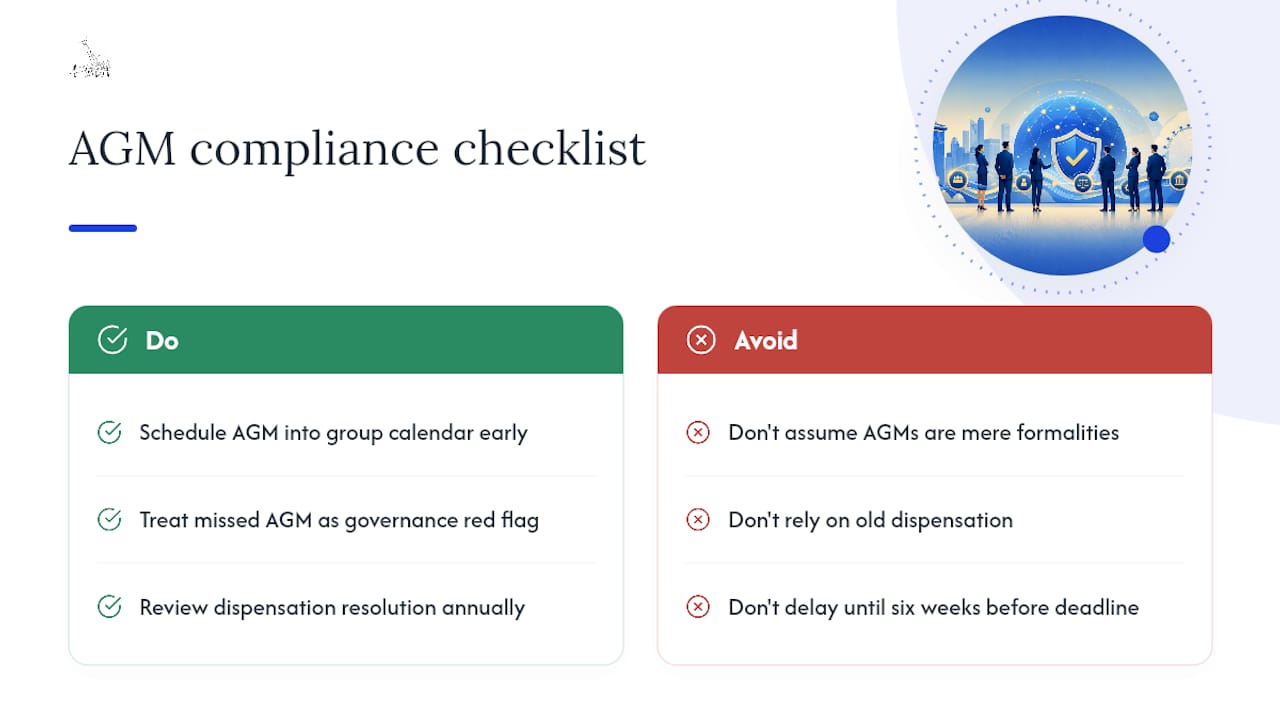
AGM compliance checklist for directors and company secretaries
Use this timeline as a working reference. Adapt the dates to your company’s FYE.
Immediate next steps (next 30 days)
Calculate your AGM due date from your last FYE.
Confirm whether your company qualifies for an exemption or has a valid dispensation resolution in place.
Contact your auditors and agree a completion date at least 14 days before the planned AGM.
If the due date is within 60 days and accounts are not ready, apply for an EOT via BizFile before the deadline.
Book the meeting date and prepare the notice.
Pro Tip: Outsourcing AGM administration to a corporate secretarial provider such as Headington removes the risk of missed deadlines from your board’s plate. A professional company secretary tracks filing windows, prepares notices, and lodges returns as a matter of routine, not as a crisis response.
Why AGM compliance matters more than most directors realise
The conventional wisdom is that AGMs are a box-ticking exercise, particularly for private companies with a handful of shareholders who all know each other. That view is understandable, but it misses the point.
The AGM is the moment the company’s financial position is formally presented to its owners. For a private company with external investors, a bank lender, or a parent group overseas, a missed AGM is not just a regulatory infraction. It is a signal that governance is not being taken seriously. Lenders and investors notice. So do potential acquirers during due diligence.
Cross-border groups face an additional layer of complexity. A Singapore subsidiary with a December FYE and a parent group on a March year-end faces a consolidation timeline that can make the six-month AGM window feel tight. Add a complex intercompany structure or a first-year audit and the window compresses further. Directors of multinational subsidiaries should build the AGM date into the group reporting calendar at the start of the financial year, not six weeks before the deadline.
The other underestimated risk is the dispensation trap. A company that validly dispensed with AGMs three years ago may have changed its shareholder base since then. New members may not have agreed to the dispensation. If a new investor joined after the original resolution was passed, the dispensation may not bind them. Review the dispensation resolution every year, not just when someone raises a question.
How Headington can support your AGM compliance
AGM compliance in Singapore involves more moving parts than most directors anticipate: audit coordination, notice preparation, BizFile filings, EOT applications, and post-meeting lodgements, all within fixed statutory windows.
Headington provides corporate secretarial services that cover the full AGM cycle: preparing and issuing notices, coordinating with auditors, drafting minutes and resolutions, filing annual returns via BizFile, and managing EOT applications where needed. With 25 years of experience across 90 countries, Headington supports both Singapore-incorporated entities and multinational groups managing subsidiary compliance from overseas.
For directors who want to confirm their company’s current AGM status or hand off the administration entirely, contact Headington for a compliance review. The first step is straightforward: share your company’s FYE and current filing status, and Headington’s team will map the deadlines and identify any gaps.
Sources
Bookmark these primary sources for compliance checks and filings:
This article is general information, not a substitute for advice from a qualified lawyer. Consult a qualified legal professional about your own circumstances before acting on anything here.
FAQ
When must an AGM be held in Singapore?
Listed companies must hold their AGM within four months of their financial year end; non-listed companies have six months. These deadlines are set by the Companies Act and enforced by ACRA.
Can a private company avoid holding an AGM?
Yes. A private company may pass a unanimous members’ resolution to dispense with AGMs, provided audited accounts are sent to all members within five months of FYE. Members and auditors retain the right to request a meeting at any time within the statutory window.
What is the difference between an AGM and an EGM?
An AGM is the annual statutory meeting where financial statements are presented and routine resolutions are passed. An extraordinary general meeting (EGM) is called at any other time to deal with specific business that cannot wait until the next AGM, such as a major transaction or a change to the constitution.
Is it mandatory to hold an AGM every year in Singapore?
For most companies, yes. The obligation is annual and tied to each financial year end. Private companies that have validly dispensed with AGMs are the main exception, but they still face annual account-sending and filing obligations.
What happens if a company misses its AGM deadline?
ACRA may issue warnings, impose fines, or prosecute the company and its directors. Directors can face disqualification. If the deadline has not yet passed, applying for a 60-day EOT via BizFile (SGD 200) is the correct first step.
Comments